




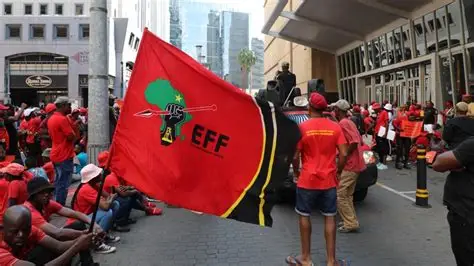
“The Economic Freedom Fighters (EFF) welcomed the extension of the Madlanga Commission of Inquiry but accused the Presidency of failing to provide transparency about its progress and purpose. With local government elections looming in November 2026, the EFF argues that repeated extensions without disclosure undermine public trust and accountability.”
South Africa’s political landscape continues to shift dramatically as opposition parties intensify their scrutiny of government actions ahead of the November 2026 local elections. The latest controversy centers on the Presidency’s decision to extend the Madlanga Commission of Inquiry, a move that has drawn sharp criticism from the Economic Freedom Fighters (EFF). While the extension itself was welcomed, the lack of transparency surrounding the commission’s progress has ignited debate about accountability, governance, and electoral strategy.
Background on the Madlanga Commission
The Madlanga Commission was established to investigate allegations of corruption and maladministration within state institutions. Its mandate includes examining procurement irregularities, misuse of public funds, and systemic failures in governance. Initially scheduled to conclude earlier this year, the commission has faced repeated extensions, raising questions about its efficiency and the government’s commitment to transparency.
President Cyril Ramaphosa’s announcement that the commission’s final report will now be delivered on November 16, 2026, just weeks after the local elections, has fueled speculation about political maneuvering. Critics argue that the timing could shield the ruling party from damaging revelations during the campaign period.
EFF’s Position
The EFF has positioned itself as a watchdog of government accountability, insisting that the commission “belongs to the people of South Africa.” Party leaders argue that the Presidency’s failure to publish interim reports undermines public confidence. They demand immediate publication of the first and second interim findings, asserting that citizens have a right to know the progress and recommendations before casting their votes.
EFF spokespersons have emphasized that transparency is not optional but a constitutional obligation. They accuse the Presidency of deliberately withholding information to protect political interests, framing the issue as a broader struggle between citizens’ rights and entrenched party power.
Political Analyst Perspectives
Political analyst Professor Sipho Seepe has noted that the extension of the commission is likely to become a campaign issue. Opposition parties, including the EFF, are expected to leverage the controversy to highlight governance failures and corruption. The timing of the extension, so close to the elections, provides fertile ground for narratives about secrecy and manipulation.
Analysts also suggest that the ruling African National Congress (ANC) risks further erosion of public trust if it fails to demonstrate transparency. With the ANC already weakened by declining voter support and coalition pressures, the controversy could amplify calls for reform and accountability.
Broader Political Context
South Africa’s political environment in 2026 is marked by fragmentation and realignment. The ANC’s dominance has been challenged by the Democratic Alliance (DA), the EFF, and newly formed coalitions such as Unite for Change. The erosion of majority control has forced the ANC into coalition arrangements, fundamentally altering governance dynamics. In this context, every controversy carries heightened significance, as opposition parties seek to capitalize on voter disillusionment.
The Madlanga Commission controversy thus fits into a larger narrative of declining trust in traditional political institutions. Citizens increasingly demand transparency, accountability, and ethical leadership—values that opposition parties are eager to champion.
Implications for the November 2026 Elections
The extension of the commission’s deadline beyond the election date raises critical questions about electoral integrity. If damaging findings are withheld until after the vote, citizens may feel disenfranchised. The EFF’s insistence on immediate publication reflects a broader demand for fairness in the democratic process.
For the ANC, the controversy represents both a challenge and an opportunity. While secrecy may protect the party in the short term, it risks long-term damage to credibility. Conversely, demonstrating transparency could bolster its image as a reformist force, though at the cost of exposing internal weaknesses.
Conclusion
The EFF’s criticism of the Presidency over the Madlanga Commission extension underscores the growing tension between government accountability and political strategy in South Africa. As the November 2026 elections approach, transparency will remain a central theme, shaping voter perceptions and party narratives. Whether the ANC can navigate this controversy without further eroding public trust remains to be seen, but one thing is clear: the demand for accountability is louder than ever.



