




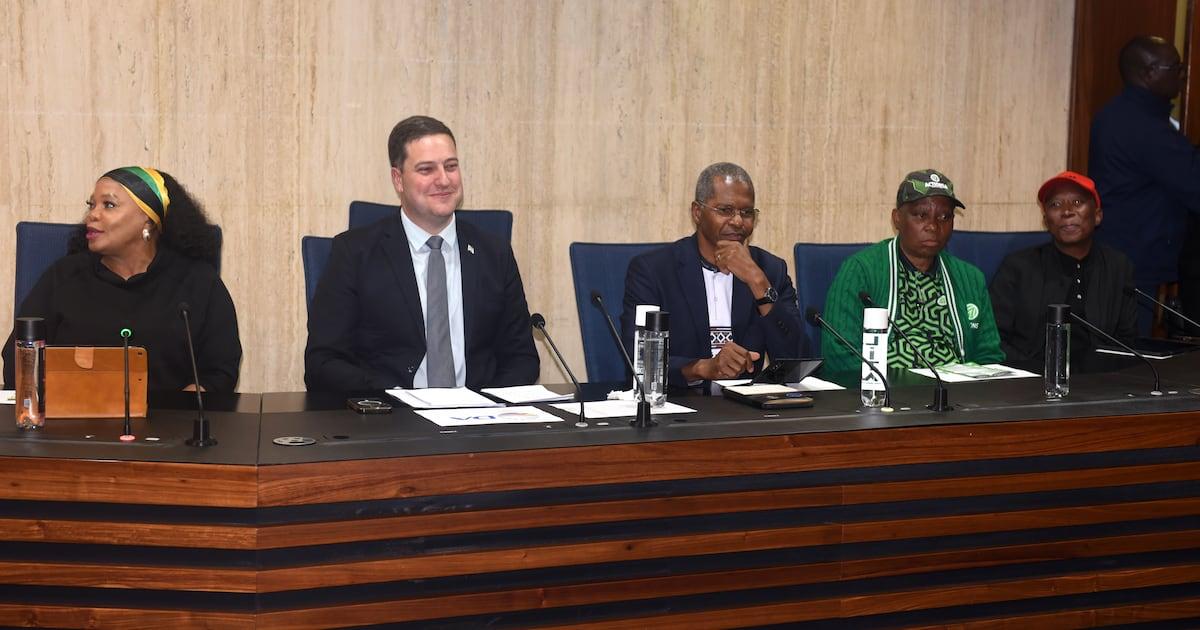
“The African National Congress (ANC) has strengthened its position in Gauteng’s major metropolitan municipalities through coalition arrangements with ActionSA, the Economic Freedom Fighters (EFF) and the uMkhonto weSizwe Party (MK Party), despite suffering a significant electoral setback. The emerging political alliance has pushed the Democratic Alliance (DA) out of several important governing arrangements, raising questions about political principles, coalition stability, accountability and the future direction of South African politics.”
The ANC limps from diminished appeal: Coalition politics reshapes South Africa’s political landscape
Introduction: A new chapter in South African party politics
South Africa’s political landscape is experiencing another significant transformation following the 2026 local government elections, which have forced major political parties to reconsider their traditional alliances, political strategies and approaches to municipal governance. The African National Congress (ANC), despite experiencing a substantial decline in electoral support, remains an influential political force through negotiations with smaller political parties.
The latest developments have brought together the ANC, ActionSA, the Economic Freedom Fighters (EFF) and the uMkhonto weSizwe Party (MK Party) in a politically significant coalition arrangement aimed at securing governing majorities in important Gauteng metropolitan municipalities. The arrangement has attracted considerable attention because these parties have historically competed against one another and have frequently disagreed over political ideology, leadership and governance priorities.
According to the Mail & Guardian’s political analysis published on 27 November 2026, the ANC has managed to retain considerable influence despite losing electoral ground. Its cooperation with ActionSA, the EFF and the MK Party demonstrates how coalition negotiations can change political outcomes after voters have completed their participation in an election.
The developments also represent a major challenge for the Democratic Alliance, which had hoped to translate its electoral performance into greater governing authority in Johannesburg and other Gauteng municipalities.
The ANC’s declining electoral appeal
For many years, the ANC dominated South African politics, benefiting from its historical role in the struggle against apartheid and its position as the country’s governing party since 1994.
However, changing voter expectations, economic difficulties, unemployment, concerns about corruption and dissatisfaction with public services have increasingly challenged the party’s political dominance.
The 2026 local government elections have further demonstrated that South African voters are becoming more willing to consider alternative political formations.
The ANC’s reduced electoral strength has created a situation in which it can no longer depend on its historical support to govern major municipalities independently. Instead, it must negotiate with other political parties to secure the votes required to establish municipal administrations.
This development is particularly important in Gauteng, South Africa’s economic centre, where Johannesburg, Tshwane and Ekurhuleni play essential roles in national economic activity.
The ANC’s coalition strategy therefore represents more than an attempt to secure mayoral positions. It is also an effort to preserve political influence, maintain access to municipal executive structures and prevent further electoral isolation.
Nevertheless, retaining political influence through coalition negotiations does not automatically demonstrate that the party has regained public confidence.
The ANC must still convince voters that it can address the challenges that contributed to its declining electoral performance.
The ANC, ActionSA, EFF and MK Party alliance
One of the most significant developments emerging from the coalition negotiations is the cooperation between the ANC, ActionSA, the EFF and the MK Party.
The four political formations have different histories, leadership structures, policy priorities and political ambitions. Their willingness to cooperate demonstrates the importance of parliamentary and municipal numbers when no political party secures an outright majority.
The Mail & Guardian analysis highlights that the four-party grouping has secured 138 seats in Johannesburg, two more than the number required for a majority, according to the figures reported in the article.
This narrow majority illustrates how individual councillor positions can become extremely important during coalition negotiations.
The ANC and ActionSA together account for most of the coalition’s seats, while the EFF and MK Party provide additional support that helps the grouping reach the required threshold.
However, the political agreement also creates questions about whether the parties can maintain cooperation after the immediate objective of establishing municipal leadership structures has been achieved.
For ActionSA, the negotiations provide an opportunity to demonstrate that it can participate in governing major metropolitan municipalities and establish itself as an independent national political alternative.
The party, led by Herman Mashaba, has become an important participant in the coalition discussions because its councillors can influence whether competing political formations secure governing majorities.
For the EFF, participation in municipal executive structures could provide an opportunity to influence policy implementation and move beyond its traditional role as an opposition party.
The MK Party also has an opportunity to strengthen its institutional position by participating in municipal governance beyond its electoral support base.
For the ANC, the arrangement offers an opportunity to remain part of municipal leadership structures even where its electoral performance has weakened.
ActionSA emerges as a powerful political kingmaker
ActionSA’s position in the negotiations demonstrates how smaller political parties can become influential when election results produce hung councils.
The party’s leadership has found itself in a position where its cooperation can determine which political formation controls important municipalities.
Herman Mashaba’s political journey makes this development particularly interesting.
Having previously served as Johannesburg mayor under a DA-led coalition, Mashaba established ActionSA after leaving the Democratic Alliance. His party has since become a competitor to the DA while also engaging with political formations that have historically been its opponents.
The current developments illustrate how political relationships can change considerably when parties face the practical requirements of forming governments.
ActionSA’s participation in the emerging coalition arrangements could provide the party with an opportunity to demonstrate its governing capabilities.
However, it also faces political risks.
Its supporters may question whether cooperation with the ANC, EFF and MK Party is consistent with the principles and promises presented during election campaigns.
The party will therefore need to explain its decisions clearly and demonstrate that participation in coalition government will result in measurable improvements in municipal administration.
If ActionSA successfully demonstrates effective governance, it could strengthen its position ahead of future national elections.
If the arrangements become unstable or fail to deliver services, however, the party could experience difficulties defending its decisions to voters.
The Democratic Alliance faces a major political setback
The Democratic Alliance has emerged as one of the most affected political parties in the Gauteng coalition negotiations.
The DA had hoped that its electoral performance would provide a foundation for establishing governing arrangements in Johannesburg, Tshwane and Ekurhuleni.
However, the emerging coalition between the ANC, ActionSA, EFF and MK Party has significantly complicated those ambitions.
The position of Helen Zille, the DA’s Johannesburg mayoral candidate, has become particularly important.
Zille has been at the centre of political disagreements surrounding the proposed Johannesburg governing arrangements.
The DA has criticised the exclusion of its candidates and questioned the motivations behind the coalition negotiations.
The Mail & Guardian analysis describes the situation as a major political setback for the DA, particularly because the party had expected its electoral position to translate into greater governing influence.
Nevertheless, the DA’s political options are not limited to securing mayoral positions.
A strong opposition can influence municipal decisions, scrutinise expenditure, question executive appointments and demand explanations from governing parties.
In reporting published on 27 November, EWN quoted political analyst Miyelani Holeni, who argued that Zille should remain involved in Johannesburg politics even if she does not become mayor.
Holeni suggested that the DA could establish itself as a credible opposition capable of holding the new administration accountable.
Helen Zille’s political future in Johannesburg
Helen Zille’s position illustrates the growing importance of individual leadership in South African coalition politics.
Her political experience, public profile and history within the DA make her an influential figure in the party’s approach to the Johannesburg negotiations.
However, the coalition developments have raised questions about whether individual personalities are becoming more important than political principles.
Political analyst Miyelani Holeni has questioned whether coalition negotiations are increasingly being influenced by personal relationships rather than the policy priorities that should guide municipal governance.
This is an important concern because political parties should ultimately establish partnerships that enable municipalities to function effectively.
The exclusion of a particular political leader should not automatically become more important than the ability of a coalition to address infrastructure problems, improve public safety and manage municipal finances.
Zille could therefore use an opposition position to focus on public accountability, municipal performance and the DA’s political rebuilding.
Her ability to remain influential will depend on how effectively she and her party engage with residents and demonstrate that they can offer credible alternatives to the governing coalition.
The EFF and MK Party’s changing political positions
The participation of the EFF and MK Party in the emerging arrangements also deserves considerable attention.
Both parties have challenged the ANC’s political leadership and have attracted voters dissatisfied with the governing party.
Their cooperation with the ANC therefore represents a significant development in the country’s political environment.
The EFF, led by Julius Malema, has traditionally presented itself as a radical opposition movement advocating economic transformation, greater state intervention and policies aimed at addressing historical inequality.
The MK Party, associated with former president Jacob Zuma, has also emerged as an important political competitor to the ANC, particularly in KwaZulu-Natal.
Their willingness to participate in arrangements involving the ANC illustrates the flexibility of municipal coalition politics.
However, the parties will need to reconcile their political differences when making practical decisions about municipal budgets, executive responsibilities and service delivery.
The challenge will be moving beyond political agreements and establishing working relationships capable of surviving disagreements.
For both parties, participation in government could provide valuable experience and an opportunity to demonstrate their ability to influence policy.
At the same time, cooperation with former political opponents could create tensions among supporters who expected stronger opposition to the ANC.
Coalition politics and the Government of National Unity
The municipal coalition developments could also influence South Africa’s national political environment.
At national level, the ANC and DA participate in the Government of National Unity, an arrangement established after the 2024 general elections.
However, their competing municipal interests demonstrate that cooperation at one level of government does not necessarily guarantee political partnership at another.
The ANC’s decision to pursue arrangements involving ActionSA, the EFF and MK Party in Gauteng creates further pressure on the relationship between the ANC and DA.
The Mail & Guardian analysis argues that the situation tests the underlying assumptions of the national unity arrangement.
Nevertheless, municipal disagreements do not automatically mean that the national government arrangement will collapse.
The parties still have national responsibilities and shared interests that could encourage continued cooperation.
However, disagreements over economic policy, public administration, local government and political strategy could create additional tensions.
South Africa’s coalition environment is therefore becoming increasingly complex, with parties cooperating in some institutions while competing aggressively in others.
The consequences for municipal service delivery
While political parties concentrate on coalition negotiations, residents are primarily concerned with the performance of their municipalities.
Johannesburg, Tshwane and Ekurhuleni face important challenges involving water infrastructure, electricity reliability, road maintenance, waste management, public safety and financial administration.
These issues require consistent leadership, professional municipal management and effective planning.
Political disagreements can undermine these objectives when parties spend more time negotiating positions than developing practical solutions.
A coalition agreement should therefore establish clear responsibilities, measurable objectives and accountability mechanisms.
The parties must also ensure that political appointments do not undermine professional administration.
Municipal officials need the necessary skills and resources to implement approved programmes, manage budgets and maintain essential infrastructure.
The ANC-led coalition arrangement will ultimately be judged by whether residents experience improvements in everyday municipal services.
Political leaders may celebrate their success in securing mayoral positions, but residents will be more interested in reliable water supplies, functioning electricity systems, maintained roads and improved municipal accountability.
The risk of unstable political partnerships
The emerging coalition arrangement also presents a significant test of political cooperation.
The participating parties have different electoral constituencies and ideological positions.
Their immediate agreement to cooperate does not necessarily mean they share a long-term political vision.
Disagreements could emerge over budget allocations, executive responsibilities, municipal appointments and policy implementation.
For example, parties may disagree over the priorities that should receive municipal funding or the appropriate approach to managing municipal assets.
These differences could become particularly difficult when public resources are limited and residents demand immediate improvements.
Coalition agreements therefore need more than political signatures.
They require transparent decision-making processes, regular communication between party leaders and mechanisms for resolving disagreements.
The ANC and its partners will need to demonstrate that their arrangement can provide stable government rather than merely securing political positions.
What the developments mean for future elections
The 2026 coalition negotiations could influence the strategies of political parties ahead of the next national elections.
The ANC may view its ability to establish municipal coalitions as an opportunity to rebuild its political organisation and restore voter confidence.
However, there is also a potential risk that the smaller coalition partners could benefit more from their participation.
ActionSA, the EFF and the MK Party could use their involvement in municipal government to strengthen their organisational structures, gain administrative experience and attract voters.
If these parties demonstrate successful governance, they could become stronger competitors in future elections.
For the DA, the current developments provide an opportunity to reconsider its coalition strategy, improve relationships with smaller parties and strengthen its opposition activities.
The party will also need to examine whether its campaign messaging and leadership choices have affected its ability to negotiate with potential coalition partners.
Ultimately, future electoral success will depend on the ability of political parties to demonstrate practical achievements rather than relying exclusively on campaign promises.
Conclusion: South Africa’s political future depends on effective governance
The coalition developments reported on 27 November 2026 demonstrate that South African politics is entering a period in which political influence increasingly depends on negotiation, cooperation and the ability to build governing majorities.
The ANC has managed to retain an important position despite its declining electoral appeal, while ActionSA has emerged as a significant coalition partner.
The EFF and MK Party have also demonstrated their willingness to participate in arrangements involving political formations with which they have historically competed.
Meanwhile, the DA faces the challenge of rebuilding its coalition strategy and deciding how best to exercise its influence from the opposition benches.
However, the ultimate success of these political arrangements will not be determined by which party secures the most influential positions.
It will depend on whether the new municipal administrations can improve public services, strengthen financial management, address infrastructure problems and restore public confidence in local government.
South Africans expect political parties to demonstrate that coalition government can deliver practical improvements.
The ANC and its partners have secured an opportunity to govern, but they must now demonstrate that their cooperation can produce meaningful results.
The DA, meanwhile, has an opportunity to establish a constructive opposition that holds the governing coalition accountable.
The most important lesson from these developments is that political survival and electoral success are not the same as effective leadership.
South Africa’s political future will ultimately depend on the ability of its political parties to place residents’ interests above their individual ambitions.



