




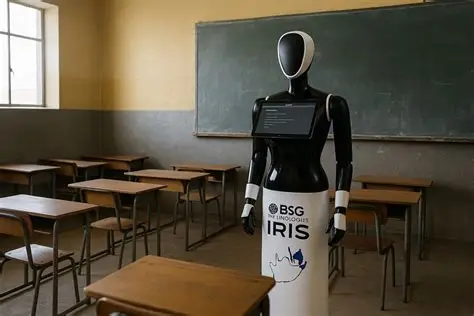
“Iris, a humanoid robot designed to support teachers and enhance learning in South Africa’s classrooms, can teach in all 11 official languages and is aligned with the national curriculum. However, despite its promise, government funding has stalled, leaving only five schools with access to the technology, supported mainly by donations.”
South Africa’s education system faces persistent challenges: overcrowded classrooms, under-resourced schools, and uneven access to quality teaching. Against this backdrop, the introduction of Iris, a humanoid classroom robot, has sparked both excitement and debate. Iris represents a bold attempt to integrate robotics into education, but its journey reveals the complexities of innovation in a resource-constrained environment.
What is Iris?
- Design: Wheeled humanoid robot, roughly the height of a primary school pupil.
- Features: Chest-mounted screen, speakers, interactive software.
- Capabilities: Responds to student questions, explains concepts, assists with assessments, logs classroom performance.
- Languages: Operates in all 11 official South African languages.
- Curriculum: Fully mapped to the national curriculum from grade R through matric.
Promise of Iris
- Accessibility: Bridges language barriers in diverse classrooms.
- Support for Teachers: Acts as an assistant in overcrowded classrooms.
- Data Collection: Provides real-time analytics on student performance.
- Innovation: Positions South Africa as a leader in educational robotics.
Challenges Facing Iris
- Funding Shortfalls: Government promises of widespread rollout remain unfulfilled.
- Limited Deployment: Only five schools currently use Iris.
- Reliance on Donations: The project survives through contributions from its creators and private donors.
- Equity Concerns: Risk of widening the gap between well-resourced and under-resourced schools.
Broader Context
South Africa’s robotics landscape is expanding beyond manufacturing and industry. Initiatives like Roboticon 2026 highlight the role of robotics in culture and innovation, while the CSIR’s showcase at the Manufacturing Indaba demonstrates industrial applications. Iris fits into this broader narrative, showing how robotics can address social challenges like education.
Expert Opinions
- Educators: Praise Iris for its ability to engage students in multiple languages.
- Policymakers: Acknowledge the potential but cite budget constraints.
- Parents: Express cautious optimism, concerned about sustainability.
Future Prospects
For Iris to succeed, South Africa must:
- Secure consistent government funding.
- Expand deployment to rural and under-resourced schools.
- Integrate Iris into broader digital transformation strategies in education.
- Foster public-private partnerships to sustain innovation.
Conclusion
Iris is more than a robot—it is a symbol of South Africa’s ambition to harness technology for social good. Yet, without adequate support, its promise risks fading into another unrealized innovation. The story of Iris underscores the tension between technological possibility and systemic constraints in South Africa’s education system.



