




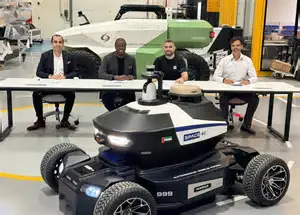
“At the Manufacturing Indaba 2026 in Johannesburg, the Council for Scientific and Industrial Research (CSIR) unveiled cutting-edge robotics systems designed for precision manufacturing, automated assembly, and industrial inspection. These innovations aim to boost efficiency, reduce reliance on imports, and strengthen South Africa’s position in global manufacturing.”
South Africa’s manufacturing industry is undergoing a transformative shift, driven by the integration of robotics and advanced automation technologies. At the Manufacturing Indaba 2026, held at the Sandton Convention Centre in Johannesburg, the Council for Scientific and Industrial Research (CSIR) unveiled a suite of robotics innovations that promise to revolutionize industrial processes. This showcase was not merely a technological exhibition but a strategic intervention aimed at revitalizing South Africa’s industrial base, fostering resilience, and positioning the nation as a global leader in innovation-driven manufacturing.
Robotics at the Forefront
Among the technologies presented, robotics stood out as the most transformative. CSIR researchers demonstrated systems capable of:
- Precision manufacturing – ensuring accuracy in production lines.
- Automated assembly – reducing production time and minimizing human error.
- Industrial inspection – guaranteeing consistent product standards.
These systems are already being integrated into production lines, warehouses, and healthcare applications, signaling a broad impact across multiple sectors.
South Africa’s manufacturing industry is undergoing a transformative shift, driven by the integration of robotics and advanced automation technologies. At the Manufacturing Indaba 2026, held at the Sandton Convention Centre in Johannesburg, the Council for Scientific and Industrial Research (CSIR) unveiled a suite of robotics innovations that promise to revolutionize industrial processes. This showcase was not merely a technological exhibition but a strategic intervention aimed at revitalizing South Africa’s industrial base, fostering resilience, and positioning the nation as a global leader in innovation-driven manufacturing.
Robotics at the Forefront
Among the technologies presented, robotics stood out as the most transformative. CSIR researchers demonstrated systems capable of:
- Precision manufacturing – ensuring accuracy in production lines.
- Automated assembly – reducing production time and minimizing human error.
- Industrial inspection – guaranteeing consistent product standards.
These systems are already being integrated into production lines, warehouses, and healthcare applications, signaling a broad impact across multiple sectors.
Efficiency and Economic Gains
Robotics offers multiple advantages:
- Efficiency Gains: Automated assembly lines significantly reduce production time.
- Cost Reduction: Localized robotics manufacturing lowers dependency on costly imports.
- Quality Assurance: Industrial inspection robots ensure consistent product standards.
- Sectoral Expansion: Applications extend beyond manufacturing into logistics, healthcare, and agriculture.
This integration is expected to boost productivity, reduce operational costs, and create new opportunities for South African industries.
Complementary Technologies
The robotics showcase was complemented by other advanced manufacturing technologies:
- Metal 3D Printing – enabling rapid prototyping and customized production.
- Hot Isostatic Press (HIP) – improving material strength and durability.
- Laser Surface Engineering – enhancing industrial component longevity.
- Materials Engineering – supporting sustainable and eco-friendly manufacturing.
Together, these technologies form an ecosystem where robotics plays a central role in automation and efficiency.
Policy Context
The South African government has prioritized industrial localization to reduce dependency on imports and create jobs. Robotics aligns with this policy by enabling local production of high-value goods, reducing reliance on foreign suppliers, and fostering innovation-driven growth.
Global Competitiveness
By integrating robotics into manufacturing, South Africa is positioning itself as a competitive player in global markets. The CSIR’s innovations are expected to attract foreign investment, stimulate exports, and enhance the country’s reputation as a hub for advanced technology.
Challenges Ahead
Despite the promise, challenges remain:
- Skills Gap: South Africa must invest in training workers to operate and maintain advanced robotics systems.
- Infrastructure: Reliable electricity and digital connectivity are essential for robotics deployment.
- Cost Barriers: Initial investment in robotics can be high, requiring government and private sector collaboration.
Conclusion
The CSIR’s robotics showcase at the Manufacturing Indaba 2026 marks a pivotal moment in South Africa’s industrial journey. By embracing robotics and complementary technologies, the nation is not only modernizing its manufacturing sector but also laying the foundation for sustainable economic growth, job creation, and global competitiveness.



