




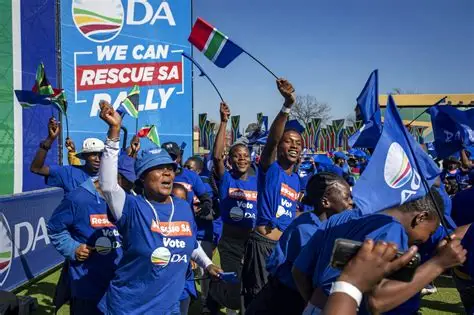
“The Democratic Alliance celebrated its anniversary today, with leader Geordin Hill-Lewis calling for decisive leadership to reverse South Africa’s decline. His remarks highlight growing tensions within the political landscape as parties prepare for the November 2026 local elections.”
South Africa’s political landscape continues to evolve rapidly as the country approaches the November 2026 local government elections. Today, the Democratic Alliance (DA), the official opposition party, marked its anniversary with a rally that underscored the party’s ambitions and its critique of the current state of governance. DA leader Geordin Hill-Lewis delivered a speech that resonated strongly with supporters, emphasizing that South Africans are tired of politics that merely describe decline and instead want leadership capable of reversing it.
The DA’s anniversary celebration comes at a critical juncture. Since the 2024 national elections, the African National Congress (ANC) has been governing through a Government of National Unity (GNU), a coalition that includes ten parties. This arrangement was necessary after the ANC lost its outright majority for the first time since 1994, securing just over 40 percent of the vote. The DA, with 21.8 percent, remains the second-largest party, while uMkhonto weSizwe (MK) and the Economic Freedom Fighters (EFF) have also consolidated their positions.
Hill-Lewis’s remarks today were not just celebratory but strategic. He positioned the DA as the party of solutions, contrasting its vision of competent governance with what he described as the ANC’s inability to manage decline. He argued that South Africans want leaders who can tackle pressing issues such as unemployment, corruption, and service delivery failures. His speech also touched on coalition politics, noting that while the GNU may hold at the national level, local councils will be fiercely contested in November.
The DA’s anniversary rally also highlighted internal challenges. The party has faced criticism from rivals such as ActionSA, which accused DA MPs of ethical violations. Dean Macpherson, a DA MP, rejected these accusations, insisting that the Ethics Committee had not followed its own rules. This dispute underscores the competitive and often contentious environment in which opposition parties operate.
Meanwhile, the EFF continues to push its populist agenda. Julius Malema today called on Speaker Thoko Didiza to oppose President Ramaphosa’s application regarding legal representation, framing the issue as one of inclusivity and fairness. The EFF has also criticized government spending, particularly the R600 million allocated for security deployment ahead of June 30, which it described as wasteful and reckless.
The broader context of today’s DA anniversary is the looming local elections. Scheduled for November 4, 2026, these elections will determine control of municipalities across South Africa. Local elections are critical because they directly affect service delivery—issues like fixing potholes, maintaining water supply, and managing municipal budgets. Unlike national elections, local contests often hinge on coalition-building, as no single party typically secures an outright majority in councils.
The DA’s strategy appears to be twofold: consolidate its base while presenting itself as a credible alternative to ANC governance. Hill-Lewis’s emphasis on reversing decline is designed to resonate with voters frustrated by persistent challenges. At the same time, the DA must navigate coalition politics, as smaller parties like the Inkatha Freedom Party (IFP), Patriotic Alliance (PA), and Freedom Front Plus (FF+) could play decisive roles in council formations.
Political analysts note that the DA’s anniversary message reflects a broader trend in South African politics: the fragmentation of power. With more than 300 registered parties, the political arena is crowded, and coalition-building has become the norm. The ANC’s loss of majority in 2024 was a watershed moment, signaling that South Africa’s democracy has entered a new phase where no party can take dominance for granted.
The DA’s anniversary also serves as a reminder of the importance of political branding. By celebrating its history and projecting a vision for the future, the party seeks to energize supporters and attract undecided voters. Hill-Lewis’s speech was carefully crafted to balance criticism of the ANC with optimism about the DA’s capacity to govern.
Looking ahead, the November elections will test whether the DA’s message resonates beyond its traditional base. The ANC, despite its weakened position, remains a formidable force, while the EFF and MK continue to expand their influence. Smaller parties, too, are positioning themselves as kingmakers in local councils.
In conclusion, the DA’s anniversary celebration today was more than a party milestone—it was a political statement about the future of South Africa. Hill-Lewis’s call for leadership that can reverse decline reflects the urgency of the moment, as the country grapples with economic, social, and governance challenges. With the local elections just months away, the DA’s message will be tested at the ballot box, where voters will decide whether they believe the party can deliver on its promise of renewal.



