




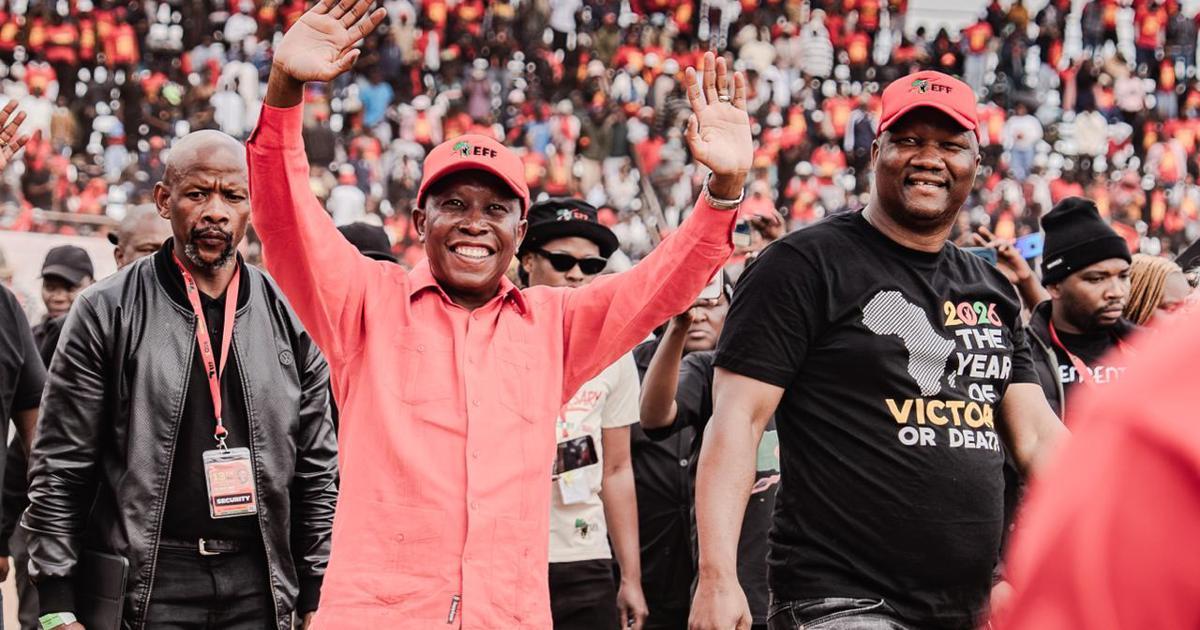
“The Economic Freedom Fighters (EFF) is making its final campaign push to persuade South Africans to support the party in the 2026 Local Government Elections, with party leader Julius Malema expected to present its service-delivery offering to supporters. The campaign comes as political parties intensify their efforts to win municipal support ahead of the 4 November elections, with service delivery, municipal accountability and the performance of local government among the central issues facing voters.”
EFF makes final push to persuade South Africans to vote ahead of the 2026 Local Government Elections
The Economic Freedom Fighters (EFF) is using the final stretch of South Africa’s 2026 local government election campaign to make a direct appeal to voters, with party leader Julius Malema scheduled to address supporters at Orlando Stadium in Soweto on Saturday. The rally, branded “Tshela Thupa”, is intended to present the party’s service-delivery offering and persuade residents to support the EFF when municipal elections take place on 4 November. The event is part of a wider final campaign push by political parties seeking to translate public frustration with local government into votes.
SABC News reported on 31 October that the EFF planned to use the gathering to communicate its message to thousands of supporters. The party has described the rally with the phrase “Victory or Death”, while “Tshela Thupa” is loosely translated as “crack the whip”. Those are the party’s own campaign expressions. They convey urgency, but the practical test for voters will be the details of the party’s municipal proposals and whether its candidates can implement them within the legal and financial limits of local government.
The election is scheduled for Wednesday, 4 November 2026. The Electoral Commission of South Africa (IEC) has said that approximately 29 million people are registered to vote. The commission has also indicated that special voting is planned for 2 and 3 November for approved voters who cannot attend their voting stations on election day, including eligible people who need home visits. EWN reported that about 2.6 million special votes are expected and that more than 600,000 home visits are planned. These arrangements are intended to make participation possible for people whose circumstances may otherwise prevent them from voting.
The EFF rally is one part of a crowded campaign landscape. The Democratic Alliance is also holding a final rally in Mamelodi on 31 October, while other parties have been making their last public appeals in different municipalities. SABC’s election coverage has listed the EFF event alongside the DA rally as a major campaign activity on the day. This illustrates that the final weekend is not simply a contest between two parties: it is a nationwide effort by many organisations and candidates to persuade voters in wards, towns and metropolitan councils.
Local government elections differ from national elections because the decisions made by municipal councils shape services close to where people live. Municipalities are responsible for functions that include local roads, water and sanitation services, refuse removal, electricity distribution where applicable, municipal planning and other community services. The exact allocation of responsibilities varies, and some services depend on district municipalities, provincial departments, national entities or agreements with other providers. Nevertheless, residents often experience the municipality as the first point of accountability when taps run dry, rubbish is not collected or local roads deteriorate.
For that reason, a campaign promise about service delivery needs to be assessed against more than its slogan. Voters can examine whether a party explains how it would maintain infrastructure, fund repairs, improve billing and revenue collection, appoint qualified officials, publish performance information and monitor contractors. They can also ask whether proposed projects have realistic budgets, timelines and measurable targets. Municipal councils operate under legal requirements and financial constraints; a party’s ability to carry out a promise depends on council decisions, administrative capacity and available revenue, not only on the announcement made at a rally.
The EFF’s public message at Orlando Stadium will therefore be important as a campaign presentation, but the SABC report available on 31 October does not set out the detailed contents of the service-delivery programme expected from Malema. It would be inaccurate to attribute specific targets, spending commitments or municipal plans to the party without the full speech or a published manifesto to verify them. The central reported fact is that Malema is expected to present the party’s service-delivery offering to supporters as it seeks votes for 4 November. The substance of the proposals should be checked against the party’s official documents and the complete address.
The wider political environment makes the municipal contest significant beyond the immediate allocation of council seats. EWN’s AFP report noted that the vote will provide an indication of whether frustration with municipal performance is changing established political loyalties ahead of the 2029 national election. The ANC lost its national parliamentary majority in 2024, and the local elections will take place amid a fragmented political landscape in which more than 500 parties are registered with the electoral commission, according to the same report. The number of parties competing can widen voter choice, but it can also make council formation and coalition negotiations more complex where no party secures a majority.
The IEC’s voting arrangements are another important part of the election story. Voters in metropolitan municipalities are generally expected to receive two ballot papers: one to elect a ward councillor and another to choose a political party for proportional representation in the municipal council. In municipalities outside the eight metros, voters may receive a third ballot for district representation. The precise ballot papers depend on the municipality in which a person is registered. Voters should confirm their registration details and voting station through official IEC channels before election day, rather than relying on campaign material or unverified social media posts.
The election will also test the ability of institutions and communities to protect peaceful participation. Police have reported identifying 331 voting stations assessed as high-risk ahead of the polls, with concentrations in KwaZulu-Natal and Gauteng. The police have linked their risk assessments to possible flashpoints involving service-delivery protests, community unrest and other security incidents. This does not mean that violence will occur at those stations; it indicates that authorities have identified locations requiring additional attention and planning. All parties, candidates and supporters have a responsibility to respect the rights of others, avoid intimidation and allow voters to make their choices freely.
For the EFF, the Soweto rally offers an opportunity to make its final appeal at a prominent public gathering before voters go to the polls. For residents, the event is one source of information among many. A speech can communicate priorities and energise supporters, but a municipal mandate lasts beyond election day. Once councillors take office, the work involves approving budgets, overseeing municipal administrations, scrutinising spending, responding to residents and making decisions that affect local services over the council term.
Voters can use the final days before 4 November to compare party manifestos with the actual responsibilities of the municipality in which they live. They can check whether promises address the most pressing local problems, whether proposed solutions identify funding and implementation steps, and whether candidates have explained how residents will be kept informed. They can also distinguish between responsibilities controlled by a municipality and those that belong to provincial or national government. This helps prevent campaign debates from confusing different levels of authority.
The EFF’s final campaign push is therefore part of a broader national conversation about the performance and future of local government. The party is seeking support by placing service delivery at the centre of its message, while voters face a choice among numerous parties and candidates offering different approaches. The SABC report confirms the planned rally and Malema’s expected address; the broader reporting from EWN, AFP and the IEC provides context on the public concerns, voting arrangements and security preparations surrounding the election.
The decisive measure of any party’s municipal programme will not be the size of its rally or the force of its slogans. It will be whether elected representatives can turn commitments into lawful, funded and measurable improvements, while explaining delays and accepting scrutiny. On 4 November, registered voters will have the opportunity to choose ward representatives and parties to serve on their councils. The task after the ballots are counted will be to convert those choices into accountable local government that responds to the needs of the communities it serves.



