




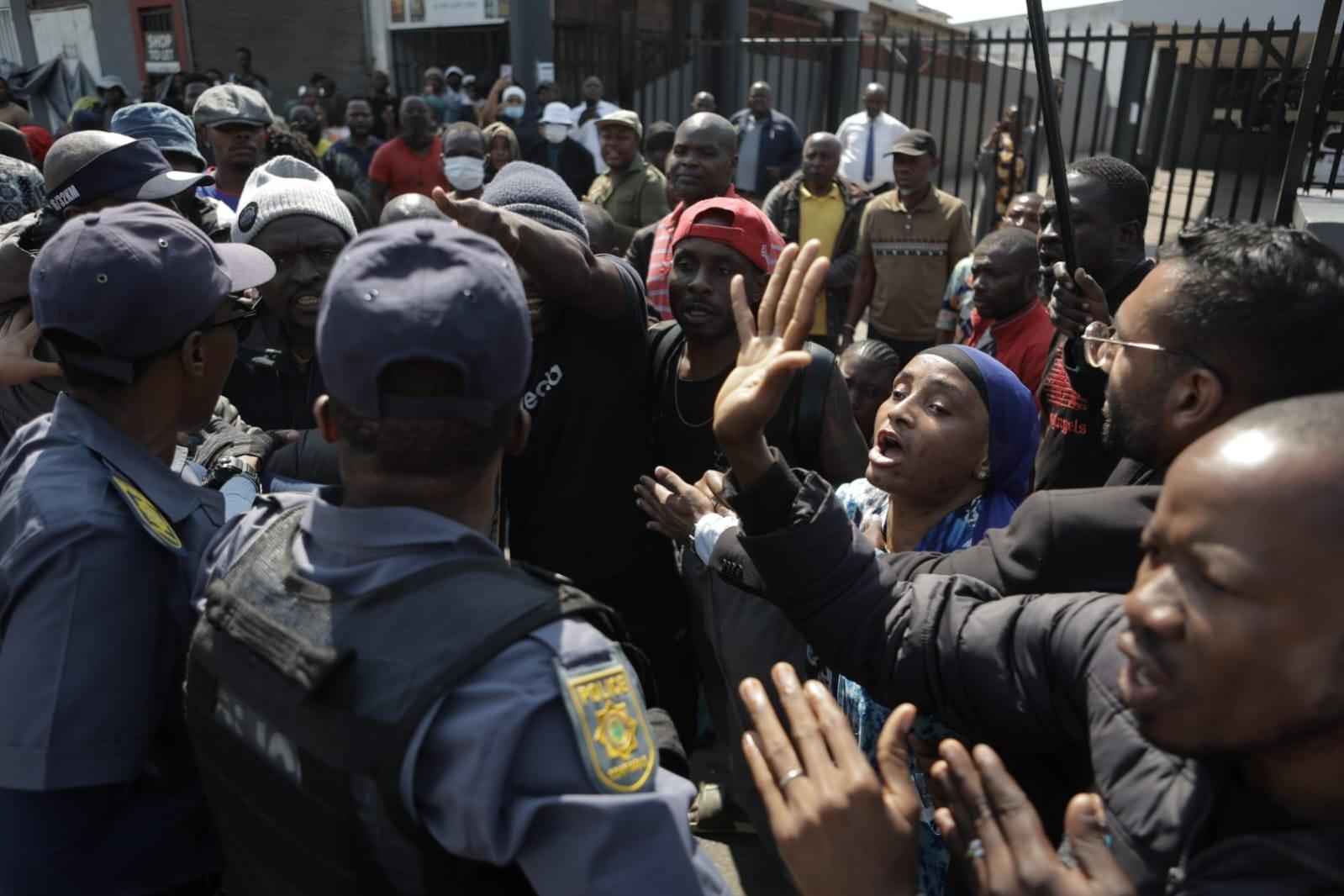
“The March and March movement has disputed police allegations that its members breached a court order during a confrontation in Durban’s Umbilo area, accusing officers of excessive force against people who allegedly complied with instructions to leave the demonstration area. The dispute highlights growing tensions between protest rights, immigration-related activism, judicial restrictions on public gatherings and the responsibility of law enforcement to maintain public safety.”
March and March disputes police account after Durban protest confrontation
The March and March movement has rejected allegations that its members violated restrictions governing public demonstrations in Durban, accusing police officers of using excessive force during a confrontation on Che Guevara Road in Umbilo. The disagreement has intensified scrutiny of the relationship between protest movements, policing practices, constitutional freedoms and immigration-related activism in South Africa.
In a statement reported on Thursday, March and March spokesperson Sandile Dube said the organisation had conducted its own investigation into the incident, interviewed members and visited the scene following the confrontation outside Home Affairs offices. The movement disputed the South African Police Service’s account that demonstrators embarked on an unlawful march after the permitted demonstration hours.
The incident occurred against the background of growing tensions surrounding anti-migrant demonstrations in KwaZulu-Natal and other parts of South Africa. These protests have increasingly become a national political issue, raising questions about immigration administration, public security, human rights and the enforcement of constitutional protections.
March and March challenges police allegations
March and March maintained that it had neither organised nor encouraged a march on Tuesday afternoon. According to Dube, approximately 20 members of the public attempted to walk towards nearby traffic lights on Che Guevara Road before police officers approached them and instructed them to return to their tents.
The spokesperson claimed that the individuals complied with police instructions and were leaving their traditional weapons behind when an officer allegedly opened fire.
Dube further disputed the timing provided by police, arguing that the confrontation occurred at approximately 2.15pm rather than after 3pm.
The organisation also explained that not everyone staying at its Moore Road camping site permanently resides there. Some participants reportedly travel from different townships and occasionally arrive or leave in groups, a circumstance the movement said should not automatically be interpreted as evidence of an organised march.
These allegations have not independently established wrongdoing by individual officers. However, they introduce competing accounts of the confrontation and underline the importance of an impartial investigation.
Police defend intervention during confrontation
KwaZulu-Natal police presented a different account of the incident.
According to the South African Police Service, Public Order Police officers intervened after a group moved away from the gazebos opposite Home Affairs offices and began marching shortly after 3pm.
Police said officers reminded the participants of an interim court order regulating demonstrations in the area.
The restrictions reportedly included a prohibition on demonstrations after 3pm, carrying dangerous weapons and wearing masks or other items intended to conceal participants’ faces during marches.
Police further alleged that some demonstrators threw stones at officers during discussions about compliance with the court order.
The authorities said officers subsequently used stun grenades and rubber bullets to disperse the group.
Police reported that no injuries had been recorded in their account of the confrontation. Investigations were reportedly opened into possible violations of the interim court order and alleged assaults against police officers.
The contrasting accounts illustrate the difficulties of determining responsibility during confrontations involving large groups, security personnel and politically charged demonstrations.
Court restrictions become central to the dispute
The confrontation follows a Durban High Court decision that permitted March and March to continue demonstrating under specified conditions.
On October 31, 2026, Judge Peter Olsen ruled that the movement could conduct demonstrations between 9am and 3pm, subject to restrictions on weapons, face coverings and property damage.
The court’s decision followed legal action initiated by Acting Police Minister Firoz Cachalia, who sought intervention amid escalating anti-migrant demonstrations and concerns about public safety.
Authorities had argued that demonstrations were creating significant security challenges, particularly around refugee reception facilities and areas where foreign nationals seek immigration documentation.
The court ultimately allowed demonstrations to continue under restrictions rather than imposing an unconditional prohibition.
The ruling placed the movement’s activities within a clearly defined legal framework. It also created an obligation for demonstrators and authorities to understand and comply with the conditions governing public gatherings.
March and March has argued that its constitutional right to demonstrate should not be undermined by restrictions or allegations it disputes.
The current disagreement therefore extends beyond the immediate confrontation. It concerns how constitutional rights can be exercised while complying with judicial orders and protecting the public.
Immigration activism remains politically sensitive
March and March has emerged as a prominent participant in South Africa’s anti-migrant mobilisation.
Its demonstrations have focused on undocumented immigration, border enforcement and demands for stronger government intervention in immigration administration.
Supporters argue that immigration enforcement should be strengthened and that government institutions must respond to public concerns about employment, public services and documentation.
However, anti-migrant mobilisation has also generated significant criticism from human rights organisations, immigrant communities and civil society groups.
Critics warn that demonstrations targeting foreign nationals can contribute to discrimination, intimidation and violence against people based on nationality or perceived immigration status.
South Africa’s immigration debate is particularly sensitive because it intersects with unemployment, poverty, inequality, crime concerns and longstanding weaknesses in public administration.
Consequently, public demonstrations concerning immigration have increasingly become an arena in which competing political, economic and social grievances are expressed.
The challenge for democratic institutions is to distinguish legitimate criticism of government immigration policy from conduct that threatens the safety or dignity of individuals.
Constitutional rights and responsibilities
South Africa’s Constitution protects freedom of expression, peaceful assembly and association.
These protections allow individuals and organisations to organise demonstrations, communicate political demands and participate in public debates.
Nevertheless, constitutional protections do not eliminate the responsibility to comply with lawful restrictions or respect the rights of others.
Public gatherings must be conducted within applicable legal requirements, while law enforcement officers must exercise their powers lawfully and proportionately.
The March and March confrontation highlights the importance of these competing responsibilities.
Where demonstrators allege excessive force, accountability mechanisms should provide a credible avenue for investigating complaints.
Similarly, where police allege violations of court orders or assaults against officers, those allegations require evidence and appropriate legal processes.
Neither a political organisation’s statement nor a police account should automatically substitute for independent verification.
Transparent investigations are particularly important in politically sensitive incidents because competing narratives can quickly influence public opinion and increase tensions.
Questions surrounding police conduct
The movement’s allegations of excessive force raise broader questions about public-order policing.
Police officers are responsible for maintaining public safety, protecting people participating in demonstrations and preventing violence.
At the same time, their response must remain consistent with legal standards governing the use of force.
The circumstances surrounding the alleged shooting, the instructions given to demonstrators and the sequence of events before the confrontation will be important in establishing what happened.
Evidence from witnesses, video recordings, police operational records and other available material could help clarify the dispute.
An independent investigation would also help establish whether the actions of individual officers complied with applicable procedures.
The investigation should examine the competing accounts without presuming guilt on either side.
Such an approach would strengthen confidence in law enforcement while ensuring that allegations against officers or demonstrators are addressed through appropriate institutions.
Movement calls for further mobilisation
March and March said it would announce the date of its planned Durban march in due course.
The organisation was also preparing for a demonstration in Gqeberha, with Dube calling on supporters to remain calm and mobilise residents across the Eastern Cape.
The movement additionally called for police deployment in Mayfair, Gqeberha and Point Road, arguing that similar security resources should be allocated to those areas as were deployed during the Che Guevara Road operation.
The planned demonstrations indicate that immigration-related activism remains an active political issue despite judicial restrictions and ongoing investigations.
Future gatherings will likely attract attention from law enforcement, civil society organisations and political stakeholders concerned about public safety and the protection of constitutional rights.
The movement’s ability to demonstrate within the legal framework established by the court will be an important factor in determining whether subsequent gatherings proceed peacefully.
Broader implications for South African democracy
The Durban confrontation illustrates the complex relationship between activism and democratic governance.
Political movements can provide platforms for communities to express grievances and demand government intervention. However, public mobilisation also carries responsibilities, particularly where demonstrations involve vulnerable groups or highly contested social issues.
The government faces pressure to address immigration administration, strengthen institutional capacity and respond to public concerns without allowing intimidation or violence to undermine constitutional protections.
Law enforcement authorities must maintain public order while ensuring that demonstrations are managed fairly and that allegations of excessive force receive meaningful attention.
Courts, meanwhile, play an important role in balancing competing rights and establishing conditions under which public gatherings can take place.
The effectiveness of these institutions depends partly on public confidence in their independence, consistency and accountability.
What happens next?
The immediate questions surrounding the confrontation remain unresolved.
March and March continues to dispute the police account, while authorities have indicated that investigations are underway into possible violations of the court order and alleged assaults on officers.
The organisation’s planned demonstrations in Durban and Gqeberha could provide another test of compliance with the judicial restrictions.
The outcome of investigations into the Che Guevara Road confrontation may also influence future discussions about public-order policing and protest management.
For South Africa, the broader issue is how to protect democratic participation while preventing violence, discrimination and unlawful conduct.
The March and March dispute demonstrates that activism remains an important force in the country’s political landscape. It also highlights the need for responsible mobilisation, lawful policing and credible accountability mechanisms.
Ultimately, the legitimacy of public demonstrations and the authority of law enforcement depend on both operating within the Constitution and respecting the rights of all people.
The Durban confrontation is therefore more than a disagreement between protesters and police. It is a reminder that South Africa’s democratic institutions must continually balance freedom, accountability, public safety and human dignity in an increasingly contested political environment.



