




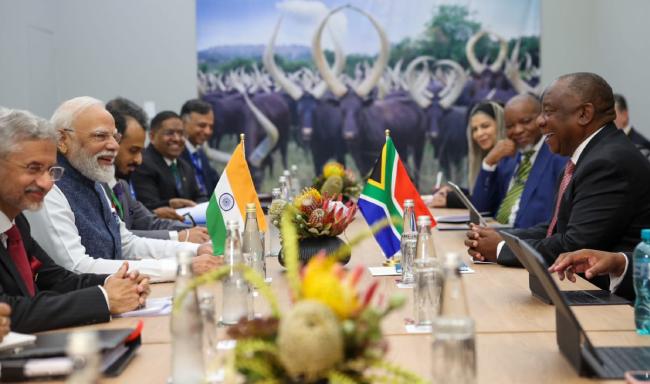
“India and South Africa have reaffirmed their commitment to strengthening their strategic partnership after holding the 12th round of Foreign Office Consultations in Pretoria, covering trade, investment, defence, security, science, technology and multilateral cooperation. The discussions also set the stage for the 30th anniversary of their strategic partnership in 2027, with both countries seeking deeper cooperation in Africa, the Global South and international institutions.”
India and South Africa Strengthen Strategic Partnership as Pretoria Hosts Key Diplomatic Consultations
India and South Africa have renewed their commitment to expanding bilateral relations following the 12th round of Foreign Office Consultations held in Pretoria, marking another important development in diplomatic cooperation between two influential countries in the Global South. The discussions brought together senior diplomatic representatives from both governments to assess existing cooperation, explore opportunities for future collaboration and exchange views on regional and international developments.
The consultations represent a significant step in maintaining the momentum of the India–South Africa Strategic Partnership, which has developed through historical solidarity, economic cooperation, political engagement and shared interests in international affairs.
According to information released by India’s Ministry of External Affairs, the meeting reviewed the full range of bilateral relations, including political exchanges, institutional cooperation, trade, investment, defence, security, development partnerships, science and technology, education, counter-terrorism, cultural relations and people-to-people connections.
The Indian delegation was led by Janesh Kain, Joint Secretary responsible for East and Southern Africa at India’s Ministry of External Affairs. South Africa’s delegation was led by Ambassador David Malcomson, Acting Deputy Director-General in the Department of International Relations and Cooperation.
The meeting highlighted the importance of continued diplomatic engagement between Pretoria and New Delhi as both countries navigate an increasingly complicated international environment characterised by geopolitical competition, changing economic relationships and debates over the future of global governance.
Strengthening a Historic Diplomatic Partnership
India and South Africa maintain a relationship deeply influenced by historical experiences, including India’s support for the struggle against apartheid and South Africa’s subsequent democratic transformation.
Their diplomatic relationship has developed into a strategic partnership that extends beyond traditional bilateral engagement. Both countries have consistently emphasised cooperation on development, international equality, economic opportunity and the representation of developing nations in global institutions.
The consultations provided an opportunity for officials to assess how existing diplomatic mechanisms can support stronger coordination and practical cooperation.
The upcoming 30th anniversary of the establishment of their Strategic Partnership in 2027 offers an additional incentive to strengthen relations and identify new areas of collaboration.
Rather than treating the anniversary merely as a ceremonial event, both governments have an opportunity to use it as a platform for reviewing achievements, identifying shortcomings and establishing priorities for the next phase of cooperation.
Trade and Investment Remain Central Priorities
Economic cooperation continues to represent one of the most important dimensions of India–South Africa relations.
India is a major emerging economy with extensive manufacturing, technological and services capabilities. South Africa, meanwhile, offers access to a sophisticated regional economy, established financial infrastructure, natural resources and strategic connections throughout the African continent.
The discussions on trade and investment therefore carry significance for both countries.
Greater economic cooperation could support investment in manufacturing, mining, infrastructure, agriculture, pharmaceuticals, renewable energy and digital services.
South African companies seeking opportunities in India could benefit from the country’s large consumer market, industrial development and expanding technological sectors.
Similarly, Indian companies can explore investment opportunities in South Africa’s industrial economy, logistics networks, financial services and infrastructure development.
Nevertheless, the potential for stronger economic relations depends on practical improvements in market access, investment conditions, regulatory cooperation and business engagement.
Diplomatic consultations provide an important framework for identifying obstacles and encouraging governments to address concerns affecting companies and investors.
Defence and Security Cooperation
Defence and security cooperation also featured prominently in the consultations.
Both countries face evolving security challenges, including terrorism, organised crime, maritime insecurity, cyber threats and regional instability.
South Africa occupies an important strategic position along major maritime routes connecting the Atlantic and Indian Oceans. India, meanwhile, has significant interests in maritime security, trade routes and stability across the Indian Ocean region.
Cooperation between the two countries could strengthen information-sharing, maritime engagement, defence dialogue and efforts to address emerging security threats.
Counter-terrorism cooperation remains particularly relevant as governments seek to prevent extremist organisations from exploiting international networks and technological developments.
Security discussions also contribute to broader diplomatic trust by enabling officials to understand one another’s priorities and coordinate responses to shared challenges.
Science, Technology and Education
Scientific cooperation and technological development are increasingly important elements of modern diplomacy.
India has developed substantial capabilities in information technology, digital public infrastructure, pharmaceuticals, space research and technology-based services.
South Africa possesses established research institutions, universities, scientific capabilities and an innovation ecosystem with opportunities for further development.
Cooperation between the countries could support research partnerships, student exchanges, skills development, technology transfer and joint scientific projects.
Education and training programmes may also strengthen connections between universities, research institutions and businesses.
Such partnerships can contribute to employment creation, industrial development and improved technological capacity.
In addition, cooperation in emerging technologies could help both countries participate more effectively in discussions concerning artificial intelligence, digital governance and the international regulation of technological innovation.
Cooperation on Africa and the Global South
A particularly important dimension of India–South Africa relations is their shared interest in advancing the priorities of developing countries.
Both governments have frequently advocated for greater representation of developing nations in international decision-making structures.
Their cooperation within multilateral institutions reflects concerns about unequal economic opportunities, development financing, international trade arrangements and the distribution of influence in global governance.
South Africa’s position within Africa gives it a significant role in continental diplomatic initiatives. India, through its economic relationships, development programmes and diplomatic engagement, has also maintained extensive connections with African countries.
Consequently, cooperation between Pretoria and New Delhi could support wider engagement on African development, infrastructure, trade, investment and institutional capacity-building.
Both countries have an interest in promoting a more balanced international system in which developing economies possess greater influence over decisions affecting their future.
However, achieving these objectives requires sustained diplomatic coordination rather than declarations alone.
The effectiveness of their partnership will depend on whether political commitments translate into measurable development outcomes.
Multilateral Cooperation and Global Governance
The consultations also addressed regional and global issues of mutual interest, including cooperation in multilateral forums.
India and South Africa share interests in strengthening international institutions and promoting reforms that reflect contemporary economic and political realities.
Both countries have supported discussions about improving the representation of developing nations in international governance, including debates concerning the United Nations and global financial institutions.
Their engagement through BRICS provides another important platform for diplomatic cooperation.
The grouping offers opportunities to discuss economic development, financial cooperation, international trade, technology and geopolitical developments.
South Africa and India can use these platforms to coordinate positions on matters affecting developing countries, although their individual national interests and diplomatic priorities may sometimes differ.
BRICS and the Changing International Order
India and South Africa’s diplomatic relationship also operates within the broader context of BRICS cooperation.
Both countries view the grouping as an important platform for strengthening cooperation among emerging economies and expanding opportunities for developing countries.
BRICS discussions have increasingly addressed international economic governance, development financing, technological cooperation and the representation of emerging economies.
India and South Africa’s bilateral engagement can therefore reinforce their ability to coordinate within multilateral settings.
Their partnership is particularly relevant as countries across Africa and Asia seek greater economic diversification and stronger participation in global decision-making.
Nevertheless, BRICS cooperation does not eliminate differences among its members. Each country maintains its own foreign policy priorities, economic interests and relationships with other international partners.
Effective cooperation consequently requires diplomatic flexibility and continued dialogue.
The 2027 Strategic Partnership Anniversary
The approaching 30th anniversary of the India–South Africa Strategic Partnership represents a significant diplomatic milestone.
The anniversary provides an opportunity for both governments to evaluate their relationship and develop new initiatives.
Potential areas for deeper cooperation include expanding trade, increasing investment, strengthening educational partnerships, improving technological collaboration and supporting development programmes.
The anniversary could also provide a platform for high-level visits and additional diplomatic engagement.
The September 2026 meeting between Indian Prime Minister Narendra Modi and South African President Cyril Ramaphosa on the sidelines of the BRICS Summit in New Delhi further demonstrated the importance both governments attach to maintaining close relations.
During that engagement, the leaders discussed the broader strategic partnership, including trade, infrastructure, mining, critical minerals, food security, digital public infrastructure and emerging technologies.
Their discussions reflected an emphasis on combining historical solidarity with practical economic and development cooperation.
Opportunities and Challenges Ahead
Despite the positive diplomatic momentum, several challenges remain.
Economic cooperation must contend with global market uncertainty, investment competition and differences in regulatory environments.
Both governments must also ensure that diplomatic agreements produce practical benefits for businesses, institutions and citizens.
Trade opportunities require stronger commercial connections, reliable market information and mechanisms for resolving investment concerns.
Similarly, educational and technological cooperation depends on sustained institutional engagement and adequate resources.
The political relationship must also remain adaptable to changing international circumstances.
As global competition intensifies, India and South Africa will need to balance their shared interests with their respective relationships across different geopolitical groupings.
Their continued consultations offer a mechanism for managing these complexities through dialogue.
Conclusion: A Partnership Looking Towards the Future
The 12th round of Foreign Office Consultations in Pretoria represents another important step in strengthening India–South Africa relations.
By reviewing cooperation across trade, investment, defence, security, education, science, technology and multilateral engagement, both countries have reinforced their commitment to maintaining a comprehensive strategic partnership.
The discussions also demonstrate the continuing relevance of diplomatic dialogue in addressing contemporary international challenges.
With the 30th anniversary of their Strategic Partnership approaching in 2027, India and South Africa have an opportunity to transform longstanding diplomatic goodwill into stronger economic relationships, practical cooperation and coordinated international engagement.
Ultimately, the success of their partnership will depend on implementation, sustained political commitment and the ability to deliver tangible benefits to their populations.
The consultations reaffirmed that India and South Africa remain important partners in advancing cooperation between Africa and Asia, strengthening the Global South and promoting a more representative international order.



