




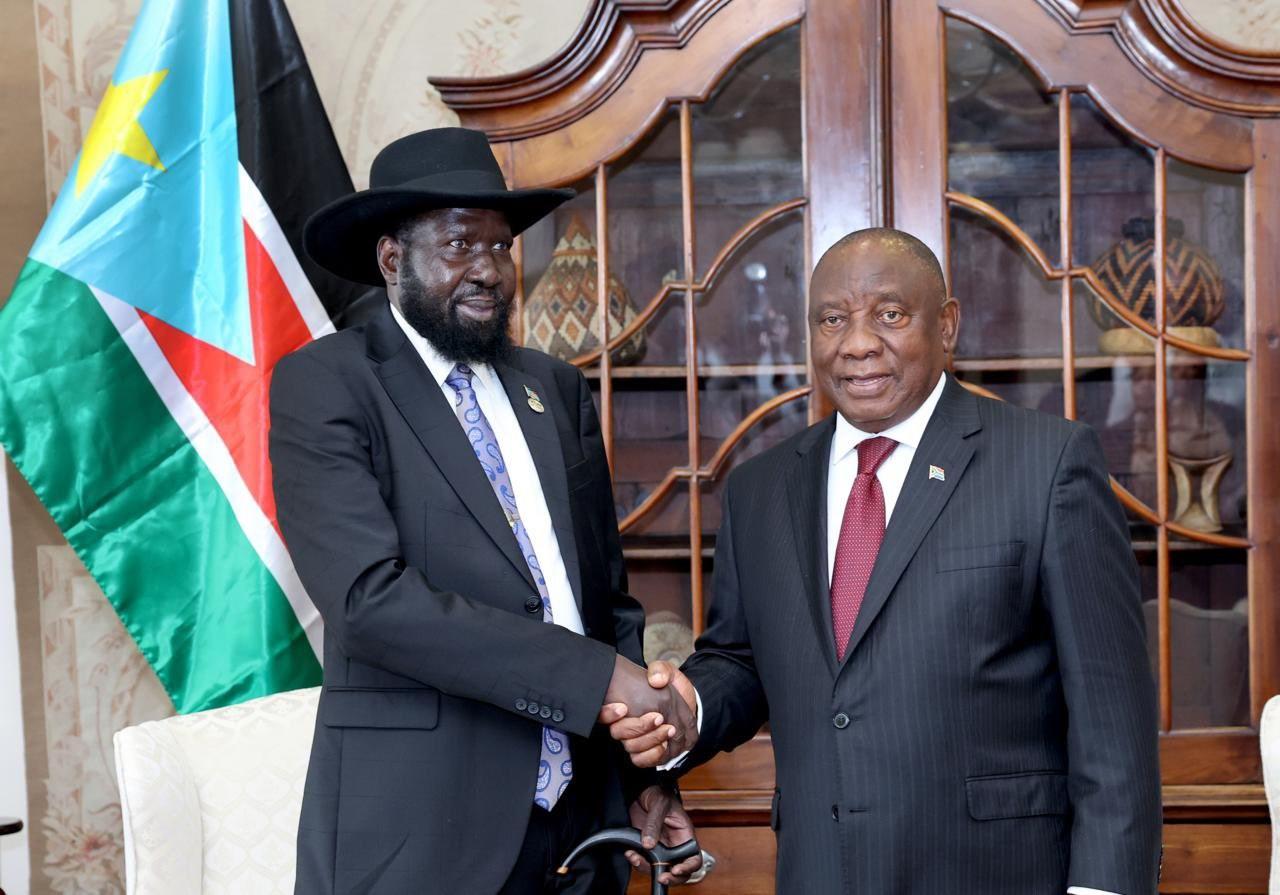
“South African President Cyril Ramaphosa has urged South Sudanese President Salva Kiir Mayardit to fully implement the country’s revitalised peace agreement and ensure an inclusive electoral process ahead of the planned December 2026 elections. The discussions in Pretoria underscore South Africa’s continuing diplomatic role in African peacebuilding, while highlighting concerns about unresolved political challenges, trust between South Sudanese stakeholders and the practical preparations required for credible elections.”
South Africa Urges South Sudan to Implement Peace Deal as December Elections Approach
South African President Cyril Ramaphosa has intensified diplomatic engagement with South Sudan, urging President Salva Kiir Mayardit to implement the country’s peace agreement fully as the world’s youngest nation prepares for planned general elections in December 2026. The discussions, held in Pretoria during Kiir’s working visit to South Africa, highlight Pretoria’s continuing commitment to regional stability, democratic governance and peaceful political transitions across the African continent.
According to a statement issued by the South African Presidency on 7 October, Ramaphosa emphasised that full adherence to the Revitalised Agreement on the Resolution of the Conflict in the Republic of South Sudan (R-ARCSS) is essential for advancing the peace process and establishing lasting stability. He also stressed the importance of an inclusive electoral process founded on mutual trust and cooperation among South Sudanese political stakeholders.
The engagement comes at a crucial moment for South Sudan, where delays in implementing political and security reforms have complicated preparations for elections. South Africa’s diplomatic intervention therefore reflects broader African efforts to prevent renewed conflict and support a credible transition towards representative government.
South Africa Strengthens Its Diplomatic Role
South Africa has maintained an active role in African diplomacy, particularly in initiatives addressing political instability, conflict resolution and institutional development. Its engagement with South Sudan forms part of wider regional cooperation involving the African Union and neighbouring countries.
During the Pretoria meeting, Ramaphosa and Kiir discussed bilateral relations, economic cooperation, institutional development and implementation of the peace agreement. The South African Presidency said the meeting reaffirmed the importance of sustained regional engagement and collaboration in support of peace, stability and political progress in South Sudan.
Ramaphosa’s position is significant because South Africa chairs the African Union High-Level Ad Hoc Committee on South Sudan, commonly known as the C5. This mechanism brings together regional leaders to support the implementation of the peace agreement and encourage progress towards an inclusive political settlement.
The committee’s work provides South Africa with a diplomatic platform to encourage dialogue between South Sudanese leaders while coordinating support from African partners. However, lasting progress depends on cooperation among the country’s political factions, institutions and communities rather than diplomatic pressure alone.
The Pretoria discussions consequently represent part of a wider regional effort to translate commitments into measurable progress before the election deadline.
The Peace Agreement at the Centre of Negotiations
The R-ARCSS was signed in September 2018 following years of devastating conflict. It established a framework for power-sharing, security arrangements, institutional reforms and preparations for elections.
The agreement was intended to help South Sudan move away from armed confrontation towards a more stable political system. Nevertheless, implementation has faced persistent obstacles, including disagreements between political leaders, delays in security sector reforms and difficulties completing institutional preparations.
The agreement remains central to international and regional efforts to support peace in South Sudan. Its implementation is also important for restoring public confidence in political institutions and creating conditions in which citizens can participate peacefully in national decision-making.
For Ramaphosa, the challenge is to encourage the South Sudanese leadership to treat the agreement as a practical roadmap rather than simply a diplomatic commitment.
The distinction matters because signing a peace agreement does not automatically resolve political disputes or guarantee that institutions will function effectively. Implementation requires cooperation, sustained funding, administrative capacity and willingness among competing political actors to honour their obligations.
The coming weeks will therefore be important in determining whether South Sudan can demonstrate sufficient progress to strengthen confidence in its political transition.
December Elections Present a Major Test
The planned December 2026 elections represent a significant milestone in South Sudan’s political development. However, their credibility will depend on more than the announcement of a voting date.
An inclusive electoral process requires political parties to participate meaningfully, institutions to operate effectively and citizens to have confidence that their votes will be respected. It also requires adequate preparations, clear procedures and a political environment in which disagreements can be addressed without violence.
Ramaphosa’s emphasis on mutual trust and cooperation reflects these requirements. The South African President urged South Sudanese stakeholders to address outstanding challenges and create an enabling environment for implementation of the peace agreement ahead of the elections.
South Sudan’s electoral preparations have previously encountered delays. The authorities have postponed elections that were initially expected earlier, citing the need to complete important elements of the transition. The December timetable therefore carries considerable political significance.
If preparations advance successfully, the elections could provide an opportunity to strengthen public participation and move the country towards more representative governance. Conversely, unresolved disagreements or inadequate preparations could undermine confidence in the process and intensify political tensions.
South Africa’s diplomatic message is consequently focused on ensuring that electoral preparations remain connected to the wider peace agreement.
Regional Cooperation and the African Union
South Africa’s involvement is part of a collective African diplomatic approach. The African Union and regional partners have repeatedly emphasised the importance of implementing the peace agreement and supporting peaceful, credible, inclusive and transparent elections.
A declaration adopted by the C5 Plus at a virtual summit on 29 September 2026 reaffirmed the African Union’s commitment to supporting South Sudan’s political transition. It identified 22 December 2026 as the scheduled date for general elections and called for coordinated support towards completing the transition and conducting the vote.
The declaration also acknowledged renewed hostilities and reported ceasefire violations, underlining the fragility of the political and security environment.
These concerns demonstrate why regional coordination remains important. South Sudan’s challenges cannot be addressed through bilateral diplomacy alone. The African Union, regional governments and international partners have roles in encouraging dialogue, supporting institutional development and coordinating assistance.
South Africa’s position as chair of the C5 provides an opportunity to help align these efforts. Nevertheless, diplomatic statements must be followed by practical cooperation, including support for electoral preparations and the implementation of agreed reforms.
The effectiveness of this approach will ultimately depend on whether the different partners can maintain a consistent message while respecting South Sudanese ownership of the political process.
Security and Humanitarian Concerns
Political stability remains closely connected to security conditions across South Sudan. Renewed fighting and political tensions have raised concerns about the durability of the peace process.
Recent reporting by The Guardian on 8 October described heavily strained trauma services in South Sudan amid renewed fighting between government forces and opposition-aligned groups. The report highlighted the humanitarian consequences of insecurity and the risks associated with the country’s unresolved political crisis.
Such conditions complicate electoral preparations. Insecurity can restrict movement, disrupt public services and make it harder for communities to participate in political activities. It can also divert government resources away from institutional development and essential services.
A sustainable peace process therefore requires progress beyond formal political negotiations. Security arrangements must be implemented, disputes must be managed peacefully and public institutions must be able to operate without intimidation or disruption.
South Africa’s emphasis on implementing the peace agreement is relevant to these interconnected challenges. A credible political transition could help strengthen confidence in institutions, although elections alone cannot resolve every underlying cause of instability.
For regional partners, the priority is to encourage political progress while recognising that peacebuilding also requires long-term investment in security, governance and community reconciliation.
Economic Cooperation and Institutional Development
The Pretoria meeting also addressed bilateral relations, economic cooperation and institutional development, illustrating the broader scope of South Africa’s engagement with South Sudan.
Peace and economic development are closely linked. Political uncertainty can discourage investment, disrupt trade and weaken the ability of governments to plan and deliver public services. More predictable institutions, by contrast, can create better conditions for economic cooperation.
South Africa’s engagement could provide opportunities for exchanging institutional experience and exploring practical areas of cooperation. However, the official statement did not announce a specific new economic agreement or financial commitment arising from the meeting.
The distinction is important because diplomatic discussions establish priorities but do not automatically produce completed projects or measurable economic outcomes.
For South Sudan, progress towards a stable political settlement could support longer-term efforts to strengthen public administration and improve economic prospects. For South Africa, regional stability contributes to broader continental interests, including peaceful cooperation, trade and development.
These potential benefits depend on sustained implementation rather than diplomatic announcements alone.
Challenges Facing South Africa’s Diplomatic Strategy
South Africa’s approach faces several challenges. The first is the gap between political commitments and implementation. Leaders may publicly endorse a peace agreement while disagreements over power-sharing, security and institutional arrangements continue to delay progress.
The second challenge is maintaining coordination among regional partners. The African Union and participating governments must sustain engagement, communicate consistent expectations and provide support that responds to South Sudan’s actual needs.
A third challenge is balancing diplomatic pressure with constructive dialogue. South Africa must encourage compliance with the peace agreement without undermining the cooperation necessary to move negotiations forward.
The fourth concerns the timetable itself. As December approaches, authorities face pressure to demonstrate that electoral arrangements are sufficiently developed and that political participation can take place in a credible environment.
These challenges mean that the success of Ramaphosa’s intervention should be assessed through observable developments. Relevant indicators include progress on outstanding provisions of the peace agreement, improvements in security, meaningful political dialogue and transparent electoral preparations.
Without such progress, diplomatic engagement risks producing repeated declarations without sufficient change on the ground.
What Happens Next?
The immediate priority is to translate the Pretoria discussions and wider C5 engagement into practical steps supporting South Sudan’s political transition.
South Sudanese authorities and political stakeholders will need to address outstanding issues, strengthen cooperation and advance the preparations necessary for the planned December elections. Regional partners, meanwhile, will need to continue providing coordinated diplomatic and technical support.
The African Union’s 29 September declaration offers an important framework for these efforts, while Ramaphosa’s meeting with Kiir reinforces South Africa’s commitment to the process.
The coming weeks will be especially important because the credibility of the election timetable depends on implementation, not simply assurances from political leaders. Progress will require cooperation across political institutions and a sustained commitment to resolving disputes peacefully.
For South Africa, continued engagement also presents an opportunity to demonstrate the value of African-led diplomacy in addressing regional crises. However, Pretoria cannot determine South Sudan’s political future by itself. Ultimately, the responsibility for implementing the agreement rests with South Sudan’s leaders and institutions.
Conclusion
President Cyril Ramaphosa’s call for the full implementation of South Sudan’s peace agreement underscores the urgency of preparing for credible elections in December 2026. His discussions with President Salva Kiir highlight the importance of political inclusion, mutual trust, regional cooperation and institutional development.
The engagement also reinforces South Africa’s role in the African Union’s efforts to support peace and stability in South Sudan. Yet the effectiveness of this diplomacy will depend on whether political commitments lead to concrete progress on security, governance and electoral preparations.
As the election deadline approaches, South Sudan faces a consequential test of its transition from conflict towards representative government. South Africa and its regional partners can provide diplomatic encouragement and coordinated assistance, but lasting progress will require South Sudanese stakeholders to implement the agreement and resolve their differences peacefully.
The central question is therefore whether the renewed diplomatic engagement will produce sufficient practical progress to support an inclusive and credible electoral process. The answer will have implications not only for South Sudan but also for wider African efforts to prevent conflict and strengthen democratic governance.



