




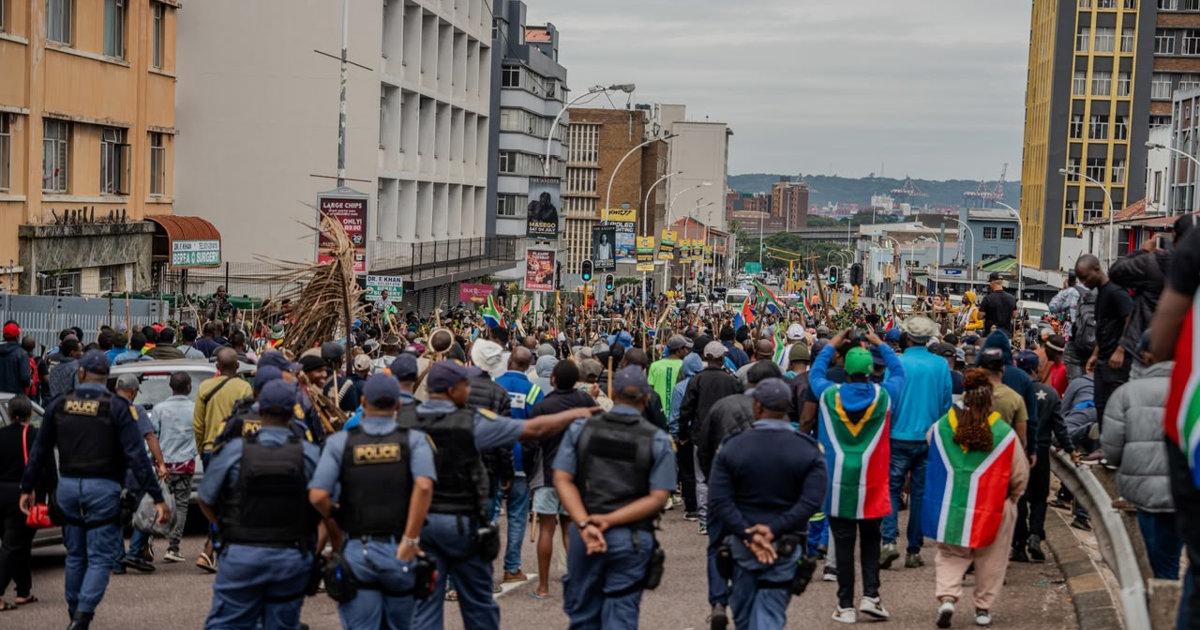
“South Africa’s Department of Home Affairs withdrew a directive concerning asylum applications on 9 October after anti-immigrant protests in Johannesburg and Durban turned violent, with vehicles torched and foreign-owned businesses looted. The developments have intensified debate about citizens’ right to protest, the protection of migrants, the implementation of constitutional rulings and the government’s responsibility to address public concerns without allowing violence or intimidation.”
South Africa’s Anti-Immigrant Protests Test the Limits of Political Activism and Constitutional Democracy
JOHANNESBURG, 9 October 2026 — South Africa is facing renewed scrutiny over political activism, immigration policy and the protection of human rights after anti-immigrant protests in Johannesburg and Durban escalated into violence, prompting the Department of Home Affairs to withdraw a directive concerning asylum applications. The events have highlighted the challenge facing the government as it attempts to address public dissatisfaction while upholding constitutional protections and maintaining public order.
The demonstrations have placed activism at the centre of a national debate about the responsibilities of political movements, the rights of citizens to express dissatisfaction and the safety of foreign nationals living and working in the country. They have also raised questions about whether government institutions are responding effectively to public concerns and communicating complicated legal decisions clearly enough to prevent misinformation.
Protests escalate in Johannesburg and Durban
On Thursday, 8 October, hundreds of protesters gathered in Durban and marched through parts of the city centre, targeting people they suspected of being immigrants. GroundUp reported that businesses were vandalised, shops were looted and vehicles were set alight. At least one person was reportedly taken to hospital after being shot, while other people sustained injuries during the unrest.
The violence was not confined to Durban. In Soweto, Johannesburg, vehicles were also torched and foreign-owned businesses were looted. Reuters reported that 14 vehicles were burned in Durban and another 10 in Soweto, illustrating the scale of the destruction associated with the demonstrations.
The incidents have intensified concerns about the direction of anti-immigration activism in South Africa. Although public demonstrations are an established feature of the country’s democratic system, the destruction of property, intimidation of individuals and attacks on businesses raise serious questions about the boundaries between lawful protest and criminal conduct.
Authorities said the situation had stabilised by Friday, 9 October. Police indicated that they would continue monitoring affected areas and pursuing those responsible for violence where evidence supported criminal charges.
Asylum policy becomes a central political issue
The immediate dispute centres on South Africa’s asylum application process and the implementation of a Constitutional Court ruling delivered on 7 July 2026.
According to Reuters, the ruling established that asylum seekers could not be prevented from accessing the asylum determination system solely because of procedural issues, including entering the country without the required documentation. The subsequent directive sought to implement that ruling by allowing asylum applications to be received.
The policy change generated pressure on refugee reception offices, where officials reportedly struggled to manage the resulting demand. Home Affairs said the directive had been introduced as an operational measure, but its implementation had overwhelmed facilities, created risks for officials and raised public-order concerns.
On Friday, the department withdrew the directive following the violence. The government also sought to clarify that access to the asylum application process did not automatically confer refugee status, permanent residence or other immigration rights.
The distinction matters because applying for asylum and being granted refugee status are separate stages of a legal process. Public debate can become distorted when these differences are misunderstood or deliberately misrepresented.
Nevertheless, withdrawing an administrative directive does not automatically resolve the underlying policy questions. Authorities must still determine how to implement court rulings, process applications efficiently and protect the rights of people who qualify to seek asylum under the law.
Activism and the right to protest
South Africa’s democratic system recognises the importance of public participation, including demonstrations, marches, pickets and organised campaigns. Activism enables communities to raise concerns, demand accountability and place issues that might otherwise receive limited attention on the political agenda.
Immigration policy, employment opportunities, crime and pressure on public services are issues that can generate strong public reactions. Residents are entitled to question government decisions and demand effective administration. However, the legitimacy of those concerns does not make violence against other people acceptable.
GroundUp reported that March and March leader Jacinta Ngobese-Zuma addressed demonstrators outside the Home Affairs refugee reception centre in Durban. She defended the right to express dissatisfaction through peaceful demonstrations, while the day’s events subsequently included reported vandalism, looting and assaults.
This distinction is essential when assessing the role of activist organisations. A movement’s stated objectives, the conduct of its members and the actions of other participants in a demonstration should be examined carefully rather than automatically treated as identical.
At the same time, political organisations have a responsibility to discourage intimidation and communicate clear expectations about lawful conduct. Organisers who advocate peaceful change can help protect participants and bystanders by coordinating with authorities, rejecting attacks and ensuring that grievances remain focused on the relevant institutions.
The challenge is to preserve space for legitimate dissent without allowing demonstrations to become opportunities for targeted violence.
The danger of blaming migrants for complex problems
Anti-immigrant protests frequently draw on concerns about employment, crime, business competition and access to public services. These issues are important to communities experiencing economic hardship, but assigning responsibility to an entire group of foreign nationals risks replacing evidence-based debate with generalisations.
Reuters reported that migrants are often blamed for unemployment, crime and pressure on public services, although social scientists have questioned the evidence supporting such broad accusations.
South Africa faces complicated economic and administrative challenges that require specific policy responses. Employment creation, effective policing, improved municipal services and reliable immigration administration cannot be achieved simply by targeting people because of their nationality.
When political campaigns portray migrants collectively as responsible for national problems, they risk obscuring the different causes of those problems. They may also expose people who have committed no offence to harassment, discrimination and violence.
This does not mean that immigration enforcement should be ignored. Governments have responsibilities to administer borders, verify documentation and enforce applicable laws fairly. The crucial question is whether enforcement is conducted through lawful institutions and consistent procedures rather than private intimidation or collective punishment.
Public confidence is more likely to improve when officials explain their decisions transparently, investigate wrongdoing consistently and provide credible information about the effects of immigration policies.
Human rights and public safety
The violence in Durban demonstrated how quickly a demonstration can threaten the safety of people who are not responsible for the dispute that prompted it.
GroundUp reported that protesters damaged businesses, attacked at least one shopkeeper and harassed journalists attempting to document events. Reporters also described being pushed, grabbed and threatened while covering the march.
Such incidents raise concerns beyond immigration policy. Journalists play an important role in documenting public events, scrutinising the conduct of authorities and ensuring that communities receive reliable information. Threatening reporters can prevent the public from understanding what happened and weaken accountability.
Shopkeepers and workers also have a legitimate interest in carrying out their activities without intimidation. Destroying a business can affect employees, customers, suppliers and families whose incomes depend on daily trade.
For foreign nationals, the immediate consequences can be particularly serious when a demonstration turns into targeted hostility. People may fear travelling to work, opening their businesses or accessing essential services.
The authorities therefore face two related responsibilities: protecting the right to peaceful assembly and intervening when there is a credible threat of violence. Police responses must be proportionate, effective and consistent with the law. Investigations should identify individual responsibility rather than relying on assumptions about an entire protest movement.
Government accountability and policy implementation
The withdrawal of the asylum directive highlights a wider question about the relationship between legal decisions, administrative capacity and public communication.
A constitutional ruling must be implemented in practice. That requires suitable staffing, functioning reception facilities, clear operating procedures and accurate explanations of what the law requires.
Where an administrative change produces unexpected pressure, departments should communicate what has gone wrong, what adjustments are being considered and how affected applicants will be treated. Otherwise, uncertainty can create opportunities for rumours and political manipulation.
The events also demonstrate why government cannot rely solely on policing to resolve disputes rooted in public frustration. Police can prevent immediate violence and investigate offences, but they cannot independently fix administrative delays, unemployment or weaknesses in public services.
Those responsibilities require coordinated action across government departments, local authorities and community organisations.
Equally, public consultation should not become a substitute for complying with court judgments. Authorities must balance operational challenges with their legal obligations, ensuring that administrative difficulties do not become a justification for denying lawful access to essential procedures.
Lessons for civil society and political movements
The current controversy presents a test for South Africa’s broader civil society sector. Community organisations, advocacy groups, trade unions and political movements can influence policy by presenting evidence, mobilising supporters and negotiating with officials.
Their influence is strongest when demands are specific, proposed solutions are practical and campaign methods respect the rights of others.
Peaceful picketing outside a government office, submitting a memorandum, organising a public meeting or pursuing legal action can direct attention towards a policy failure without putting communities at risk.
Activists should also distinguish between demanding government accountability and targeting individuals who have little control over the policy being challenged. Refugee applicants waiting for administrative decisions are not substitutes for the officials responsible for designing or implementing those decisions.
The same standard applies to political leaders. Public statements should avoid encouraging hostility, and organisations should address misinformation promptly when it threatens public safety.
Independent journalism and credible community dialogue are equally important. They help establish what occurred, identify legitimate grievances and challenge claims that cannot be substantiated.
Regional implications and the way forward
South Africa’s handling of immigration-related unrest has implications beyond its borders. Reuters reported that the increase in anti-immigrant protests has strained relations with other African countries and contributed to foreign nationals leaving South Africa.
The country has longstanding social, economic and personal connections with neighbouring states. People move across borders for employment, family relationships, education and protection. Violence against foreign nationals can therefore affect diplomatic relations, regional commerce and public perceptions of South Africa’s commitment to democratic values.
Rebuilding confidence will require more than a temporary return to calm. Authorities must investigate reported offences, protect vulnerable communities and explain how the asylum process will operate following the withdrawal of the directive.
Community leaders should encourage peaceful participation, while political parties must demonstrate that they can debate difficult policy questions without legitimising intimidation. Government departments, meanwhile, need to improve administrative capacity and provide consistent public information.
The public also has a role to play by verifying claims before sharing them, reporting threats and rejecting attempts to justify collective blame.
Conclusion
South Africa’s latest anti-immigrant protests reveal the tension between legitimate political activism, public frustration and the protection of constitutional rights. The withdrawal of the asylum directive has addressed an immediate administrative development, but it has not resolved the broader questions surrounding immigration management, community confidence and public safety.
The events in Johannesburg and Durban underline a fundamental democratic principle: citizens must be able to challenge government policy, but peaceful protest cannot be used to justify attacks on other people or their property.
The government’s next steps will be important. Effective communication, fair law enforcement, stronger administrative systems and meaningful engagement with communities could help reduce tensions and restore confidence.
Ultimately, successful activism should be judged not only by the attention it attracts, but also by whether it advances accountability and practical solutions while respecting the dignity and safety of everyone affected.



