




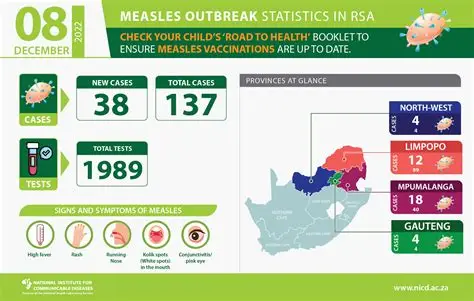
“The NICD’s week 25 situational report reveals a growing number of measles and rubella cases in South Africa, with clusters emerging in Gauteng, KwaZulu-Natal, and Limpopo. Public health experts warn that declining vaccination rates and misinformation are fueling the outbreak, demanding urgent nationwide interventions.”
South Africa is facing a renewed public health challenge as measles and rubella cases continue to rise across multiple provinces. The National Institute for Communicable Diseases (NICD) has issued its latest situational report, underscoring the urgency of strengthening vaccination campaigns and addressing misinformation that has weakened public trust in immunization programs. This outbreak comes at a time when the country is still grappling with broader healthcare system pressures, including tuberculosis, HIV, and the lingering effects of the COVID-19 pandemic.
Current Situation
According to NICD’s week 25 report, measles and rubella clusters have been identified in Gauteng, KwaZulu-Natal, and Limpopo. These provinces have reported increasing numbers of suspected and confirmed cases, with children under five years old being the most affected demographic. The outbreak is particularly concerning because measles is one of the most contagious diseases known, with a basic reproduction number (R0) estimated between 12 and 18. This means that one infected person can spread the virus to up to 18 others in a susceptible population.
Vaccination Coverage Challenges
South Africa’s measles vaccination coverage has declined in recent years, falling below the World Health Organization’s recommended threshold of 95% needed to achieve herd immunity. Several factors contribute to this decline:
- Misinformation campaigns spreading vaccine hesitancy.
- Healthcare access gaps in rural and underserved communities.
- Logistical challenges in vaccine distribution, particularly in provinces with strained health infrastructure.
The NICD has emphasized that rubella, while often milder than measles, poses severe risks to pregnant women, potentially leading to congenital rubella syndrome (CRS), which can cause birth defects such as deafness, heart disease, and developmental delays.
Public Health Response
The Department of Health, in collaboration with NICD, has launched targeted vaccination drives in affected provinces. Mobile clinics are being deployed to schools and community centers, while public awareness campaigns are being rolled out across radio, television, and social media platforms. Authorities are also working with local leaders to counter misinformation and encourage parents to vaccinate their children.
Expert Perspectives
Dr. Portia Mkhize, a pediatric infectious disease specialist, warns that “measles is not a benign childhood illness—it can lead to severe complications including pneumonia, encephalitis, and death. The resurgence of measles in South Africa is a direct consequence of declining vaccination rates.”
Public health experts argue that the outbreak is a wake-up call for policymakers to invest more heavily in routine immunization programs and strengthen surveillance systems to detect outbreaks early.
Regional and Global Context
South Africa’s outbreak is part of a broader regional trend. Neighboring countries such as Zimbabwe and Mozambique have also reported measles clusters in recent months, raising concerns about cross-border transmission. Globally, measles cases have been rising, with the World Health Organization reporting a 79% increase in cases worldwide in 2025 compared to the previous year. This underscores the interconnected nature of public health and the need for coordinated regional responses.
Risks and Challenges
- Healthcare system strain: South Africa’s health system is already burdened by TB and HIV, limiting resources available for outbreak response.
- Misinformation: Anti-vaccine narratives continue to spread online, undermining public trust.
- Equity gaps: Rural communities remain underserved, with limited access to vaccination services.
Looking Ahead
Experts recommend a multi-pronged strategy:
- Strengthening routine immunization to restore coverage above 95%.
- Expanding surveillance systems to detect outbreaks earlier.
- Community engagement to rebuild trust in vaccines.
- Regional cooperation to prevent cross-border spread.
Conclusion
The measles and rubella outbreak in South Africa is a stark reminder of the fragility of public health gains. Vaccination remains the most effective tool to prevent these diseases, but declining coverage threatens to undo decades of progress. As the NICD continues to monitor the situation, the country faces a critical test: whether it can mobilize resources, counter misinformation, and protect its most vulnerable citizens from preventable diseases.



