




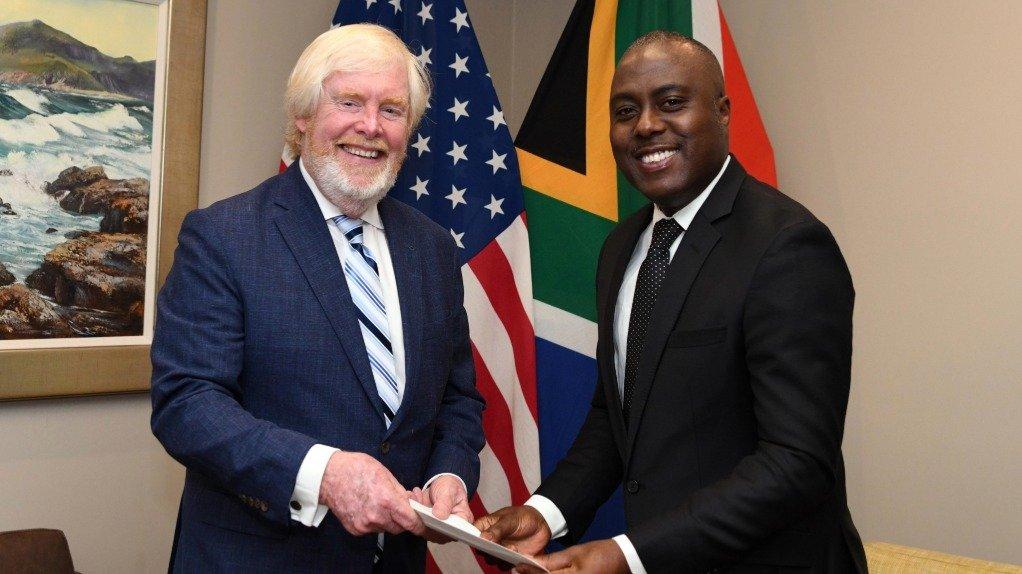
“South Africa has issued a third formal diplomatic protest against US Ambassador Leo Brent Bozell III in nine months, with International Relations and Cooperation Minister Ronald Lamola accusing the envoy of undiplomatic conduct and interference in South Africa’s domestic affairs. The dispute highlights growing tensions between Pretoria and Washington over sovereignty, transformation policies, the “white genocide” narrative, Gaza and South Africa’s independent foreign-policy position.”
South Africa’s diplomatic relationship with the United States has entered another difficult phase after Pretoria issued a third formal démarche to US Ambassador Leo Brent Bozell III in nine months, with International Relations and Cooperation Minister Ronald Lamola accusing the envoy of interfering in South Africa’s domestic politics.
The latest confrontation is significant because it comes as both governments say they still want dialogue. Pretoria is attempting to defend its sovereignty and domestic policy choices while preserving a strategically important relationship with Washington, even as disagreements over race, land reform, economic empowerment, Gaza and diplomatic conduct continue to widen.
The immediate dispute
South African officials summoned Bozell after what the government described as a pattern of undiplomatic conduct. Reuters reported that the ambassador was called in for the third time since taking up his duties, although the government initially did not publicly disclose every detail behind the latest protest. Parliament subsequently said it was concerned about the third démarche and indicated that its Portfolio Committee on International Relations and Cooperation would seek a fuller briefing from the Department of International Relations and Cooperation.
The matter became clearer through Lamola’s subsequent comments. Speaking before travelling to Egypt for the African Union Mid-Year Coordination Meeting, the minister said Pretoria was particularly unhappy with Bozell’s public comments about the so-called “white genocide” narrative and with his engagement with AfriForum. Lamola also objected to the ambassador’s reported assertion that Washington was tired of discussions with South Africa and that the time for talking had passed.
For Lamola, that position contradicts the fundamental role of diplomacy. He argued that an ambassador should use dialogue to manage disagreements rather than publicly intervene in the political affairs of the host country. His unusually sharp warning that Bozell should “get out of the kitchen” if he no longer believes in dialogue underlined Pretoria’s frustration.
A démarche is a formal diplomatic protest. It does not automatically mean that diplomatic relations are being severed, but repeated démarches can signal a serious deterioration in trust. In this case, the fact that three formal protests have been issued within nine months demonstrates how quickly bilateral tensions have accumulated.
A relationship under pressure
The current dispute cannot be understood as an isolated disagreement between one ambassador and one minister. South Africa and the United States have been experiencing a broader diplomatic crisis involving competing interpretations of domestic policy and international affairs.
Washington has repeatedly criticised aspects of South Africa’s transformation agenda, including Black Economic Empowerment and land policy. US officials and political figures have also amplified allegations that white South Africans face systematic persecution. Pretoria rejects the “white genocide” narrative and argues that South Africa’s constitutional democracy, courts and law-enforcement institutions should be allowed to address the country’s serious problems without foreign political intervention.
South African officials also see a connection between the bilateral dispute and Pretoria’s foreign-policy positions, especially its approach to Israel’s war in Gaza. South Africa has pursued legal and diplomatic action against Israel at the International Court of Justice, while the Trump administration has taken a sharply different position. Lamola has argued that Washington’s criticism of Pretoria is partly connected to South Africa’s stance on the Middle East.
The United States, however, maintains its own concerns about South African policies and wants Pretoria to respond to issues Washington considers important. This creates a difficult diplomatic balance. Both countries have legitimate interests in maintaining communication, but each is increasingly sensitive to actions that it believes cross political or diplomatic boundaries.
Parliament enters the dispute
South Africa’s Parliament has now added another layer to the controversy. Its Portfolio Committee on International Relations and Cooperation said it was concerned about the third démarche and called for greater clarity from DIRCO.
The parliamentary response matters because foreign policy is not conducted exclusively by the executive. Parliament has oversight responsibilities, and the committee’s involvement means that the government may have to explain the circumstances surrounding the ambassador’s latest summons and the broader direction of Pretoria-Washington relations.
The committee has also emphasised the importance of respecting South Africa’s sovereignty and constitutional order. That message reflects the central issue at the heart of the dispute: where legitimate diplomatic engagement ends and interference in domestic politics begins.
Washington’s position and the search for dialogue
Despite the escalating rhetoric, neither side appears to be seeking a complete diplomatic rupture. South Africa has repeatedly said it remains willing to engage the United States. Recent discussions have focused on areas of disagreement while trying to preserve broader bilateral cooperation.
The economic relationship is one reason restraint remains important. The United States is an important trading and investment partner for South Africa, while American companies operate across major sectors of the South African economy. Diplomatic instability can therefore have consequences beyond politics, affecting investor confidence, trade discussions, tourism, academic exchanges and people-to-people links.
South Africa also has strategic reasons to maintain a relationship with Washington. The United States remains a major global economic and military power, a permanent member of the UN Security Council and an important actor in African diplomacy. At the same time, Pretoria has expanded its relationships with countries across the Global South and has sought a more representative international order through platforms such as BRICS and IBSA. South Africa and India and Brazil recently reaffirmed their commitment to stronger South-South cooperation and reform of global institutions.
That broader foreign-policy strategy means South Africa is unlikely to abandon its principle of strategic autonomy. Pretoria wants to cooperate with Washington where interests overlap while retaining the freedom to disagree on issues such as Gaza, global governance, trade and domestic transformation.
The African and global context
Lamola’s latest comments also came as he travelled with President Cyril Ramaphosa to Egypt for the African Union Mid-Year Coordination Meeting. Ramaphosa is attending the meeting in his capacity as chairperson of the Southern African Development Community.
The timing is notable. While South Africa is dealing with a difficult bilateral relationship with Washington, it is simultaneously positioning itself within African regional diplomacy and continental integration. The AU meeting is expected to address issues including regional economic integration, the African Continental Free Trade Area, infrastructure, conflict prevention and the coordination of regional economic communities.
For Pretoria, this reinforces the argument that its international influence should not be defined solely by its relationship with the United States. South Africa remains active in African institutions and multilateral diplomacy and wants to be seen as a country capable of defending international law while maintaining independent foreign-policy choices.
What happens next?
The immediate challenge is preventing a diplomatic dispute from becoming a permanent breakdown in relations. Repeated public accusations can reduce room for quiet diplomacy, particularly when domestic political groups on both sides become involved.
The United States will likely continue pressing South Africa on policies that Washington considers problematic. Pretoria, meanwhile, is expected to remain firm on sovereignty, constitutional institutions and its right to pursue transformation policies.
For Bozell, the latest démarche is a serious warning. It does not mean expulsion, and Lamola has explicitly presented Pretoria’s repeated engagement as evidence that South Africa still prefers dialogue. But the minister’s comments make clear that patience has limits.
Ultimately, the dispute is about more than one ambassador. It reflects a deeper disagreement over how South Africa defines its national interests, how much influence foreign governments should have over domestic policy, and what role Pretoria should play in a changing international system.
As global politics becomes more contested, South Africa is trying to maintain a difficult position: cooperating with major powers without becoming dependent on any one of them, defending its domestic transformation agenda while attracting investment, and promoting multilateralism while navigating increasingly polarised geopolitical debates.
The third démarche therefore carries a message beyond the immediate dispute. Pretoria is signalling that diplomatic engagement remains welcome, but that engagement must operate within the boundaries of sovereignty and mutual respect. Washington, for its part, faces a choice over whether continued pressure will produce concessions or instead strengthen South Africa’s determination to pursue an independent foreign policy.
The priority now is to keep channels open while defending national sovereignty.



