




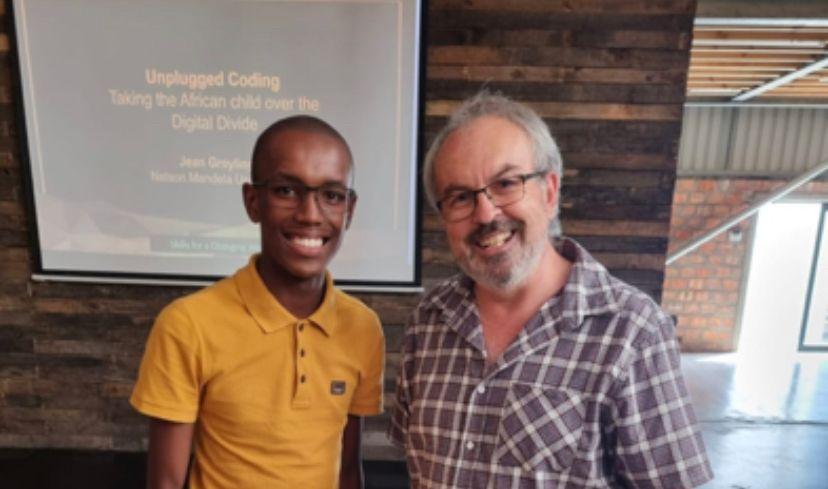
“Nelson Mandela University’s Department of Computing Sciences and the University of Pretoria’s Faculty of Education convened an international colloquium examining how schools can teach coding and robotics when computers and other technological resources are scarce. Researchers and educators from five countries shared inclusive low-tech and no-tech teaching approaches designed to develop computational thinking while addressing digital inequalities in South African classrooms.”
South African Researchers Explore Coding and Robotics Teaching Without Computers
South African academics and educators are examining how coding and robotics can be taught effectively in classrooms where computers, connectivity and other technological resources remain limited. The question was at the centre of a recent Teaching Coding: Lo-Tech, No-Tech research colloquium hosted at the University of Pretoria’s Groenkloof Campus, bringing together researchers, postgraduate students and teachers from five countries.
The event was hosted by Nelson Mandela University’s Department of Computing Sciences in collaboration with the Living Lab for Innovative Teaching (LLITUP) and the University of Pretoria’s Faculty of Education. Its focus was practical and increasingly important: as more education systems introduce Coding and Robotics into school curricula, how can schools ensure that learners are not excluded simply because they lack access to digital devices?
The colloquium explored inclusive teaching practices, teacher preparedness and approaches that allow computational thinking to be introduced even in resource-constrained environments. Participants presented 19 research papers, with contributions from South Africa, Brazil, the United States, Ireland and the United Kingdom. The international participation placed South African experiences within a wider conversation about equitable technology education.
Reframing What It Means to Teach Coding
A central idea discussed at the gathering was that coding education is not synonymous with time spent in front of a computer. While digital tools are valuable for programming practice and experimentation, learners can also develop foundational computational thinking through structured activities, familiar objects, games, collaboration and carefully designed classroom exercises.
Computational thinking generally involves breaking a problem into manageable parts, identifying patterns, designing step-by-step instructions, testing possible solutions and refining them. These habits are relevant to programming, but they also support problem-solving in mathematics, science and everyday life.
Unplugged coding approaches attempt to make these concepts accessible without requiring learners to use a computer for every activity. For example, learners may follow or create sequences of instructions, organise information, identify errors in a process or work together to solve a logic challenge.
Such activities can help teachers introduce concepts including algorithms, sequencing, debugging and decision-making before moving to digital programming environments.
The colloquium’s emphasis on low-tech and no-tech approaches does not suggest that schools should abandon computers. Rather, it highlights the importance of designing learning that can continue when devices are unavailable, shared among many learners or unreliable.
A classroom can begin building coding knowledge while teachers work within the realities of local resources.
International Research and South African Experience
The keynote address was delivered by Professor Don Passey, Emeritus Professor at Lancaster University in the United Kingdom. Passey presented findings from a report commissioned by the International Federation for Information Processing on school-based computational thinking and informatics in South Africa.
The report examined approaches that use computers as well as those that do not. According to Nelson Mandela University’s account, Passey highlighted South Africa’s work in resource-constrained schools and said its experiences with unplugged coding could offer lessons internationally.
That perspective matters because unequal access to devices remains a practical obstacle to technology education in many communities.
If a school has only a small number of computers, a conventional lesson in which every learner individually uses a device may be difficult to organise. Teachers may need to rotate groups, adapt activities or make use of offline resources.
Low-tech methods can provide a complementary route: learners can practise concepts together, discuss solutions and demonstrate understanding even when access to a computer is intermittent.
Such activities may also give teachers a way to assess comprehension before learners encounter the additional demands of software interfaces or programming syntax.
Teacher Preparation Is a Critical Part of the Equation
The colloquium also addressed the role of educators. Introducing Coding and Robotics into curricula requires more than distributing devices or adopting a new subject label.
Teachers need confidence in the concepts, suitable lesson designs and strategies for supporting learners with different levels of access and experience.
Professor Jean Greyling, head of Nelson Mandela University’s Department of Computing Sciences, said the colloquium reinforced the importance of exploring alternative approaches to coding education.
The university’s report described presentations showing how familiar activities and creative teaching methods can make coding more accessible, while helping educators develop computational thinking without relying exclusively on digital devices.
Teacher preparation is especially significant where educators are expected to teach unfamiliar material while managing large classes and limited equipment.
Professional development can help teachers translate abstract computing ideas into activities that fit their learners’ age, language, context and available resources.
It can also encourage teachers to treat mistakes as part of the learning process. Identifying and correcting an error is a core practice in programming, not simply evidence of failure.
Jeanette Viljoen, a teacher at Roedean School, said the event left her inspired, with practical ideas and a clearer understanding of approaches to Coding and Robotics education.
Her response reflects the value of research gatherings that connect academic discussion with classroom practice.
Why Access Should Not Determine Opportunity
The wider significance of the colloquium is the relationship between access and educational opportunity.
Digital devices can support powerful learning, but making computer access the sole gateway to computational thinking risks creating a divide between learners who can practise regularly and those who cannot.
A flexible teaching model can help reduce that divide.
Schools may combine unplugged exercises, shared computer sessions, offline software, demonstrations and individual projects. The mix will depend on local conditions, curriculum requirements and the age of learners.
The essential principle is that students should be able to engage with the underlying concepts even when technology is not continuously available.
Such an approach also recognises that digital inclusion has several dimensions.
Infrastructure matters, but so do teacher skills, learning materials, language, affordability and the ability to use technology meaningfully.
A computer laboratory alone cannot guarantee that learners understand algorithms or can apply computational thinking to real problems.
From Classroom Activities to Broader Digital Skills
Coding and Robotics education is often discussed in connection with future employment and the technology sector. Those pathways are important, but the skills developed through computing education are broader than preparation for a programming job.
Learners who practise breaking down problems, testing assumptions, communicating instructions and revising solutions can apply those habits in many fields.
Collaborative activities can also develop teamwork and communication, particularly when learners explain why a sequence works or help classmates identify an error.
No-tech approaches can make these skills visible.
A teacher can observe how learners plan, reason and cooperate without needing to assess only the final output produced on a screen. This can be useful in classrooms where devices are shared and where formative assessment needs to happen across groups.
At the same time, hands-on digital practice remains essential for learners to progress into actual programming and robotics.
The challenge for schools is therefore not choosing between computers and no computers, but sequencing learning so that conceptual understanding and practical digital experience reinforce one another.
A Research Conversation With Practical Implications
The meeting’s 19 research papers and international participation suggest that teaching computing under resource constraints is not a challenge confined to one school or country.
Education systems introducing new technology subjects face common concerns: curriculum design, teacher confidence, assessment, equipment availability and ensuring that all learners can participate.
South Africa’s experience may be particularly relevant to settings where schools operate with uneven resources.
Strategies that allow meaningful learning to take place without constant device access can help teachers maintain continuity and make better use of available equipment.
They may also support planning for gradual improvements in infrastructure rather than making learning dependent on resources that have not yet arrived.
The university account does not report a single prescribed model or claim that unplugged instruction can replace all computer-based learning.
Instead, it describes a research colloquium focused on exploring inclusive and practical alternatives.
That distinction is important: effective implementation will require teachers and schools to adapt approaches to their circumstances and evaluate whether learners are meeting curriculum goals.
The Way Forward
The event points to a practical agenda for schools, universities and education authorities.
Teacher development should include both technical knowledge and adaptable pedagogy. Curriculum resources should offer activities that work with different levels of equipment. Schools should be able to combine unplugged learning with meaningful access to computers as infrastructure becomes available.
Universities can contribute by testing classroom methods, documenting evidence and sharing resources with educators.
Partnerships between computing departments and education faculties can help ensure that lessons are technically sound and suitable for real classrooms.
International collaboration, as demonstrated at the colloquium, can also bring new perspectives to local challenges.
Ultimately, the question of how coding can be taught without computers challenges the assumption that technology education begins and ends with hardware.
Devices are important, but the foundations of computing are ideas: logic, instructions, patterns, problem-solving and the ability to improve a solution.
Teaching those foundations creatively can widen participation while schools continue to work towards better digital access.
Nelson Mandela University’s colloquium brought that issue into focus by placing resource-constrained classrooms at the centre of a global research conversation.
Its message is not that computers are unnecessary, but that learners’ opportunities to think computationally should not be postponed until every classroom is fully equipped.
For South Africa, the discussion highlights an important direction for computing education: combining innovation in teaching with sustained investment in digital infrastructure, teacher development and inclusive learning opportunities.
As Coding and Robotics education expands, approaches that recognise the realities of different schools could help ensure that computational thinking becomes an accessible educational foundation rather than a privilege reserved for learners with the best technology.
The event therefore represents an important contribution to the conversation about how South Africa can develop digital skills while addressing persistent inequalities in educational resources.
The broader challenge remains translating research, classroom experience and policy ambitions into practical support for educators and learners across the country.



