




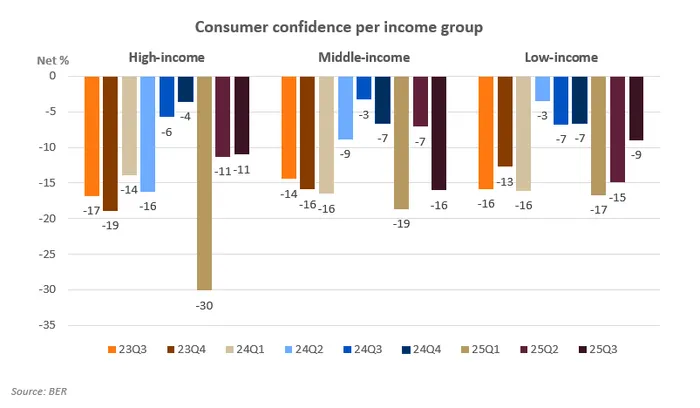
“South Africa’s economy continues to grow modestly, but higher oil prices, a weaker rand, and elevated interest rates are eroding household finances and business margins. Consumer confidence has dropped sharply, signaling that the recovery is fragile and vulnerable to external shocks.”
South Africa’s macroeconomic trajectory in mid-2026 reflects a paradox: six consecutive quarters of growth have been recorded, yet the recovery remains fragile. PwC’s mid-year economic update forecasts GDP growth of 1.2% for 2026, broadly aligned with the South African Reserve Bank’s expectations. However, the sustainability of this growth is under threat from global and domestic pressures, particularly rising fuel costs, elevated interest rates, and weakening consumer confidence.
Global Pressures
- Geopolitical tensions in the Middle East have driven oil prices higher, increasing South Africa’s fuel import bill.
- The rand has weakened, amplifying imported inflation and raising transport and energy costs.
- Inflation has risen to 4%, prompting the Reserve Bank to raise interest rates to 7% in May 2026.
These external shocks have become key drivers of South Africa’s economic trajectory, underscoring the vulnerability of an import-dependent economy.
Domestic Impact
- Households are already under strain: the FNB/BER Consumer Confidence Index fell from -7 in Q1 to -19 in Q2, its lowest since early 2025.
- Surveys show growing pressure on disposable incomes, with debt levels rising and spending power eroding.
- Businesses face squeezed margins as higher costs reduce profitability, limiting investment and job creation.
Policy Response
The Reserve Bank’s decision to raise interest rates reflects its commitment to price stability, but it also reduces relief for indebted households. PwC expects rates to remain higher for longer, prolonging financial stress. Policymakers face a difficult balancing act: maintaining credibility while supporting growth.
Structural Challenges
South Africa’s economy continues to grapple with:
- Energy reliability issues that constrain industrial output.
- Logistics bottlenecks that weaken export competitiveness.
- High unemployment, with growth insufficient to reduce structural joblessness.
These constraints mean that even modest growth fails to translate into broad-based prosperity.
Outlook for 2026
PwC’s forecast of 1.2% GDP growth highlights the limited momentum. The recovery is uneven, with sectors like finance and services showing resilience, while manufacturing and mining remain vulnerable. The outlook suggests households will face another difficult six months, with elevated costs and weak confidence.
Conclusion
South Africa’s macroeconomic story in July 2026 is one of fragile stability. Growth persists, but pressures from global oil markets, a weaker rand, and elevated interest rates are eroding the foundations of recovery. Without structural reforms to improve energy reliability, logistics, and job creation, the country risks stagnation. The challenge for policymakers is clear: sustain credibility while fostering inclusive growth in an increasingly uncertain global environment.



