




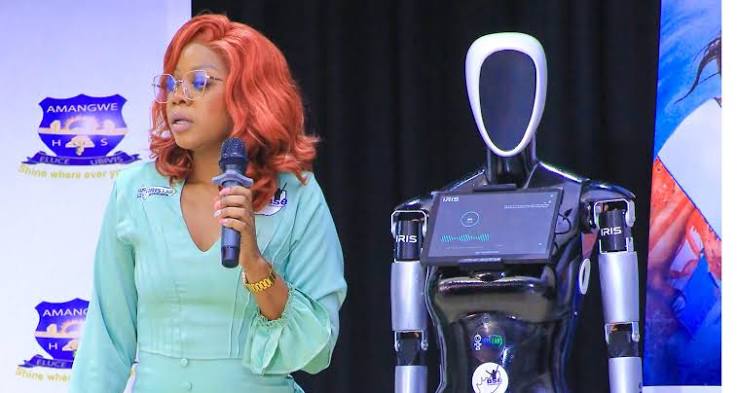
“Iris, a humanoid classroom robot capable of teaching in all 11 official languages, has been hailed as a breakthrough in South African education but remains underfunded by the government. Despite promises of widespread rollout, only five schools currently use the system, relying on donations from its creators.”
South Africa’s education system has long grappled with challenges of overcrowded classrooms, under-resourced schools, and uneven access to quality teaching. Against this backdrop, the introduction of Iris, a humanoid classroom robot designed to support teachers and enhance learning, has generated significant excitement. Yet, nearly a year after its launch, the project illustrates both the promise and the pitfalls of integrating robotics into public education.
What is Iris?
Iris is a wheeled humanoid robot, roughly the height of a primary school pupil, equipped with a chest-mounted screen, speakers, and interactive software. Teachers can prompt Iris via keyboard or voice, and the robot responds to student questions, explains concepts, assists with assessments, and logs classroom performance. Crucially, Iris works in all 11 official South African languages and is mapped to the national curriculum from grade R through matric.
Deployment Status
At present, Iris is operational in just five schools in KwaZulu-Natal: Amangwe High, Mgidla Secondary, Ekuthuthukeni Secondary, George Caltex Primary, and Intakemazolo Secondary. These installations were donated by the robot’s creator, Bonisiwe “Thandoh” Gumede, through her company BSG and Technologies Services. Each installation includes not only the robot but also 20 laptops, a smart television, cybersecurity systems, and Wi-Fi infrastructure.
Costs and Funding Challenges
The financial barrier is stark. A single Iris installation costs approximately R650,000 per school, with the robot itself priced at R250,000. Scaling this across South Africa’s 22,381 public schools would require an estimated R5.6 billion for robots alone, and R14.5 billion for full installations. Despite public endorsements, the Department of Science, Technology & Innovation (DSTI) has not allocated funding, leaving the project reliant on private investment and donations.
Government Endorsement Without Investment
Government officials, including Deputy Science Minister Nomalungelo Gina, have praised Iris as proof that South Africa can be a producer of advanced technologies rather than merely a consumer. However, this endorsement has not translated into financial support. The DSTI has explicitly stated that while it supports innovation and STEM education, it has “not considered funding” Iris.
Educational Impact
Teachers using Iris report that the robot reduces repetitive tasks such as marking and drilling, allowing them to focus on more interactive teaching. Students benefit from immediate feedback, multilingual explanations, and digital integration with laptops and smart screens. In classrooms where Iris is deployed, early results suggest improved engagement and comprehension, particularly in STEM subjects.
Broader Context: Robotics in Education
Globally, robotics in education is gaining traction, from Japan’s humanoid teaching assistants to AI-driven tutoring platforms in the United States. Iris represents South Africa’s attempt to localize this trend, offering a culturally and linguistically tailored solution. Its ability to operate in all official languages is particularly significant in a country where linguistic diversity often complicates education delivery.
Economic and Social Implications
If scaled, Iris could help bridge educational inequalities by standardizing access to quality teaching support. Moreover, the project could stimulate South Africa’s robotics industry, creating jobs in manufacturing, programming, and maintenance. Analysts argue that investment in Iris could yield long-term dividends in workforce readiness, particularly in STEM fields critical to the country’s economic competitiveness.
Challenges Ahead
- High Costs: The upfront expense remains the biggest obstacle.
- Infrastructure Needs: Many schools lack reliable electricity and internet, complicating deployment.
- Training Requirements: Teachers must be trained to integrate Iris effectively into their classrooms.
- Policy Gaps: Without government funding, scaling remains unrealistic.
Conclusion
Iris embodies both the potential and the challenges of robotics in South African education. It demonstrates how technology can enhance learning, promote STEM engagement, and position South Africa as a leader in innovation. Yet, without substantial investment, Iris risks becoming a symbol of unfulfilled promise rather than a transformative force.



