




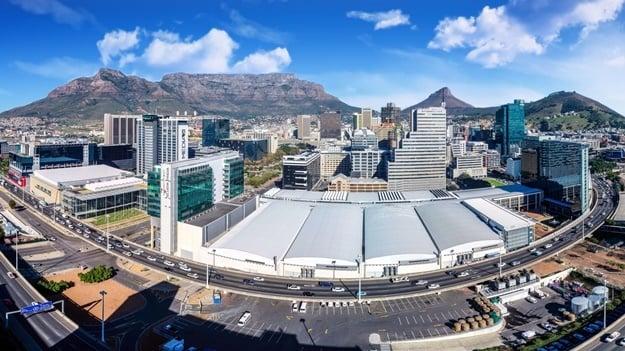
“Afrirent has doubled its investment plan for a proposed R2.5 billion tower associated with the Cape Town International Convention Centre, with construction expected to start in April 2027. The project highlights investor interest in commercial property connected to Cape Town’s business events and tourism economy, although the final impact will depend on delivery, financing, tenant demand and operating performance.”
A major investment in the Foreshore
Cape Town’s commercial property market is attracting renewed attention following the announcement that Afrirent Holdings and its co-developer, Lance Chalwin-Milton, intend to invest approximately R2.5 billion in ThirtyFour18, a proposed 35-storey mixed-use development beside the Cape Town International Convention Centre (CTICC). The project represents a substantial increase on the R1 billion to R1.3 billion investment initially indicated when Afrirent secured a long-term lease on the site from the City of Cape Town in 2024. Construction is scheduled to begin in April 2027, subject to the necessary preparations and approvals.
The development is significant because it combines commercial offices, hospitality, residential accommodation, restaurants and retail activities within one strategically positioned building. Rather than relying on a single property use, the project seeks to serve several overlapping markets, including business travellers, conference delegates, residents, corporate tenants and visitors to Cape Town’s central business district.
This approach reflects the growing importance of mixed-use developments in urban property investment. By combining different income-generating activities, developers can create destinations that remain active beyond conventional office hours. However, the eventual success of ThirtyFour18 will depend on construction delivery, leasing performance, operating costs and the strength of demand for its different components.
What the ThirtyFour18 development will offer
According to Moneyweb’s report published on 29 October 2026, ThirtyFour18 is planned to include 94 private apartments, seven penthouses and a 155-room hotel. The building will also feature four floors of commercial office space, street-level retail outlets, restaurants, a rooftop sky bar and swimming pool.
These facilities could create several commercial opportunities. The hotel is intended to serve visitors attending conferences and business events, while serviced residential accommodation could appeal to people seeking longer stays in central Cape Town. Office space may attract businesses looking for a prestigious address close to major transport connections, hotels and conference facilities.
The retail and restaurant components could also benefit from activity generated by hotel guests, office workers, residents and conference visitors. Nevertheless, each component will have its own operational requirements, tenant expectations and financial risks. The developers will need to ensure that the building’s design, service arrangements and pricing meet the needs of its intended customers.
The strategic importance of the CTICC location
The project’s proximity to the CTICC is one of its principal commercial advantages. The convention centre is an important part of Cape Town’s business tourism infrastructure, bringing together conference organisers, exhibitors, delegates, suppliers and hospitality businesses.
For corporate visitors, accommodation and working facilities close to a conference venue can reduce travel time and make attending events more convenient. A hotel with direct access to the convention centre’s surrounding business environment could therefore offer an attractive proposition to companies organising meetings, exhibitions and conferences.
The developers also plan to provide a co-working facility on the first floor, with direct access to the CTICC, and an innovation hub across the second and third floors. These spaces are intended to complement the conference economy by supporting flexible working, exhibitions and technology-related activities.
If successfully implemented, these facilities could help connect conference activity with commercial networking and business development. However, demand for the innovation hub and co-working space will need to be demonstrated through tenant commitments and practical operating arrangements.
Why the investment budget has increased
The move from an initial investment estimate of R1 billion to R1.3 billion to a proposed R2.5 billion budget is a central feature of the announcement. It represents a substantial increase in the scale of capital committed to the development.
Large urban towers require complex planning, structural engineering, building services, fire safety systems, vertical transport, security and coordination with surrounding infrastructure. In a constrained site beside a busy road and an established convention centre, construction logistics can also be challenging. PropertyWheel reports that the site presents engineering and access constraints, with construction expected to start in late April 2027, subject to necessary approvals.
The larger budget should not automatically be interpreted as evidence of higher profitability. A more expensive project must generate sufficient revenue to justify its development costs, financing expenses and ongoing maintenance obligations.
Investors will consequently need to evaluate the expected income from hotel operations, apartment sales or rentals, office leases, retail tenants and hospitality facilities. The balance between upfront sales revenue and recurring rental income will also influence the project’s financial profile.
Potential employment and economic benefits
Afrirent founder Senzo Tsabedze has indicated that the development could create approximately 2,500 jobs during construction and around 400 permanent positions once completed. These are projected employment figures rather than confirmed outcomes, but they illustrate the potential scale of the project’s economic contribution.
Construction employment could benefit contractors, engineers, architects, electricians, plumbers, suppliers and other specialists. Additional opportunities may arise for small businesses providing transport, catering, equipment, security and professional services.
Once the building becomes operational, employment could extend to hotel management, reception, housekeeping, food services, retail, property management, maintenance and office support. Restaurants and other commercial operators could also create demand for locally supplied goods and services.
The developers have stated that they deliberately appointed Cape Town-based professionals to help retain a greater share of the project’s economic benefits within the local economy. The practical impact will depend on procurement decisions, workforce recruitment and the extent to which local businesses participate throughout construction and operations.
Implications for commercial property investors
ThirtyFour18 highlights a strategy in which developers seek to capture demand from multiple property markets through a single urban destination. For commercial property investors, the project offers an opportunity to assess how hospitality, offices, retail and residential accommodation can support one another.
Office space is particularly important because its performance depends on the quality of the location, accessibility, building specifications, tenant demand and the total cost of occupation. Companies may value proximity to conference facilities, restaurants and accommodation, particularly when entertaining clients or hosting visiting employees.
Retail and food outlets may benefit from a concentrated customer base, although their performance will depend on foot traffic, affordability, competition and trading conditions. Meanwhile, hotel revenue can fluctuate with seasonal tourism, conference schedules and broader economic conditions.
A diversified building may reduce reliance on one source of income, but it also introduces greater management complexity. Hotel operations differ considerably from conventional office leasing, and residential services require different maintenance and customer support arrangements. Effective management will therefore be essential.
Cape Town’s broader property investment environment
The announcement comes amid wider investment activity in Cape Town’s central business district. BusinessDay reported on 29 October that the ThirtyFour18 project was expected to contribute to the city’s business tourism ecosystem and create opportunities for additional private-sector investment. Its coverage also cited the Cape Town Central City Improvement District’s reporting on increased investment activity and a pipeline of developments in the CBD.
Such activity may strengthen confidence in selected parts of the market, but it does not mean every property category or location will perform equally well. Developers still need to consider infrastructure capacity, construction costs, municipal services, financing conditions and the ability of businesses and households to afford the completed space.
For ThirtyFour18, the location beside a major convention centre offers a clear commercial rationale. Yet the project’s long construction timeline means market conditions could change before the tower opens. Investors should distinguish between the development’s proposed benefits and the revenue it ultimately achieves.
Risks and challenges ahead
The first challenge is delivery. Large mixed-use projects require coordination between design teams, contractors, authorities, financiers and operators. Delays can increase costs, postpone income and complicate contractual arrangements.
The second challenge is demand. The developers will need to secure suitable hotel operators, office tenants and retail businesses while establishing whether the residential units can achieve their intended sales or rental performance. The proposed rooftop dining concept may also depend on the availability of an experienced operator and sufficient demand.
Third, construction and operational costs could influence the project’s returns. Financing expenses, utilities, maintenance, staffing and building management all affect the amount of income available after costs.
Finally, the project will need to integrate successfully with the surrounding urban environment. Access, pedestrian movement, traffic management, security and reliable municipal services can all influence the experience of tenants and visitors.
Transparent progress reporting, realistic budgeting and strong operational planning will therefore be important as the project moves towards construction.
Outlook: a development to watch
Afrirent’s expanded investment plan makes ThirtyFour18 one of the notable commercial property developments to watch in Cape Town. Its proposed combination of a hotel, private residences, offices, retail outlets and conference-related facilities reflects an effort to create a commercially active destination in the Foreshore.
The projected creation of construction and permanent jobs, together with opportunities for local suppliers and service providers, gives the project significance beyond its physical structure. Its location beside the CTICC may also help connect property investment with the city’s established conference and tourism economy.
Nevertheless, the R2.5 billion commitment is a development plan, not proof of future financial returns. Construction progress, approvals, tenant demand, operating performance and final project costs will determine whether the development fulfils its commercial ambitions.
For South Africa’s commercial real estate sector, the key lesson is that major investments must combine a strong location with a viable business model. ThirtyFour18 has a clear strategic proposition; the next test will be delivering it successfully and turning that proposition into sustainable economic activity.



