




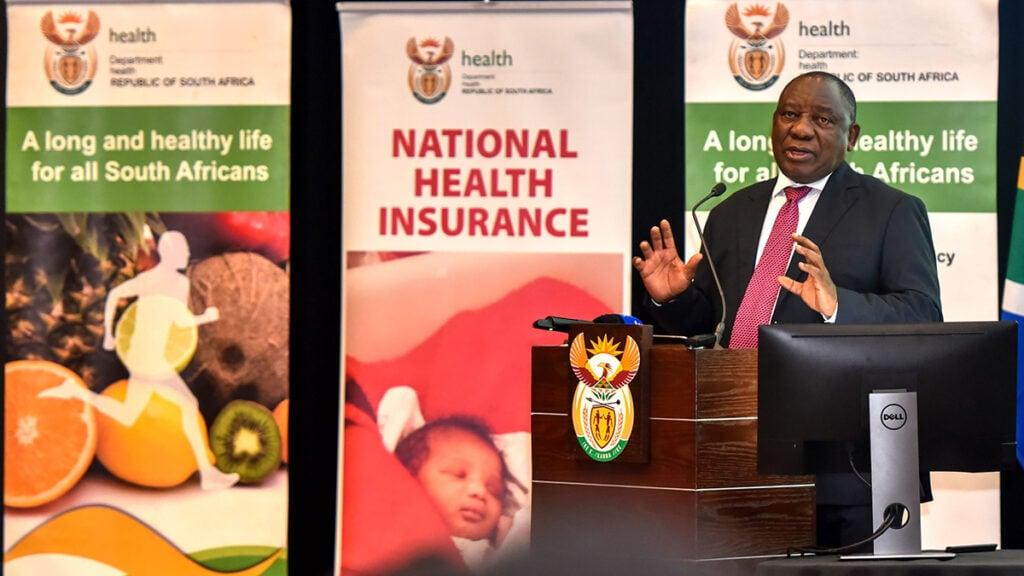
“South Africa’s healthcare policy debate has intensified following allegations that about R182 million in Department of Health communication contracts may have involved money intended for critical programmes, including HIV, tuberculosis and child nutrition, prompting parliamentary scrutiny and referrals to investigative institutions. The controversy has also raised broader questions about financial controls, transparency and governance as the government continues preparing for the proposed National Health Insurance system, despite continuing legal and operational uncertainty around its implementation.”
South Africa’s Healthcare Policy Debate Enters a New Phase
South Africa’s healthcare policy landscape is facing renewed scrutiny as questions over the management of public health resources intersect with the country’s long-running National Health Insurance debate.
At the centre of the latest controversy are reports concerning approximately R182 million in communication and marketing contracts awarded by the national Department of Health. The allegations have attracted attention from Parliament, professional organisations and investigative bodies because of claims that funds connected to important healthcare programmes may have been used for communications work. Parliament’s Portfolio Committee on Health has said it is concerned about the allegations and intends to seek further information from the Department of Health.
The issue is particularly significant because South Africa’s health system is under considerable pressure. Public hospitals and clinics continue to face challenges involving staffing, infrastructure, medicine availability, equipment, and financing. Against this background, any allegation that money intended for healthcare delivery was redirected toward other activities inevitably raises questions about whether government resources are being used according to their intended priorities.
The Department of Health has rejected the suggestion that the contracts demonstrate wrongdoing and has referred the allegations to the Special Investigating Unit (SIU), the Auditor-General and potentially the Public Protector. This means the allegations remain allegations and should not be treated as proven misconduct before the relevant investigations are completed.
Why the R182 Million Allegations Matter
The controversy is not simply about a communications budget. It touches on a much wider question: how should scarce public healthcare resources be allocated while South Africa is attempting to transform its health system?
According to Parliament, media reports alleged that funds associated with programmes such as HIV/AIDS, tuberculosis and child nutrition, as well as NHI-related initiatives, may have been diverted toward communication and marketing contracts. The parliamentary committee has stressed that it will not prejudge the outcome of investigations. Instead, it wants the Department of Health to explain the nature of the contracts, how they were approved and what safeguards were applied.
That distinction is important. Communication is itself a legitimate component of healthcare policy. Government needs to inform people about vaccinations, HIV prevention, tuberculosis treatment, medicines, health campaigns and major reforms such as NHI.
However, the central policy question is whether communications expenditure is proportionate, properly procured and transparently accounted for.
The Department of Health says independent investigations should establish the facts. Its decision to approach investigative institutions is therefore potentially important because it moves the dispute beyond competing political and media claims and toward formal examination of the underlying documentation.
NHI Adds Another Layer to the Controversy
The issue has particular significance because the National Health Insurance Act remains one of the government’s most ambitious healthcare reforms.
The NHI is intended to create a system in which healthcare resources are pooled and services are purchased more centrally, with the long-term objective of expanding access to healthcare and reducing the divide between people who rely on the public system and those who can afford private medical care.
Yet implementation has encountered substantial legal and political challenges.
In February 2026, President Cyril Ramaphosa agreed to delay proclamation of sections of the NHI Act while Constitutional Court challenges proceeded. The Presidency said the decision followed consultations with Health Minister Aaron Motsoaledi and that government would continue preparatory work to strengthen the health system.
That legal uncertainty remains relevant to healthcare policy in October because the eventual structure of South Africa’s healthcare financing and purchasing system could affect hospitals, medical schemes, healthcare professionals, insurers, patients and taxpayers.
A recent FAnews report highlighted the uncertainty facing healthcare advisers and insurers, noting that the future of medical schemes, gap cover and primary healthcare insurance remains difficult to predict while the NHI’s legal and regulatory direction is unresolved.
Governance Is Becoming as Important as Policy Design
The latest controversy demonstrates that healthcare reform cannot be judged only by the objectives written into legislation.
Even a policy designed to expand healthcare access depends on strong institutions, effective procurement, financial controls and public confidence.
If a government wants South Africans to support a major reform such as NHI, citizens need confidence that the institutions responsible for administering the programme can manage large amounts of public money transparently.
This is particularly important because an NHI system would potentially involve enormous public expenditure. The proposed system would place significant responsibilities on government institutions responsible for purchasing healthcare services and managing healthcare funding.
Consequently, allegations concerning a comparatively smaller communications budget can become politically significant because they raise questions about institutional capacity and accountability.
Daily Maverick’s analysis of the R182 million controversy similarly connected the issue to broader concerns about the risks associated with centralised purchasing and administration under NHI.
The appropriate response, however, is not to assume that alleged irregularities prove that NHI itself is unworkable. Instead, the controversy reinforces the need for strong safeguards before any large-scale healthcare purchasing system is expanded.
Parliament’s Oversight Role
Parliament’s response is therefore an important part of the story.
The Portfolio Committee on Health has indicated that it wants the Department of Health to provide a detailed briefing on the allegations, including the contracts involved and the actions being taken to establish the facts.
This is consistent with Parliament’s constitutional oversight role.
Effective healthcare policy requires more than legislation and departmental announcements. It also requires continuous monitoring of whether public money is being spent efficiently and whether programmes are achieving their intended outcomes.
The committee’s involvement could therefore help establish whether the contracts were properly authorised, whether procurement procedures were followed, what services were delivered and whether the amounts paid were reasonable.
The outcome of investigations will be especially important because there is a substantial difference between an expensive but properly procured communication programme and expenditure that breached procurement rules or improperly displaced funds intended for patient services.
Healthcare Delivery Remains the Ultimate Test
For ordinary South Africans, however, the debate ultimately comes back to healthcare delivery.
Patients want medicines to be available when they visit clinics. They want functioning hospitals, shorter queues, adequate staffing, reliable equipment and access to specialist care. Communities also expect government to respond effectively to diseases such as HIV and tuberculosis and to protect vulnerable groups, including children and pregnant women.
The Department of Health continues to update national treatment guidelines and essential medicines policies. Its official programme records, for example, show updates to primary healthcare and hospital treatment guidelines and essential medicines lists during 2026.
Such policy work demonstrates that healthcare reform involves thousands of operational decisions beyond the headline NHI debate.
The challenge is ensuring that these decisions are supported by adequate funding, competent management and measurable accountability.
What Happens Next?
The immediate focus will be on the investigations into the communications contracts and Parliament’s expected engagement with the Department of Health.
The SIU, Auditor-General and potentially the Public Protector will be expected to establish the facts surrounding the contracts. Meanwhile, parliamentary oversight could provide another avenue for questioning officials about procurement, budgeting and programme management.
At the same time, the NHI debate will continue.
Healthcare professionals, insurers, medical schemes, business organisations and civil-society groups have different views about the proposed system. Legal challenges have added another layer of uncertainty, while government maintains that preparatory work to strengthen healthcare services should continue.
The eventual direction of policy will therefore depend not only on court decisions but also on negotiations, evidence, public-sector performance and the government’s ability to demonstrate that healthcare resources are being managed responsibly.
Conclusion
South Africa’s latest healthcare policy controversy is significant because it brings together three issues that will determine the future of the country’s health system: money, governance and reform.
The allegations surrounding approximately R182 million in Department of Health communication contracts must still be investigated, and no conclusion about wrongdoing should be reached before those investigations are completed. However, Parliament’s decision to seek answers and the Department’s referral of the matter to independent investigative institutions underline the seriousness of the questions being asked.
The controversy also arrives at a critical moment for South African healthcare policy. The government continues to pursue NHI while the legislation faces legal challenges and stakeholders remain uncertain about the eventual relationship between public healthcare, NHI and private medical schemes.
Ultimately, the credibility of healthcare reform will depend on whether South Africans can see tangible improvements in healthcare delivery and trust that public funds are being managed transparently. If investigations demonstrate that the contracts were properly administered, that should be established clearly. If irregularities are found, accountability will be essential.
For now, the R182 million controversy has become an important test of South Africa’s healthcare governance — and a reminder that ambitious healthcare policy requires equally strong systems of oversight, transparency and financial accountability.



