




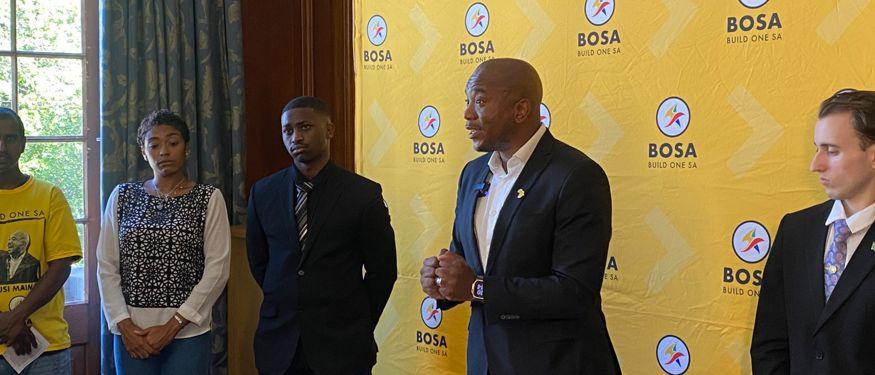
“Build One South Africa (BOSA) leader Mmusi Maimane is taking the party’s 2026 local government election manifesto to Mangaung in the Free State, where the party is contesting its first local government elections in 24 municipalities. The campaign highlights the growing political focus on municipal governance, accountability, service delivery and the ability of smaller parties to influence how South Africa’s councils will be governed after the 4 November elections.”
South Africa’s local government elections are increasingly becoming a referendum on the country’s municipal governance, with political parties stepping up campaigns aimed at convincing voters that they can provide more effective, accountable and responsive local administration. On Sunday, 4 October 2026, Build One South Africa (BOSA) is taking its campaign to Mangaung in the Free State, placing local governance and community engagement at the centre of its election message.
BOSA leader Mmusi Maimane is expected to take the party’s 2026 local government election manifesto to Mangaung, specifically Thaba Nchu, where he will participate in engagements with traditional and religious leaders before addressing residents at a public meeting. Mangaung is among the 24 municipalities BOSA is contesting in its first local government election campaign.
The development comes at a critical moment for South Africa’s municipalities. The country is less than a month away from the 4 November local government elections, when voters will choose councillors and political parties to govern municipalities across the country. The election is therefore not only about political representation but also about the practical administration of communities, including water, electricity, roads, sanitation, waste management, housing and municipal finances.
BOSA’s decision to take its manifesto directly to communities reflects the broader importance of local politics in determining how government functions at the level where citizens interact with the state most frequently. While national government determines broad policies and provincial administrations have responsibility for major areas such as education and healthcare, municipalities remain central to many everyday services.
The party’s Mangaung campaign also comes against a backdrop of widespread concern about municipal performance. Recent reporting has highlighted the financial and administrative pressures confronting local government, including irregular spending, weak accountability and deteriorating infrastructure. A TimesLIVE investigation published on 3 October described billions of rand in irregular spending and weak accountability as factors contributing to South Africa’s local government crisis.
These problems have made municipal governance one of the defining political questions ahead of the November elections. Voters are increasingly being asked to assess not simply which political party they prefer, but which leadership structures can maintain functioning municipalities and deliver services consistently.
The national government itself has acknowledged that local government requires significant reform. Cabinet approved the Revised White Paper on Local Government, 2026, following a review undertaken in response to persistent governance, institutional, financial and service-delivery challenges affecting municipalities. The document is intended to guide the transformation and renewal of the local government system.
That reform agenda provides important context for the election campaign. The challenges facing municipalities cannot be reduced to political slogans. They involve questions about financial management, administrative capacity, procurement, infrastructure maintenance, accountability and the relationship between elected councillors and municipal officials.
For residents, however, the consequences are often much more immediate. A poorly maintained road, unreliable water supply, inadequate refuse collection or malfunctioning electricity infrastructure can have a direct impact on household life and local businesses. Consequently, the performance of municipalities has become one of the clearest ways in which citizens judge whether government is working.
BOSA’s campaign in Mangaung comes as the party attempts to establish itself as a new participant in local government. Contesting 24 municipalities represents a significant test for a relatively new political organisation. Its performance will indicate whether smaller or newer parties can translate national political messages into meaningful local support.
The local election environment is becoming increasingly competitive. South Africa’s political landscape has changed substantially since the 2021 municipal elections, with coalition governments and multi-party administrations becoming increasingly important in several municipalities. Johannesburg, Tshwane and other major municipalities have experienced political instability, leadership changes and disputes over governing arrangements.
This means the 2026 elections could produce councils where no single party has an outright majority. In such circumstances, parties such as BOSA could potentially become relevant to coalition negotiations, depending on their electoral performance.
Coalition governance itself has become a major issue. Political parties are not only campaigning for votes; they are also trying to convince voters that they have the administrative capacity and political discipline required to govern in complicated multi-party environments.
The challenge is particularly significant because municipalities need stable political leadership to approve budgets, implement integrated development plans and provide oversight of administration. Political instability can make long-term planning more difficult, while disagreements between coalition partners can delay decisions.
The campaign in Mangaung therefore has implications beyond BOSA’s immediate electoral ambitions. It forms part of a wider national debate about what South Africans expect from municipal government and what qualities should define local political leadership.
The Independent Electoral Commission is preparing for the 4 November elections, while political parties continue to campaign across the country. The elections will be held on 4 November, with the day declared a public holiday to facilitate participation.
The electoral process itself has also demonstrated how complicated local government elections can be. Candidates and parties must comply with strict electoral requirements, while legal disputes in some municipalities have raised questions about ballot finalisation. Reports indicate that unresolved court cases could affect ballots in parts of the country, although the IEC has been pressing ahead with preparations.
At the same time, the public broadcaster’s ability to provide election coverage has become a governance issue in its own right. Parliament reported concerns about a funding gap that could limit SABC coverage of the local government elections, potentially affecting the public service mandate of the broadcaster.
These developments demonstrate that effective governance involves more than the functioning of municipal offices. It also depends on credible elections, public information, institutional oversight and citizens having meaningful opportunities to evaluate competing political programmes.
For BOSA, taking its manifesto to Thaba Nchu provides an opportunity to connect national political ambitions with local concerns. Engagements with traditional and religious leaders are particularly significant because these institutions remain influential within many communities. Direct engagement with residents can also give political parties an opportunity to understand concerns that may not always be visible in national political debates.
Mangaung itself represents an important political environment. The municipality includes Bloemfontein, Thaba Nchu and Botshabelo and has experienced many of the pressures affecting municipalities across South Africa. Questions around infrastructure, economic development, employment, public services and municipal administration are therefore likely to influence voters as they consider their choices.
The importance of these issues means that manifesto promises will ultimately be judged against implementation. Political parties can promise cleaner communities, better roads, improved water systems, stronger financial controls and more accountable leadership, but municipalities require competent officials, sustainable budgets and effective oversight to turn those commitments into results.
This is particularly important because local government operates under significant financial constraints. Municipalities depend on a combination of their own revenue, national transfers and other funding sources. Where revenue collection is weak or expenditure is poorly controlled, the ability to maintain infrastructure and deliver services can deteriorate.
The government’s Revised White Paper on Local Government signals recognition that the system needs structural improvement. However, policy reform alone cannot solve municipal problems. The effectiveness of the reforms will depend on political will, administrative capacity and sustained accountability.
The November election therefore gives voters an opportunity to influence the direction of municipal governance. The outcome will determine not only which parties hold council seats but also which political organisations will be responsible for negotiating coalitions, selecting mayors and overseeing municipal administrations.
BOSA’s Mangaung campaign is consequently part of a much larger contest over the future of local government in South Africa. Its first participation in municipal elections will test whether the party can build a credible local presence and persuade voters that a newer political organisation can contribute meaningfully to municipal leadership.
For South African voters, the central question is likely to extend beyond party identity. The performance of councils over the next five years will affect the quality of everyday life in communities across the country. Voters will therefore have to consider which candidates and parties offer credible plans for improving services, protecting public resources and strengthening municipal institutions.
As campaigning intensifies, governance is expected to remain at the heart of the political debate. The 4 November vote will determine who controls municipal councils, but the deeper question will be whether those councils can restore public confidence in local government.
BOSA’s appearance in Mangaung on 4 October is another indication that the campaign has entered an increasingly important phase. With only weeks remaining before South Africans cast their local government ballots, parties are competing not merely for political influence but for the opportunity to demonstrate that they can make government work closer to the people.
Ultimately, the significance of the 2026 local government elections will be measured by what happens after the votes are counted. Winning seats is only the beginning. The real test will be whether newly elected councils can provide stable leadership, manage public money responsibly, maintain infrastructure and deliver reliable services to the communities that elected them.
For BOSA and the other parties competing in November, that is the standard voters will ultimately use to judge their promises.



