




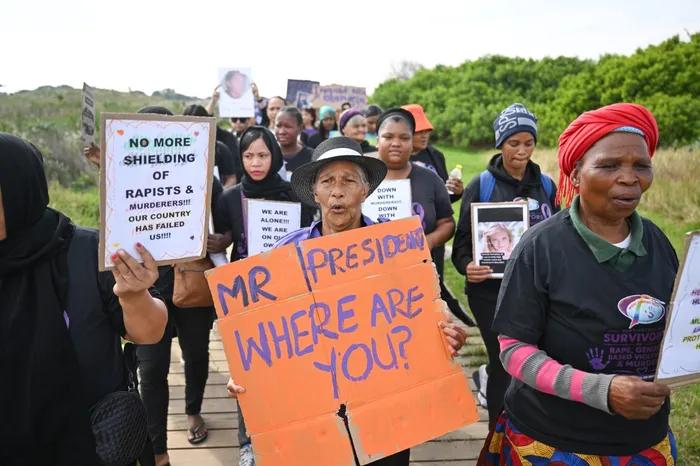
“About 100 people gathered at Princess Vlei in Cape Town on Friday evening, 9 October 2026, to protest gender-based violence and highlight the fear women and children experience in public spaces after dark. Organised by Lucinda Evans of Philisa Abafazi Bethu, the march followed reports of 12 women murdered in Ekurhuleni over two months and renewed demands for stronger government action, community involvement and accountability.”
Cape Town March Brings Gender-Based Violence Back Into National Focus
CAPE TOWN, South Africa — Activists, residents and community safety representatives gathered at Princess Vlei on Friday evening, 9 October, to call for stronger action against gender-based violence (GBV). Approximately 100 people participated in the march, which took place at sunset to highlight the dangers women and children may experience when moving through public spaces after dark.
The demonstration was organised by Lucinda Evans, director of Philisa Abafazi Bethu, a women’s safety organisation based in Steenberg. Participants included women, men, children, neighbourhood watch groups and Western Cape Social Development MEC Wendy Kaizer-Philander. Their presence reflected a shared concern about violence against women and the need for communities and public institutions to respond more effectively.
The march came amid renewed national anger following reports that 12 women had been murdered in Ekurhuleni, Gauteng, over a two-month period. Those killings prompted demonstrations and public calls for accountability across South Africa. Evans described the events as a turning point that exposed longstanding problems rather than an isolated crisis.
Why Activists Chose To March At Sunset
The timing of the Princess Vlei demonstration was central to its message. By walking along the trail as daylight faded, participants sought to illustrate how concerns about personal safety can change women’s behaviour, restrict their movements and affect their everyday choices.
Evans explained that sunset can transform how women think about travelling, walking alone and using public spaces. She argued that men often do not fully appreciate these experiences because they may not face the same calculations about personal safety.
The demonstration therefore focused on more than the immediate circumstances of individual crimes. It drew attention to a wider social problem: people should be able to access parks, roads and neighbourhood facilities without feeling that darkness automatically makes ordinary activities dangerous.
Placards carried during the march called for an end to gender-based violence and encouraged people to break their silence. By choosing a familiar community space, organisers made the issue visible in an everyday setting rather than limiting the discussion to government offices or formal political gatherings.
The event was peaceful according to the available reporting, which recorded no arrests or injuries associated with the march. Its central purpose was to raise awareness, encourage community participation and demand meaningful action.
Lucinda Evans Questions The Government’s Response
Evans used the demonstration to express frustration with the government’s handling of gender-based violence. She said the killings in Ekurhuleni had brought existing anger and anguish to the surface, arguing that communities had experienced violence for many years.
“Ekurhuleni symbolises how the government has failed over and over,” she said, according to GroundUp’s reporting.
Her criticism reflected concerns that repeated political statements have not sufficiently reassured survivors, families and community organisations. Activists have continued to demand practical improvements in prevention, victim protection, investigations and access to support services.
Evans also questioned whether government commitments would translate into tangible changes. Her remarks recalled earlier national campaigns against gender-based violence, including protests in 2019, when citizens demanded stronger action against sexual violence and femicide.
The criticism was directed at the government’s wider response, not at a specific programme operating at Princess Vlei. The march did not establish that a particular government intervention had failed locally. Instead, it amplified the broader demand that official promises be accompanied by visible results and regular public reporting.
Ekurhuleni Killings Intensify Calls For Action
The reported murders of 12 women in Ekurhuleni over two months have become a major focus of public concern. The cases prompted renewed demonstrations and brought attention to the continuing threat of violence against women.
However, the available reporting does not establish that all the deaths were connected or that they involved a single perpetrator. The circumstances and investigative status of individual cases must be assessed separately by the relevant authorities.
For activists, the significance of the reports lies partly in the public response they have generated. The killings have intensified demands for authorities to improve protection, investigate crimes effectively and provide support for people affected by violence.
The Princess Vlei march connected this national debate with local experiences of insecurity. Participants used their presence to challenge the idea that women should simply accept restrictions on their movement as an unavoidable part of everyday life.
The demonstration also reinforced the importance of sustained activism. Organisers and community members have argued that responses to gender-based violence should not depend only on moments when particularly shocking cases dominate the news. Prevention, accountability and victim support require continuing attention.
Government Promises And Public Accountability
President Cyril Ramaphosa pledged additional resources to strengthen the South African Police Service’s Family Violence, Child Protection and Sexual Offences units, according to GroundUp. He also indicated that further resources would be allocated through the Medium-Term Budget Policy Statement.
In addition, the President promised a consolidated report on government action within 90 days, followed by quarterly public progress reports.
These commitments create an opportunity for the public to examine whether promised measures are being implemented. Nevertheless, an announcement of additional resources does not itself establish that funding has been transferred, personnel recruited or investigations improved.
Progress reporting will be important because communities need clear information about what has changed, where resources are being directed and whether institutions are meeting their responsibilities.
Evans criticised the President’s address, arguing that similar promises had been made previously without delivering the changes activists expected. Her comments illustrate the gap between government assurances and public confidence.
The available report does not establish the final amount of additional funding or the specific improvements that will result. Those questions require further official information and subsequent assessments of implementation.
Men Encouraged To Challenge Harmful Behaviour
Another important message from the Princess Vlei march was the need to involve men in efforts to prevent gender-based violence. Evans said the event offered an opportunity for men to discuss how violence affects them and their communities.
She argued that men sometimes hesitate to challenge unacceptable behaviour among their peers because they fear rejection or exclusion. Organisers want to encourage men to speak up, reject abuse and support a culture in which violence is not tolerated.
This approach recognises that prevention requires action beyond formal institutions. Families, workplaces, schools, friendship groups and community organisations can all influence how people respond to abusive behaviour.
Men can contribute by challenging degrading language, refusing to excuse harassment, supporting people who disclose abuse and encouraging others to seek appropriate assistance. These actions complement, rather than replace, police investigations, court proceedings and specialist support services.
Evans described the march as the beginning of a deeper conversation. Although no specific follow-up programme was confirmed in the report, her remarks indicated an interest in sustaining engagement beyond a single demonstration.
Community Organisations And Public Institutions
The participation of neighbourhood watch groups highlighted the role local communities can play in discussing safety and supporting prevention efforts. These groups bring residents together around shared concerns, although their responsibilities differ from those of police officers and professional support organisations.
Kaizer-Philander’s attendance also brought a provincial government representative into the gathering. Her presence demonstrated official participation in the public event, but the available reporting did not include a direct statement from her or announce a new provincial initiative resulting from the march.
Organisations such as Philisa Abafazi Bethu provide an important community connection to the wider discussion. Evans’s leadership linked the protest with work focused on women’s safety and support.
Responding effectively to gender-based violence requires coordination between prevention initiatives, emergency assistance, social services and the criminal justice system. Survivors may need safe accommodation, counselling, medical attention and legal support, depending on their circumstances.
A demonstration cannot deliver all these services by itself. However, it can help bring attention to gaps, encourage people to seek assistance and maintain pressure on institutions responsible for protecting the public.
Turning Protest Into Lasting Change
The Princess Vlei march demonstrated how a relatively small community gathering can contribute to a national political conversation. Its approximately 100 participants drew attention to the relationship between public safety, gender equality and government accountability.
The next challenge is translating public concern into sustained action. That means monitoring official commitments, improving access to support services and ensuring that allegations of violence receive appropriate attention from the relevant authorities.
Community members can also support prevention by listening to survivors, rejecting victim-blaming and challenging behaviour that normalises abuse. These steps are not substitutes for institutional reform, but they can help create environments in which violence is taken seriously.
For government, credible progress will depend on implementation and transparent reporting. For activists, continued engagement can help keep the issue visible beyond individual demonstrations. For communities, the task includes making safety a shared responsibility rather than treating it solely as a private concern for women.
The Princess Vlei demonstration did not resolve South Africa’s gender-based violence crisis. It did, however, bring residents together around a clear demand: women and children should be able to move through their communities without fear, and promises made by public leaders should be followed by measurable action.
As the participants left the trail on Friday evening, their message extended beyond Cape Town. The lasting impact of the march will depend on whether the public pressure it represents contributes to stronger accountability, more effective prevention and practical improvements in the safety and support available to those affected by gender-based violence.



