




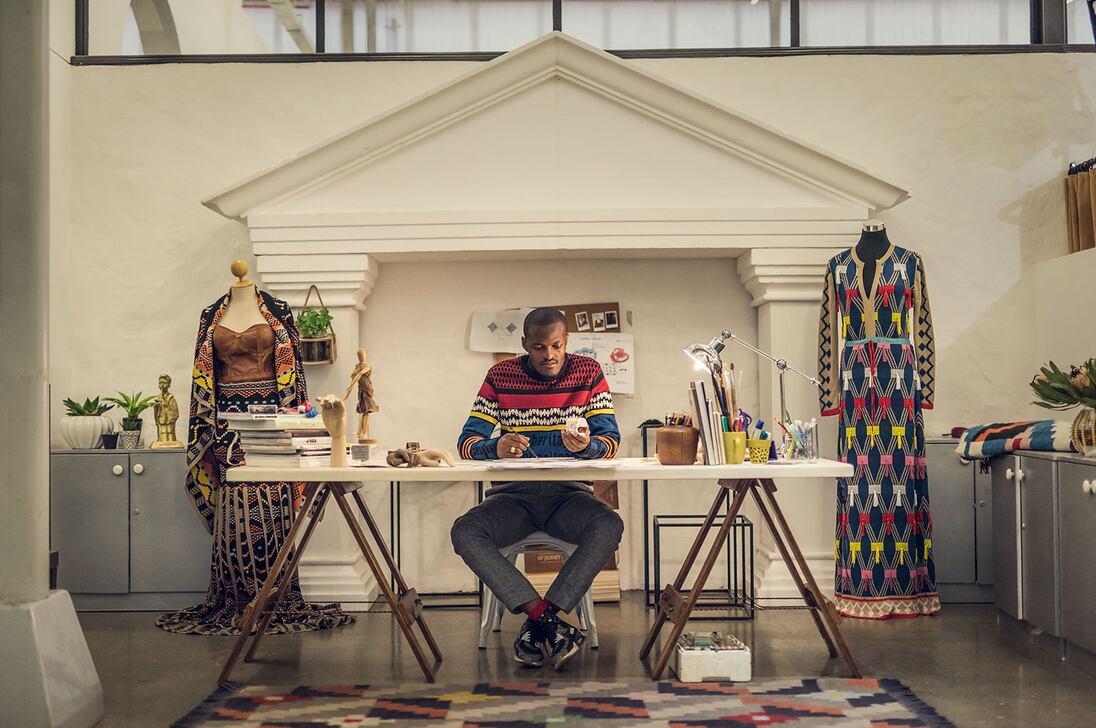
“South African creative entrepreneur Xolela Madlanga, founder of Emotives Africa, is gaining recognition for transforming African-inspired shapes, lines and patterns into distinctive designs for fashion, interiors and lifestyle products. Her selection as one of 15 participants in the 2026 Création Africa incubation and immersion programme highlights the growing opportunities for African designers to combine cultural storytelling, commercial creativity and entrepreneurship.”
Xolela Madlanga Highlights the Future of African-Inspired Fashion Design in South Africa
A creative approach to contemporary African design
South Africa’s fashion and creative industries continue to offer opportunities for designers who combine cultural inspiration, original thinking and commercial ambition. One of the emerging creative entrepreneurs contributing to this development is Xolela Madlanga, founder of Emotives Africa, a bespoke pattern-making and print business that transforms shapes, lines and imagery into expressive designs for fashion, interiors and lifestyle products.
Madlanga’s work demonstrates how design can extend beyond clothing to become a broader form of storytelling. By drawing inspiration from African visual traditions, urban environments and natural landscapes, she develops patterns that communicate identity without relying exclusively on familiar cultural symbols.
Her growing recognition has received a significant boost through her selection as one of 15 candidates from approximately 700 applicants for the 2026 Création Africa incubation and immersion programme, hosted by the French Institute of South Africa. The seven-month initiative provides an important platform for creative entrepreneurs seeking to strengthen their businesses and develop their professional capabilities.
From schoolroom experimentation to a design business
Madlanga’s creative journey began with pattern-making during her school years. Learning the technique in Grade 9 introduced her to the possibility of using shapes, lines and visual elements to express emotion and communicate ideas.
What initially developed as a personal creative interest eventually became the foundation of a professional enterprise. Through experimentation, she discovered that patterns could carry meaning, evoke feelings and tell stories without depending on written language.
This understanding shaped her approach to design. Instead of treating pattern-making as a decorative activity, she began exploring how it could become a service for businesses seeking distinctive visual identities.
Before establishing Emotives Africa in 2022, Madlanga launched a brand under her own name, Xolela M, in 2016. Her early work included creative experiments that grew from schoolroom doodles and eventually developed into opportunities to showcase her designs publicly.
The progression illustrates an important lesson for emerging fashion designers: creative interests can develop into viable businesses when talent is supported by experimentation, networking and a willingness to identify market opportunities.
Bringing African influences into contemporary fashion
A defining feature of Madlanga’s design practice is her use of varied African influences. Her sources of inspiration include Ndebele patterns, Johannesburg’s skyline and the natural landscapes surrounding her hometown of Mthatha.
These references provide a foundation for designs that connect cultural identity with contemporary visual expression. However, the objective is not simply to reproduce traditional motifs. Instead, Madlanga explores how familiar influences can be reinterpreted through abstraction, composition and original arrangements of colour and form.
This approach is particularly relevant to fashion design, where visual identity plays a major role in distinguishing one collection from another. Patterns can establish a recognisable aesthetic, communicate a brand’s values and give garments a stronger narrative.
For designers, the challenge is to balance cultural inspiration with originality. A design must be visually compelling while respecting the context from which its influences originate. Madlanga’s practice offers an example of how abstract interpretation can create space for cultural references without reducing them to predictable decorative formulas.
Collaborations expand the possibilities of pattern design
Emotives Africa’s work has appeared across garments, visual art, ceramics, cushions and other lifestyle products. This diversity demonstrates the versatility of pattern-making and its potential to connect different creative industries.
Madlanga has collaborated with Nigerian brand Alia Bare and South African businesses including House of Sebo and Tsikane African Decor. These partnerships illustrate how designers can adapt their creative methods to suit different audiences, products and cultural contexts.
In one collaboration, references provided by Alia Bare drew on the brand’s Niger roots. The resulting patterns incorporated symbols shaped around those cultural references. In another, House of Sebo sought an interpretation reminiscent of Sotho shapes without relying on overly literal cultural imagery.
These examples highlight the importance of listening to clients and understanding their identities before beginning the design process. Successful collaboration requires more than technical skill: designers must translate a brief into a visual language that feels authentic to the business commissioning the work.
For fashion labels, bespoke patterns can support seasonal collections, signature garments and distinctive brand recognition. For interior designers, the same skills can inform textiles, decorative objects and furnishings. Such flexibility creates opportunities for creative businesses to serve several markets rather than relying on one product category.
Why design matters to South Africa’s fashion industry
South Africa has a diverse creative landscape shaped by different communities, histories, artistic practices and contemporary lifestyles. Fashion designers can draw on this diversity to develop products that are locally meaningful while remaining relevant to international consumers.
However, cultural inspiration alone does not guarantee commercial success. Designers must also consider manufacturing, product quality, pricing, marketing, customer expectations and distribution.
Pattern-making businesses can contribute to this wider ecosystem by supplying original artwork and visual concepts to clothing brands and other creative enterprises. These partnerships allow designers to specialise in their strengths while helping fashion businesses develop differentiated products.
For emerging labels, distinctive prints can become an important part of their market positioning. Rather than competing only through price or familiar silhouettes, brands can offer customers a recognisable visual identity supported by a clear creative story.
Nevertheless, businesses must ensure that cultural references are used responsibly. Designers should understand the meanings of the imagery they incorporate, acknowledge collaborators where appropriate and establish clear agreements concerning ownership and commercial use.
Madlanga’s work shows how cultural influences can serve as starting points for thoughtful design rather than as shortcuts to an easily marketable African aesthetic.
Turning creativity into sustainable entrepreneurship
Recognition through the Création Africa programme is significant because creative businesses require more than artistic ability to grow. Entrepreneurs must learn to manage budgets, price services, negotiate contracts, develop relationships with clients and plan for consistent revenue.
Madlanga has described the programme as valuable for helping creatives become stronger businesspeople as well as better creators. Her perspective highlights a recurring challenge across fashion and design: talented practitioners may have compelling ideas but lack access to the business knowledge and professional networks required to scale them.
Structured incubation can help address this gap by creating opportunities for mentorship, professional development and exposure to potential partners. Such support can also encourage entrepreneurs to assess their products more strategically, identify appropriate markets and develop realistic growth plans.
For a bespoke design studio, commercial sustainability may depend on balancing commissioned projects with original collections. Client work can provide revenue and industry relationships, while self-directed products allow a designer to explore personal themes and build an independent brand identity.
Madlanga’s limited-edition scarf collection, I Am, created in collaboration with Fabric Bank in 2024, comprised 12 patterned scarves honouring 12 women who shaped her life. The project demonstrates how personal storytelling can be translated into a tangible product with both aesthetic and emotional significance. Emotives Africa was also a finalist in the 2026 Fashionomics Africa Accelerator Program hosted by Co-Creation Hub.
Opportunities for emerging designers
Madlanga’s progress offers practical lessons for South African designers beginning their careers. First, creative development often starts with experimentation. Sketching, observing everyday surroundings and studying different visual traditions can help establish a distinctive approach.
Second, collaboration can open doors to new audiences. Working with fashion labels, furniture businesses and other creative professionals exposes designers to different production methods and customer requirements.
Third, a strong portfolio is essential. Designers should document their work, explain the thinking behind their choices and demonstrate how their skills can solve practical problems for clients.
Finally, entrepreneurship requires a willingness to keep learning. Designers need to understand the costs of producing work, the value of their intellectual property and the importance of building lasting professional relationships.
These principles are relevant beyond pattern-making. They apply to textile development, garment construction, accessories, footwear, jewellery and other areas where creative identity meets commercial opportunity.
Madlanga has expressed an ambition to collaborate with more South African creatives, particularly fashion designers, interior designers and footwear brands. Such partnerships could help bring her designs into additional product categories and introduce her work to new customers.
The importance of cultural authenticity
As African-inspired fashion attracts attention in different markets, designers face the responsibility of presenting cultural influences with care. Authenticity is not simply a matter of using traditional patterns or describing a collection as African. It requires an understanding of context, meaningful creative decisions and respect for the people and traditions that inform the work.
Abstract interpretation can provide one way to engage with cultural references while avoiding repetitive visual clichés. However, abstraction must still be supported by research, collaboration and sensitivity to cultural meaning.
For businesses commissioning designs, clear communication is equally important. Clients should explain their objectives, provide relevant cultural context and agree on how finished artwork will be used. Designers, in turn, should establish appropriate terms for fees, attribution, licensing and future adaptations.
These practices help build trust and create opportunities for longer-term collaboration. They also reinforce the value of designers as creative partners rather than treating original artwork as an interchangeable decoration.
Looking ahead for African fashion design
Madlanga’s story reflects a broader opportunity for South Africa’s fashion industry to build commercially sustainable businesses around original design, local knowledge and international collaboration.
The sector’s future will depend partly on whether emerging creatives can access the resources needed to turn promising concepts into products that customers value. Incubation programmes, industry partnerships and stronger connections between designers and manufacturers can contribute to that process.
Equally important is the need to build local demand. South African consumers, retailers and fashion brands can support creative businesses by commissioning original work, investing in locally developed products and recognising the skill involved in producing distinctive designs.
International opportunities can expand a designer’s reach, but long-term resilience also requires a dependable customer base and a business model capable of supporting continued experimentation.
For Emotives Africa, the combination of pattern-making, cultural storytelling and cross-industry collaboration provides a foundation for further development. The next stage will depend on how the business converts recognition into lasting relationships, new commissions and commercially successful collections.
Ultimately, Madlanga’s journey demonstrates that fashion design is not limited to the construction of garments. It can begin with a line, a shape or a personal memory and grow into a business that connects artists, brands and consumers.
As South African creatives continue to explore the relationship between heritage and contemporary expression, designers such as Madlanga are helping demonstrate how original visual ideas can contribute to a more diverse and innovative creative economy.



