




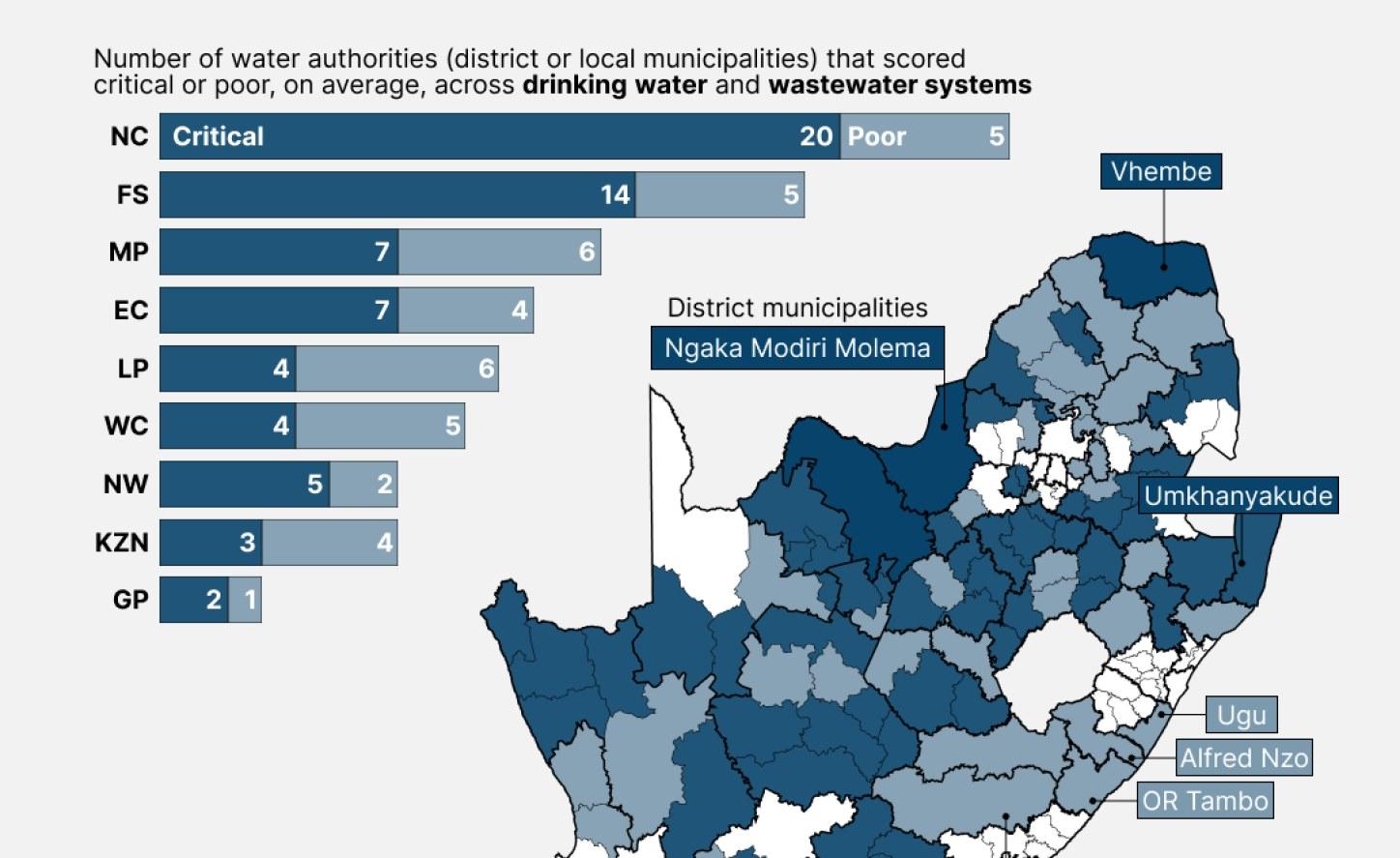
“South Africa’s parliamentary committee responsible for cooperative governance has questioned whether national government support is producing measurable improvements in struggling municipalities, despite the Department of Cooperative Governance reporting that it achieved 86% of its annual performance targets in the 2025/26 financial year. Concerns include inadequate water and sanitation services, weak municipal accountability, under-spending on infrastructure grants and unresolved audit findings, prompting calls for clearer performance measures and stronger coordination between government departments.”
South Africa’s Municipal Governance Under Scrutiny as Parliament Demands Evidence of Better Service Delivery
South Africa’s local government challenges have come under renewed parliamentary scrutiny after the Portfolio Committee on Cooperative Governance and Traditional Affairs questioned whether national government support is delivering meaningful improvements in struggling municipalities. The committee’s concerns, raised during a briefing on 8 October 2026, highlight persistent difficulties involving water and sanitation, municipal infrastructure spending, financial accountability and coordination between government institutions.
The parliamentary engagement involved the Department of Cooperative Governance (DCoG), the Municipal Infrastructure Support Agent (MISA) and the Department of Traditional Affairs. Representatives presented their annual reports for the 2025/26 financial year, providing lawmakers with an opportunity to examine reported performance, outstanding weaknesses and the effectiveness of programmes intended to strengthen local government.
The discussion raises a central governance question: how should government measure success when administrative performance targets are achieved but residents continue to experience inadequate basic services?
Parliamentary committee questions government performance
The committee noted that the Department of Cooperative Governance achieved 86% of its annual performance targets and received an unqualified audit opinion with findings. Although these results indicate that the department met many of its planned objectives, committee members questioned whether the reported achievements adequately reflect conditions in municipalities.
Committee chairperson Dr Zweli Mkhize challenged the department to explain how its interventions translate into tangible improvements for communities. His concerns focused on whether the department’s performance indicators measure the outcomes that municipal support programmes are intended to achieve.
This distinction is important in public administration. A department can complete planned activities, conduct assessments and provide technical assistance without necessarily resolving the problems affecting residents. Consequently, performance reporting needs to establish not only whether activities occurred but also whether they improved service delivery.
The committee indicated that it would return to Programme 2, which covers local government operations and support, to examine how success should be evaluated and when interventions can reasonably be considered effective.
The department’s reported performance therefore became a starting point for a broader discussion about accountability, implementation and the relationship between government expenditure and public benefit.
Municipal infrastructure spending remains a concern
One of the principal issues raised during the briefing was the spending of the Municipal Infrastructure Grant (MIG), a funding mechanism intended to help municipalities provide and improve essential infrastructure.
The department had set a target that 80% of municipalities receiving the grant should spend at least 60% of their allocations by 31 March 2026. However, only 70.9% of municipalities reached that threshold, meaning the department fell short of its performance target.
Officials identified several contributing factors, including procurement delays, litigation involving projects and poor contractor performance. These challenges can slow infrastructure development, delay the completion of planned works and complicate efforts to deliver services to communities.
Nevertheless, the figures also raise questions about project preparation, contract management and the ability of municipal administrations to convert available funding into completed infrastructure.
Underspending does not automatically establish misconduct or prove that every delayed project could have proceeded as planned. However, it does require government institutions to identify the causes, establish corrective measures and explain how they intend to improve implementation.
For residents facing unreliable water supplies, inadequate sanitation or deteriorating infrastructure, the practical concern is whether allocated public funds are producing the services they were intended to finance.
Parliament’s scrutiny places responsibility on the relevant institutions to demonstrate how financial resources, technical assistance and administrative reforms contribute to measurable improvements.
Audit findings and accountability gaps
The committee also questioned why the department failed to meet its target for supporting six priority municipalities in implementing audit action plans.
According to the parliamentary briefing, the department explained that the identified municipalities had not sufficiently taken up the assistance offered. Committee members subsequently asked what action had followed and how municipal officials would be held accountable for unresolved audit findings.
The issue illustrates a recurring challenge in intergovernmental administration: national departments may provide support, but implementation ultimately depends on the capacity and cooperation of the institutions receiving that assistance.
Technical advice alone cannot guarantee better financial controls or stronger administration. Municipalities also need officials who implement corrective measures, management systems that track progress and appropriate consequences where responsibilities are repeatedly neglected.
At the same time, accountability requires a clear distinction between municipal administrations that lack adequate technical capacity and those that fail to act on available assistance. Effective oversight should establish what support was offered, whether it was appropriate, what obstacles remained and which officials were responsible for addressing them.
The committee’s questions suggest that future assessments should go beyond recording whether support was provided. They should establish whether corrective actions were implemented and whether audit weaknesses were resolved.
Stronger follow-up could help government identify recurring administrative problems earlier and determine whether additional intervention, revised management arrangements or other lawful measures are necessary.
Water and sanitation remain central governance challenges
Water shortages, sanitation failures, ageing infrastructure and inadequate facilities in informal settlements featured prominently in the parliamentary discussion.
These challenges directly affect household wellbeing, public health and economic activity. When water systems fail or sewage infrastructure becomes unreliable, residents can face disruptions that extend beyond inconvenience, affecting schools, businesses and other community institutions.
The problems also demonstrate why municipal governance cannot be assessed exclusively through financial statements or departmental performance reports. Residents experience government performance through the availability, reliability and quality of essential services.
Infrastructure problems may have several causes, including insufficient maintenance, ageing equipment, project delays and weaknesses in operational management. Identifying the precise cause in each municipality is therefore essential before selecting an appropriate remedy.
National government support can contribute technical expertise, funding oversight and institutional guidance. However, sustainable improvements also require municipalities to maintain assets, manage contractors effectively and monitor infrastructure after construction has been completed.
The parliamentary discussion places these practical outcomes at the centre of the accountability debate. A municipality’s progress should be assessed against evidence that services have improved, not simply against the number of interventions undertaken.
For communities experiencing persistent shortages, transparent reporting about repairs, construction schedules and maintenance plans would also help residents understand what action government is taking and what remains outstanding.
Coordination between government departments
Another important issue emerged when Director-General Mbulelo Tshangana acknowledged that national departments did not coordinate their support to municipalities sufficiently well.
Municipal problems often require several institutions to work together. Infrastructure projects may involve funding decisions, technical assessments, procurement, environmental considerations and operational responsibilities. When these processes are fragmented, delays and duplicated efforts can undermine implementation.
The committee consequently raised questions about accountability across the different spheres of government and whether earlier interventions could prevent municipal difficulties from escalating.
South Africa’s constitutional framework distributes responsibilities among national, provincial and local government. Effective cooperative governance therefore depends on institutions understanding their respective obligations and coordinating their actions when service-delivery failures cross administrative boundaries.
Better coordination could include shared intervention plans, clearly assigned responsibilities, common reporting deadlines and regular reviews of projects that are experiencing delays.
It would also require government departments to identify warning signs before problems become severe. Where a municipality repeatedly fails to spend infrastructure funding or resolve audit findings, early intervention may provide an opportunity to address weaknesses before they affect more services.
The committee also discussed the possibility of National Treasury withholding transfers under section 216 of the Constitution. This raised a further question about the relationship between enforcing financial discipline and protecting residents who depend on municipal services.
Any approach must take account of the applicable legal requirements, the reasons for non-compliance and the consequences for affected communities. Financial oversight is important, but its implementation should be carefully considered alongside the objective of maintaining essential services.
Questions about technical assistance
The briefing also examined the performance of the Municipal Infrastructure Support Agent, which provides technical support to municipalities.
MISA reported that it supported 55 municipalities receiving Municipal Infrastructure Grants with basic-service infrastructure during the 2025/26 financial year. Its work includes monitoring grant performance alongside the Department of Cooperative Governance and National Treasury.
However, committee members questioned whether this assistance was improving municipalities’ capacity to spend their allocations and complete projects.
One member referred to MISA’s annual report when raising concerns about continued low grant spending in 39 municipalities despite technical support. The member requested details identifying the municipalities, outlining repeated assistance and demonstrating whether expenditure and project completion had improved.
MISA undertook to provide the requested information.
That information could help clarify whether technical interventions are producing sustained results. For example, assessments could examine whether supported municipalities complete projects more consistently, improve procurement procedures or reduce repeated delays.
Such evidence would also help distinguish between problems that technical support can resolve and those requiring different interventions, including stronger financial management or changes in project oversight.
The effectiveness of a support agency should ultimately be judged against its mandate and the outcomes it can reasonably influence. Transparent evidence can help lawmakers decide whether existing programmes should be maintained, strengthened or redesigned.
Disaster management and community protection
The committee also raised concerns about delays in revising the disaster management system and the assistance available to households affected by fires or floods.
Disaster preparedness is an important part of local governance because emergencies can quickly expose weaknesses in infrastructure, coordination and public administration. Municipalities need workable arrangements for responding to incidents, assessing damage and connecting affected households with assistance.
The department said an institutional model had been agreed with the Department of Defence, but financing questions raised by National Treasury still needed to be resolved before the proposal could be submitted to Cabinet.
This illustrates how interdepartmental planning can depend on decisions beyond the control of a single institution. It also reinforces the need for clear timelines, assigned responsibilities and transparent communication about outstanding decisions.
For communities vulnerable to flooding or other emergencies, preparedness requires more than a policy framework. It depends on functioning response systems, reliable communication and coordination among institutions responsible for public safety and recovery.
The committee’s scrutiny therefore extends beyond routine administration to the ability of government to protect communities when unexpected events place additional pressure on public services.
What happens next for municipal governance?
The parliamentary engagement highlights the need to connect government performance reporting with measurable results for residents.
The immediate questions include how the Department of Cooperative Governance will address missed infrastructure-spending targets, what will happen in municipalities that have not implemented audit action plans, and whether technical assistance is producing improvements in project completion.
Further scrutiny of Programme 2 and the information requested from MISA could help lawmakers assess the effectiveness of existing interventions. However, the parliamentary statement does not establish that these problems have already been resolved or specify a final timetable for all corrective measures.
For residents, the most meaningful indicators will be practical changes: more reliable water supplies, functioning sanitation systems, completed infrastructure projects and stronger financial controls.
For government, the challenge is to make performance reporting sufficiently transparent to reveal both progress and persistent weaknesses. That requires accurate data, clear responsibilities and follow-up when institutions fail to meet agreed objectives.
The October 8 briefing demonstrates that achieving departmental targets is not necessarily the same as solving municipal problems. The committee’s questions place renewed emphasis on whether public resources and government interventions are delivering their intended benefits.
Ultimately, strengthening local government will require cooperation between national departments, provincial authorities and municipal administrations, alongside consistent oversight and evidence-based decision-making. Parliament’s continuing examination of these issues provides a mechanism for demanding explanations and monitoring performance.
The central governance test remains whether support programmes can translate administrative activity into dependable services for communities. Until that connection is demonstrated through credible results, municipal performance figures will remain only one part of the broader picture of local government effectiveness.



