




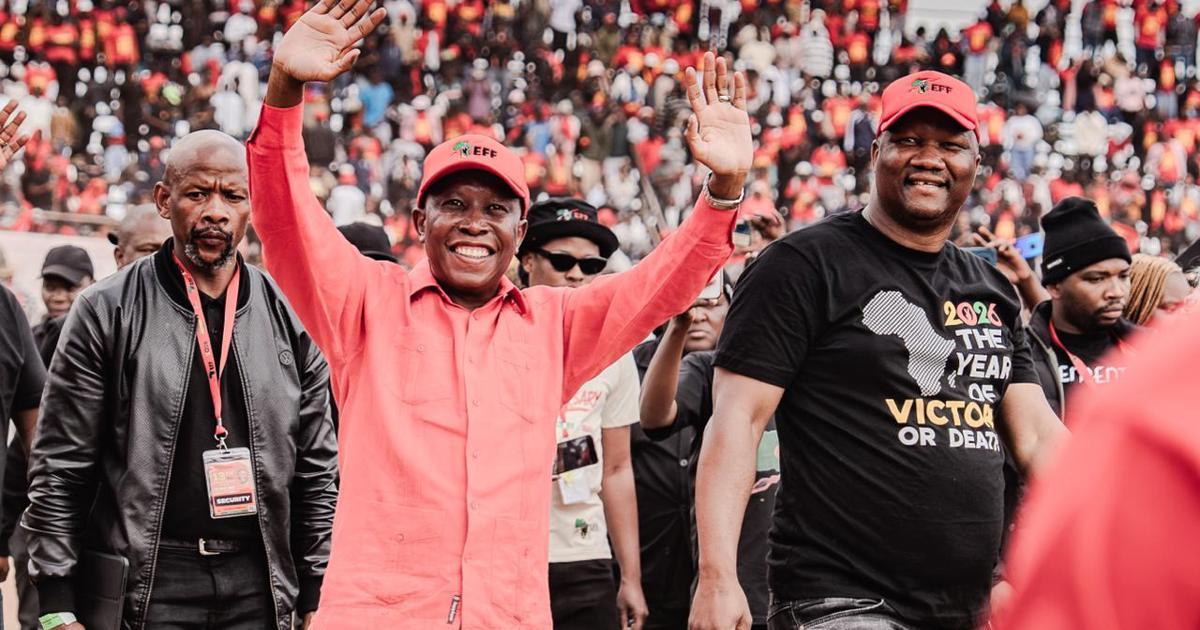
“The Economic Freedom Fighters (EFF) says it remains confident about its prospects in South Africa’s local government elections on 4 November 2026, despite the departure of prominent former leaders and competition from rival parties. Treasurer-general Omphile Maotwe claims the party has strengthened its membership and campaign structures, although its actual electoral performance will depend on voter support, local concerns and the results at the ballot box.”
EFF Seeks Electoral Recovery Despite Leadership Departures and Fierce Political Competition
South Africa’s approaching local government elections are placing renewed pressure on political parties to demonstrate their organisational strength, persuade voters and explain how they intend to improve municipal services. Among the parties facing close scrutiny is the Economic Freedom Fighters (EFF), which is seeking to reassure supporters that the departure of several prominent leaders has not undermined its political influence.
In comments reported by the Mail & Guardian on 9 October 2026, EFF treasurer-general Omphile Maotwe maintained that the party had expanded its membership and remained confident about its prospects ahead of the 4 November local government elections. Her remarks come as parties compete for support in municipalities where residents are concerned about service delivery, infrastructure, employment opportunities and the performance of local administrations.
The EFF’s claims will be tested when voters choose their municipal representatives. While campaign attendance, membership figures and internal assessments can provide indications of political activity, they do not automatically translate into votes. The election will therefore offer an important measure of whether the party can recover ground lost in previous contests and maintain its relevance in a crowded political environment.
Leadership Departures Create a Challenge for the EFF
One of the central issues confronting the EFF is the departure of senior figures following the 2024 national and provincial elections. Among those who left were former deputy president Floyd Shivambu and former party chairperson Dali Mpofu, who joined the uMkhonto weSizwe Party (MK Party), led by former president Jacob Zuma. Their departures contributed to questions about the EFF’s leadership cohesion and its ability to retain supporters.
The EFF’s electoral position had already weakened in the 2024 general election. According to the Mail & Guardian report, its share of the vote declined from approximately 14% to 9%. That fall raised questions about the party’s appeal, its competition with other political movements and the reasons some voters chose alternatives.
For a party built around a distinctive political identity, prominent departures can have consequences beyond the loss of individual officeholders. Former leaders may take political experience, established relationships and knowledge of party structures into competing organisations. They may also attract voters who previously supported the party they have left.
However, leadership departures do not necessarily determine an organisation’s future. Parties can recruit new members, strengthen local branches, refresh their leadership and adjust their campaigning strategies. The EFF appears to be relying on precisely this argument as it attempts to demonstrate that its structures remain active.
Maotwe has dismissed the suggestion that the former leaders’ exits will prevent the EFF from competing effectively. Her position is that the organisation remains sufficiently structured and politically capable to pursue its electoral objectives.
Nevertheless, voters will ultimately judge the party on more than statements from its leadership. Its ability to mobilise supporters, present credible candidates and respond to local problems will be important in determining whether its confidence is justified.
Membership Growth and Campaign Mobilisation
A major part of the EFF’s argument concerns membership. Maotwe told the Mail & Guardian that the party’s membership had grown since the departures and argued that its organisational position remained strong. She also referred to changes in branch membership requirements, indicating that the party had raised the threshold for a branch to be considered in good standing.
Such measures can be relevant to political organisation because local branches often connect national leadership with communities. They help parties identify local concerns, recruit volunteers, communicate campaign messages and coordinate activities during election periods.
Yet membership claims need to be interpreted carefully. A larger membership register does not, on its own, establish that more people will vote for a party. Members may differ in their level of participation, while registered supporters may not all turn out on election day. Similarly, well-attended political events can demonstrate enthusiasm without reliably predicting results across an entire municipality.
Maotwe pointed to the EFF’s campaign launches in Gauteng, including activities in Tshwane, Johannesburg and Ekurhuleni. She described these gatherings as evidence that the organisation remained capable of mobilising supporters and preparing for the election.
These activities matter because Gauteng contains major urban centres with complex political and service-delivery challenges. The EFF’s performance in these municipalities will help indicate whether it can turn organisational activity into meaningful electoral support.
However, an assessment of campaign strength requires evidence beyond rally attendance. Relevant indicators include verified membership figures, ward-level organisation, candidate credibility, the consistency of local campaigning and the party’s ability to reach residents who do not regularly attend political events.
The coming election will provide a clearer picture of whether the EFF’s claimed organisational growth translates into stronger support.
Competition From the MK Party and Other Political Rivals
The EFF is operating in a political environment in which several parties are competing for voters who are dissatisfied with existing political arrangements. The MK Party is particularly relevant because it attracted former EFF leaders and has become part of the competition for support, including in provinces where the EFF previously had a stronger presence.
Maotwe attributed some of the EFF’s electoral losses in Gauteng and KwaZulu-Natal in 2024 to the influence of the MK Party. She nevertheless argued that the EFF now understood the competitive challenge and was better positioned to respond.
That assessment reflects the importance of understanding why voters change their political preferences. Some may prioritise leadership, while others focus on economic policy, municipal performance, identity or dissatisfaction with established parties. Different communities can also respond differently to the same national political message.
Consequently, the EFF cannot assume that voters who previously supported it will automatically return. It must demonstrate why its policies and candidates offer a compelling choice compared with those of its competitors.
The local elections will be particularly significant because municipal politics often differs from national politics. Residents may evaluate a party according to whether refuse is collected, roads are maintained, water is available, electricity infrastructure works and municipal finances are managed responsibly.
A party may enjoy a recognisable national profile but still face difficulties in individual wards where residents are dissatisfied with its local representatives. Conversely, a party can improve its municipal performance by recruiting credible candidates and addressing community concerns directly.
For the EFF, competing effectively will require more than explaining its leadership history. It will need to communicate a practical programme for municipal government and demonstrate how its proposals would improve everyday life.
Immigration Policy Remains a Campaign Issue
Another issue highlighted in Maotwe’s comments is the EFF’s position on immigration. The party has advocated for the documentation of undocumented foreign nationals, arguing that authorities should know who is residing in the country and be able to enforce the law. It also promotes a broader vision of African unity and has criticised political messaging that portrays foreign nationals as a collective threat.
Immigration is politically sensitive in South Africa, where concerns about jobs, crime, public services and economic insecurity can shape public debate. Parties must therefore explain their positions carefully and distinguish legitimate questions about immigration administration from generalisations about people based on nationality or appearance.
Maotwe argued that the EFF’s position had been misrepresented by political opponents and sections of the establishment. She maintained that the party’s message remained consistent, despite criticism of its approach.
The electoral significance of this issue remains uncertain. Some voters may support the party’s emphasis on African solidarity, while others may prioritise stricter immigration enforcement or believe the EFF has not sufficiently addressed their concerns.
For the party, the challenge is to explain how its national principles translate into practical municipal responsibilities. Municipalities do not independently control every aspect of immigration policy, which is primarily a national government responsibility. However, local authorities influence aspects of urban management, service provision, trading regulation and community relations.
A convincing campaign will need to distinguish between the responsibilities of municipalities and those of national departments. It should also explain how local governments can respond to residents’ concerns without encouraging discrimination or undermining the rights of individuals.
Municipal Services Could Shape Voter Decisions
Although leadership disputes and immigration policy attract national attention, the performance of local government is likely to remain central to the election.
Municipal councils influence the delivery and management of essential services, including water, sanitation, waste removal, local roads and electricity distribution where applicable. They also play a role in spatial planning, local economic development and the administration of municipal budgets.
These responsibilities affect residents directly. A community experiencing repeated water interruptions may judge candidates differently from a neighbourhood concerned primarily about traffic congestion, housing development or unreliable refuse collection.
As a result, parties need locally relevant campaigns rather than relying exclusively on national slogans. Voters may want to know which infrastructure projects candidates will prioritise, how they intend to fund improvements and what accountability measures they will introduce if elected.
For the EFF, the upcoming vote offers an opportunity to demonstrate whether its political message can translate into practical municipal governance. It also presents a challenge: candidates must persuade residents that their proposals are achievable and that the party can deliver measurable improvements.
The wider political context reinforces the importance of these questions. South Africa’s 2026 local government elections are scheduled for 4 November, with municipalities across the country preparing for a contest involving numerous parties and independent candidates.
The scale of participation means that competition will not be limited to the largest national parties. Local movements and independent candidates may also attract voters by focusing on specific neighbourhood problems and offering a more direct relationship with communities.
What the Election Will Reveal
The EFF’s confidence will ultimately be measured against election results rather than campaign declarations. Several indicators will be important when assessing its performance.
First, its vote share will show whether the party has recovered support since the 2024 general election. Second, its performance across municipalities will reveal whether it can maintain or expand its presence in important urban centres. Third, ward-level results will help identify whether the party’s candidates can compete effectively against established representatives and local challengers.
Turnout will also matter. Strong enthusiasm among party activists does not guarantee that supporters will vote. Voter participation, campaign reach and the ability to persuade undecided residents can influence the final outcome.
The election may also reveal whether the departure of senior figures has weakened the EFF or encouraged it to develop stronger internal structures. If the party performs well, its leadership will have grounds to argue that its organisation is resilient. If it loses further support, it may face renewed questions about its strategy, leadership and policy appeal.
These possibilities should be treated as questions to be resolved by the results, rather than conclusions that can be drawn from campaign statements alone.
Conclusion: Confidence Must Be Tested at the Ballot Box
The EFF is entering South Africa’s November 2026 local government elections seeking to overcome questions about leadership departures, previous electoral losses and competition from rival political movements.
Omphile Maotwe’s claims of membership growth and successful campaign mobilisation indicate that the party is presenting itself as an organisation ready to compete. At the same time, its statements remain claims made by a senior party representative, not independent confirmation of its likely election performance.
The decisive issue will be whether the EFF can convert its organisational activity into votes and convince communities that its candidates can address municipal problems. Its position on immigration, its response to political rivals and the strength of its local structures may all influence voters, but practical service-delivery commitments will remain essential.
As South Africans prepare to vote on 4 November, the EFF faces both an opportunity and a test. A strong result could reinforce its argument that it has moved beyond the disruption caused by leadership departures. A disappointing result could intensify scrutiny of its political direction.
Ultimately, the election will provide the clearest evidence of the party’s standing. Until voters cast their ballots and the results are verified, claims of recovery should be understood as campaign positions rather than established electoral outcomes.



