




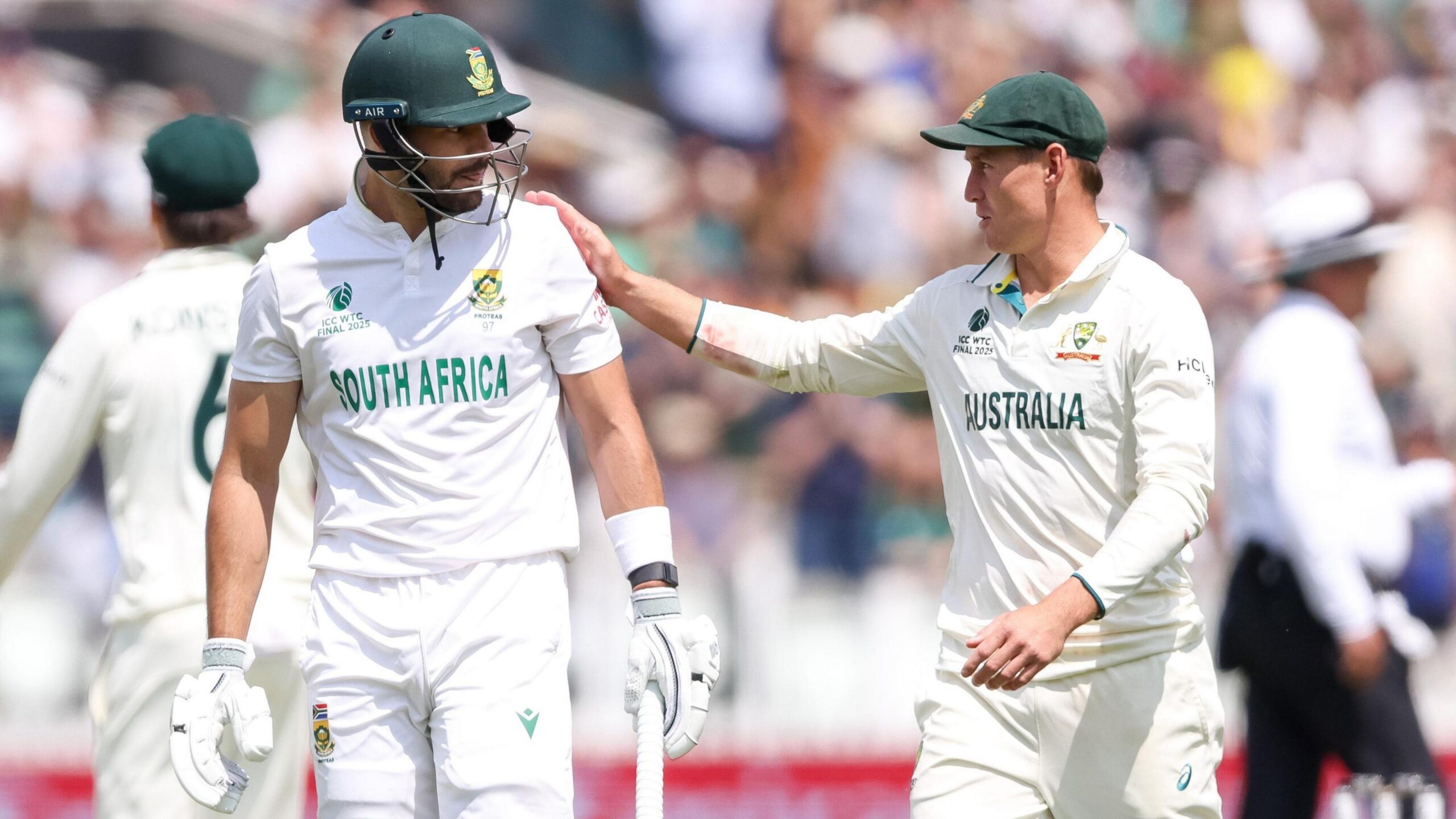
“Australia moved within six wickets of victory after setting South Africa a target of 421 runs, with the hosts ending the fourth day at 102 for four and facing a difficult final-day battle. Aiden Markram’s resistance and the contributions of the remaining South African batters became central to the home side’s hopes of salvaging a result, while Matt Renshaw’s outstanding all-round performance helped put Australia firmly in control.”
Proteas Face Uphill Battle to Save Durban Test as Australia Close in on Victory
South Africa face a demanding challenge against Australia on the fifth day of the opening Test at Kingsmead in Durban, with the Proteas attempting to prevent a defeat that would give the visitors an early advantage in the three-match series. After four days of fluctuating fortunes, Australia established a commanding position through powerful batting, disciplined bowling and a crucial late-day breakthrough that left the home team fighting to survive.
At the close of the fourth day, South Africa had reached 102 for four in pursuit of an imposing target of 421 runs. Australia therefore needed six more wickets to secure victory, while the Proteas required an exceptional final-day performance to remain in contention. However, Tuesday’s live updates subsequently showed Aiden Markram and Wiaan Mulder rebuilding the innings, with South Africa reaching 125 for one during the morning session. That resistance offered renewed hope of a draw, although the visitors remained in a strong position.
Australia’s commanding position
Australia’s advantage developed through an impressive second-innings performance led by Matt Renshaw. Having already scored 190 in Australia’s first innings, Renshaw continued his outstanding return to Test cricket by making 82 in the second innings. His contributions helped Australia build a substantial lead and declare at 314 for six, giving the visitors sufficient time to pursue victory.
Australia’s decision to accelerate the scoring proved important. Rather than concentrating exclusively on accumulating runs, the visitors balanced attacking intent with the need to leave enough time to dismiss South Africa. Their declaration placed considerable pressure on the home side, which had to contemplate a fourth-innings chase requiring sustained excellence against an experienced bowling attack.
Renshaw’s contribution extended beyond his batting. He also claimed his first Test wicket when he dismissed South African captain Temba Bavuma, strengthening Australia’s position during the decisive closing stages of the fourth day. His performance became one of the defining stories of the match.
The Australian innings also featured contributions from several other players. Nic Maddinson scored 48 before being dismissed by Anrich Nortje, while Marnus Labuschagne made 37. Captain Pat Cummins produced an aggressive 32 from only 12 deliveries, striking four sixes and helping Australia increase the scoring rate.
These contributions demonstrated Australia’s ability to recover from setbacks and apply pressure when opportunities emerged. Their attacking approach also ensured that South Africa would have to negotiate a substantial period at the crease to avoid defeat.
South Africa’s batting concerns
Although South Africa entered the contest hoping to use home conditions to their advantage, their batting has been inconsistent at critical moments. The fourth innings exposed weaknesses in shot selection and the ability to build partnerships under pressure.
Ryan Rickelton endured a particularly difficult match. After recording a first-innings duck, he managed only two runs in the second innings before edging a rising delivery from Josh Hazlewood to wicketkeeper Alex Carey. His dismissals raised questions about his immediate position in the batting order.
David Bedingham offered greater resistance, scoring 46 and sharing a 66-run partnership with Markram. Nevertheless, Hazlewood ended that stand by trapping Bedingham leg before wicket, removing a batter who had begun to provide valuable support.
Bavuma’s dismissal followed when he attempted to play Renshaw’s off-spin and was caught close to the wicket. Tristan Stubbs subsequently fell for one after edging a delivery from Cummins.
Those dismissals left South Africa struggling at 102 for four overnight. The concern was not simply the number of wickets lost but the circumstances surrounding them. Australia had repeatedly created opportunities through accurate bowling, while South Africa’s batters sometimes surrendered their wickets through ambitious or poorly judged shots.
For a team seeking consistency at the highest level, these moments provide important lessons. Patience, clear decision-making and a willingness to defend for extended periods are essential when facing a large fourth-innings target.
Markram leads the resistance
Markram’s unbeaten innings became central to South Africa’s hopes of surviving the final day. His ability to combine controlled defence with selective scoring gave the home side a foundation after the loss of early wickets.
The latest live coverage reported that Markram had progressed beyond fifty, reaching the milestone from 129 deliveries. His developing partnership with Mulder helped South Africa recover from the overnight position and demonstrated the value of remaining composed when the opposition appears close to victory.
Mulder’s role is equally important. As an all-rounder capable of contributing with both bat and ball, he offers South Africa an opportunity to stabilise the innings and make Australia work for every breakthrough.
The immediate objective is no longer simply to consider whether South Africa can chase the entire target. A successful rescue could instead depend on preserving wickets, reducing unnecessary risks and batting for as long as possible. If the pair can establish a substantial partnership, they may force Australia to reconsider its bowling plans and field placements.
However, the challenge remains considerable. Australia can rotate its fast bowlers, introduce Nathan Lyon’s spin and exploit any uncertainty in the South African batting lineup. Every new batter entering the middle will face pressure to settle quickly without taking unnecessary risks.
Bowling, conditions and the weather
Kingsmead has provided a challenging setting throughout the match. Bad light interrupted play during the earlier days, reducing the available overs and influencing both teams’ strategies.
Former South African international Shaun Pollock also questioned whether the International Cricket Council should have considered using a pink ball for the match. His argument was that the pink ball could potentially have allowed play to continue under fading light conditions, although the suggestion raises wider questions about the practical application of different ball types in traditional daytime Tests.
Weather and visibility may again influence the final outcome. If interruptions reduce the amount of cricket available, South Africa could have a better opportunity to secure a draw by surviving rather than attempting to score the runs required for victory.
Australia, meanwhile, must balance aggression with control. The visitors need wickets, but excessive attacking fields could offer Markram and Mulder scoring opportunities. Maintaining pressure through disciplined lines, accurate lengths and intelligent changes of pace will be essential.
South Africa’s bowlers also deserve recognition for their efforts earlier in the match. Nortje’s dismissal of Maddinson and Maharaj’s involvement in Renshaw’s departure showed that the home team could create breakthroughs. Nevertheless, the overall contest has favoured Australia because its batters have produced more substantial contributions when they mattered.
Steve Smith’s fitness adds another concern
Australia also faced uncertainty over Steve Smith after he was struck on the helmet by a delivery from Nortje while batting in the second innings. Smith continued briefly but was assessed under concussion protocols and did not initially join the team on the field when South Africa began their chase.
His condition could become relevant to Australia’s preparations for the second Test, scheduled to begin in Gqeberha on 18 October. Any medical decisions must prioritise player safety, and his availability should not be assumed until the team provides an appropriate update.
Although Smith’s situation does not alter the immediate requirement for Australia to dismiss South Africa, it adds another consideration to a series that has already demanded significant contributions from several players.
Implications for the series
The opening Test matters because a victory would provide Australia with a 1–0 lead and put South Africa under pressure ahead of the remaining matches. Conversely, a draw would preserve the series balance and give the Proteas an opportunity to regroup before the teams meet again.
For South Africa, the immediate priority is to demonstrate greater discipline in difficult batting conditions. The match has highlighted the importance of partnerships, particularly when early wickets fall. It has also shown how a strong individual performance, such as Markram’s resistance, can create opportunities for a team that otherwise appears to be heading towards defeat.
Australia’s performance offers a contrasting example of effective match management. Renshaw’s two substantial innings, Cummins’ attacking contribution and the bowlers’ ability to exploit mistakes helped transform a competitive contest into a position of considerable advantage.
The result will depend on how effectively both teams execute their plans during the remaining play. South Africa must resist pressure, while Australia must maintain concentration and convert its opportunities into wickets.
Conclusion
South Africa’s struggle to save the Durban Test has become the leading cricket story emerging from the country on 13 October 2026. Australia’s commanding position after the fourth day placed the Proteas in serious danger, but Markram and Mulder’s developing partnership has made the final session of the contest more intriguing.
The home side still faces a difficult task, and a victory chase remains ambitious. Nevertheless, Test cricket rewards patience as well as attacking skill, meaning that disciplined batting and interruptions could keep a draw within reach.
For Australia, the challenge is to sustain pressure and finish the job without allowing the match to drift away. For South Africa, the priority is to show resilience, protect wickets and demonstrate that the team can respond when confronted with adversity.
Whatever the final result, the match provides a significant early assessment of both teams’ strengths, weaknesses and ability to handle pressure during the 2026 series.



