




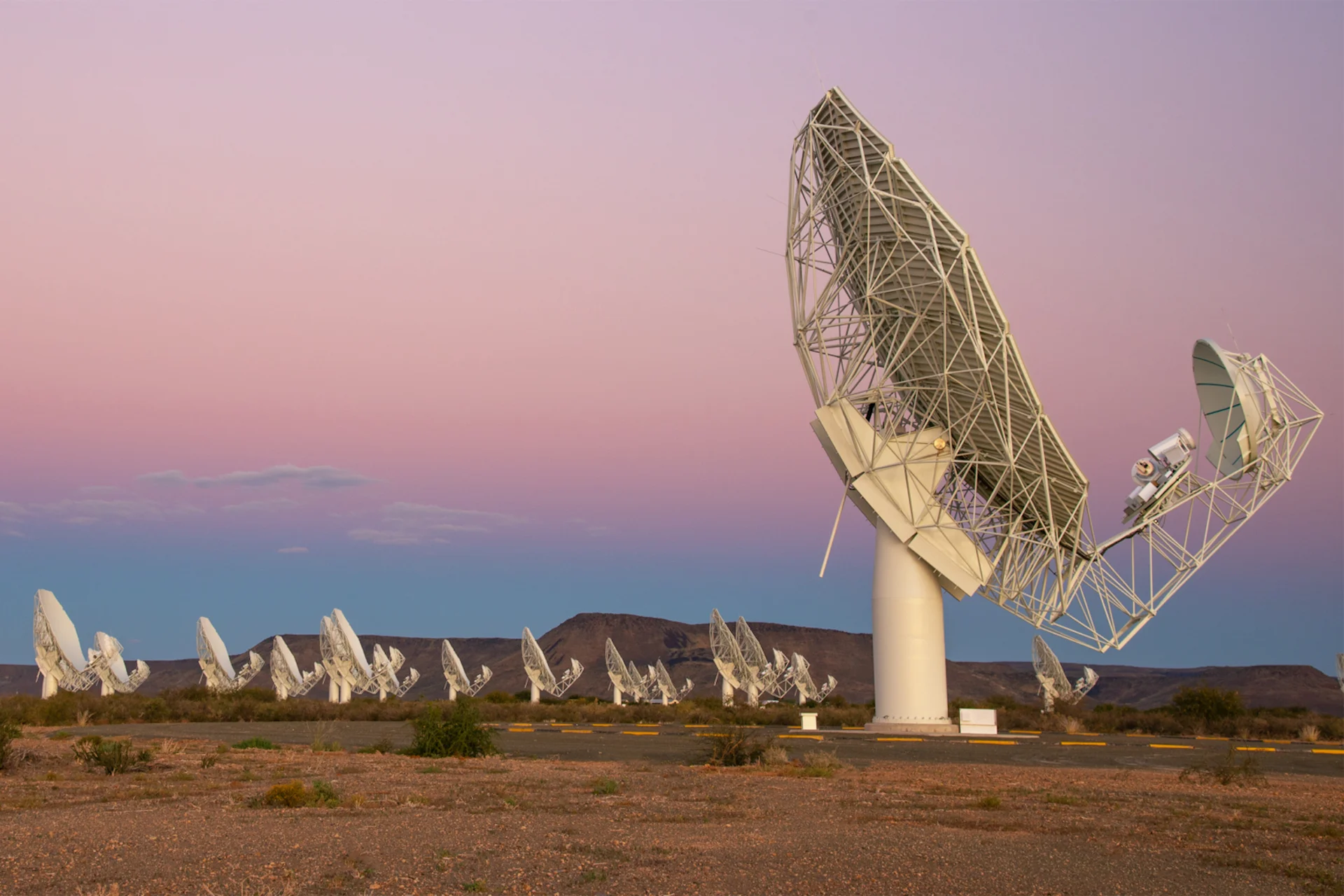
“South Africa’s MeerKAT telescope has helped astronomers detect radio signals from Beta Pictoris b, a massive gas giant about 10 times the size of Jupiter. The signals are linked to auroral activity driven by the planet’s powerful magnetic field, opening a new frontier in measuring exoplanetary magnetism.”
South Africa’s MeerKAT telescope, located in the Karoo, has once again proven its global significance in astronomy. On September 28, 2026, researchers announced that MeerKAT had detected radio signals from Beta Pictoris b, a young exoplanet orbiting the star Beta Pictoris, approximately 63 light-years away. This marks the first time in history that radio emissions have been directly observed from a planet outside our Solar System.
The Discovery
The research team, led by Kevin Ortiz Ceballos from the Center for Astrophysics | Harvard & Smithsonian, collaborated with the University of Oregon. Using MeerKAT’s 64 linked dishes, they observed the Beta Pictoris system multiple times between 2025 and 2026. Each observation revealed recurring bursts of radio emission, which were carefully compared against known positions of distant quasars to confirm their planetary origin.
What Was Detected?
The signals appear to originate from auroral activity—similar to Earth’s northern and southern lights, but on a vastly larger scale. Scientists estimate Beta Pictoris b’s magnetic field at 1,250 gauss, thousands of times stronger than Earth’s. This immense magnetism drives powerful auroras, producing detectable radio emissions.
Why It Matters
- New Measurement Technique: This breakthrough provides a novel way to measure magnetic fields of exoplanets, a crucial factor in understanding planetary atmospheres and habitability.
- Auroral Physics Beyond Earth: Studying auroras on exoplanets expands our knowledge of space weather phenomena across the galaxy.
- MeerKAT’s Role in Global Science: The discovery highlights South Africa’s contribution to cutting-edge astronomy, reinforcing its importance in the upcoming Square Kilometre Array (SKA) project.
No Aliens—Yet
While the discovery is extraordinary, scientists emphasize that no evidence of extraterrestrial life has been found. The signals are purely natural, tied to the planet’s magnetic activity rather than intelligent communication.
South Africa’s Growing Space Legacy
MeerKAT’s success adds to South Africa’s growing reputation in space science. Alongside projects like Africa2Moon and government-backed industrial initiatives in aerospace, the country is positioning itself as a continental leader in space exploration and technology.
Global Collaboration
The discovery underscores the importance of international collaboration. Although the telescope is South African, the research team was primarily American, showing how global partnerships drive scientific progress.
Conclusion
The detection of radio signals from Beta Pictoris b is a historic milestone in astronomy. It not only demonstrates the power of South Africa’s MeerKAT telescope but also opens new pathways for studying exoplanets. As the SKA project advances, South Africa’s role in unraveling cosmic mysteries will only grow stronger.



