




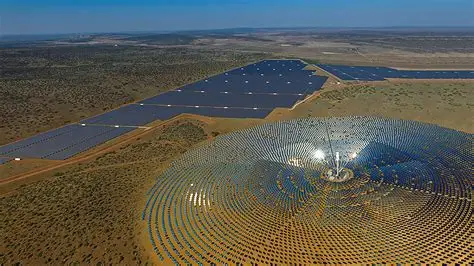
“South Africa’s energy regulator has registered 124 new renewable generation facilities between April and June 2026, representing 804 MW of capacity and R20.18 billion in investment. The expansion, led by solar PV and wind projects, enhances grid reliability, reduces coal dependence, and accelerates South Africa’s climate commitments.”
South Africa’s energy landscape is undergoing a profound transformation. On 20 August 2026, the National Energy Regulator of South Africa (NERSA) announced the registration of 124 new renewable generation facilities in the first quarter of the 2026/27 fiscal year. This development represents a combined capacity of 804 MW and an investment value of R20.18 billion, underscoring the country’s accelerating shift toward clean energy.
Breakdown of Facilities
- Solar PV dominance: 122 facilities totaling 236 MW across all nine provinces.
- Wind power expansion: 2 facilities in Northern Cape and Mpumalanga contributing 568 MW combined.
- Grid connections: 63 facilities linked to municipal networks (47 MW), while 61 connect to Eskom’s national grid (757 MW).
This dual strategy reflects both decentralized generation and reinforcement of national grid capacity.
Provincial Highlights
- Northern Cape: Leading with 440 MW capacity and R11.93 billion investment, driven by large-scale wind projects.
- Gauteng & Limpopo: Highest number of solar PV facilities, reflecting urban demand and rooftop adoption.
- Mpumalanga: Significant wind investment, diversifying a province historically reliant on coal.
These regional dynamics highlight how renewable energy is reshaping South Africa’s economic geography.
Investment Trends
The average investment cost per kilowatt was R25,099/kW, reflecting both technological efficiency and investor appetite. Since 2018, NERSA has registered 2,619 facilities with a combined capacity of 20.13 GW and total investment of R409 billion. This trajectory demonstrates exponential growth, particularly after 2020, when policy reforms and Eskom’s unbundling opened the market to independent power producers (IPPs).
Strategic Implications
- Energy Security: Diversification reduces reliance on Eskom’s aging coal fleet.
- Economic Growth: R20.18 billion in new investment stimulates local industries, construction, and job creation.
- Climate Commitments: Aligns with South Africa’s pledge to cut emissions under the Paris Agreement.
- Private Sector Confidence: Surge in registrations reflects investor trust in regulatory stability.
Challenges Ahead
Despite progress, challenges remain:
- Grid integration: Eskom’s transmission infrastructure must absorb decentralized renewable inputs.
- Policy coherence: Ensuring long-term stability in energy regulation.
- Community engagement: Addressing local concerns about land use and equitable access to energy.
Broader Context
This announcement comes amid global momentum toward renewable energy. South Africa’s move is particularly significant given its historical dependence on coal, which still accounts for over 80% of electricity generation. The new projects represent a turning point in balancing economic growth with environmental sustainability.
Conclusion
The approval of 124 renewable projects marks a historic milestone in South Africa’s energy transition. With billions in investment, hundreds of megawatts of new capacity, and strong private sector confidence, the country is positioning itself as a leader in Africa’s renewable revolution. The challenge now lies in ensuring that infrastructure, policy, and community engagement keep pace with this rapid transformation.



