




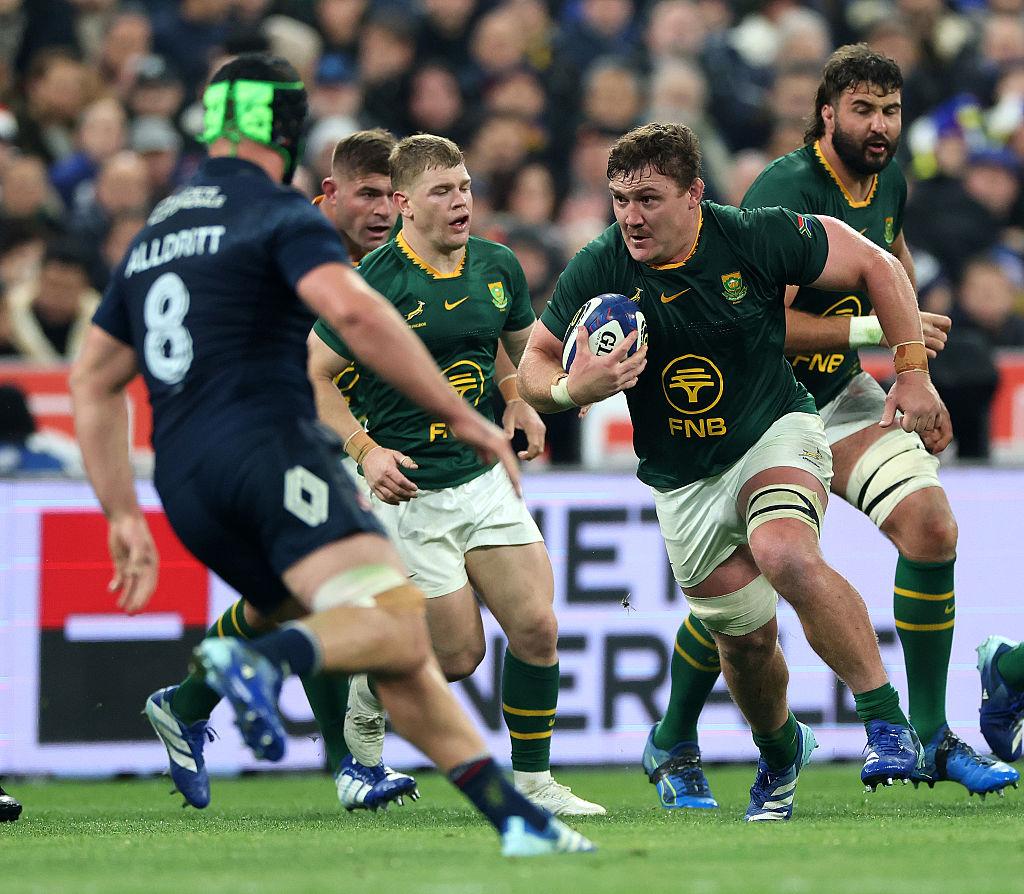
“South Africa will be without powerful number eight Jasper Wiese for the remainder of the 2026 Nations Championship after he received a four-week suspension following his red card against France. His absence is a significant setback for the Springboks as they prepare for their crucial match against Ireland in Dublin, with the team also dealing with head coach Rassie Erasmus’s six-match suspension.
The disciplinary developments have increased pressure on South Africa ahead of a decisive international rugby weekend, potentially affecting the team’s forward strategy, leadership, physical presence and prospects of reaching the Nations Championship final.”
Springboks face a major Nations Championship challenge after Jasper Wiese’s suspension
South African rugby has suffered another significant setback ahead of the Springboks’ important Nations Championship encounter against Ireland, with powerful number eight Jasper Wiese ruled out for the remainder of the competition following a disciplinary suspension. The decision comes at a difficult moment for the world champions, who are attempting to recover from a narrow defeat against France while preparing for a demanding international fixture in Dublin.
Wiese’s absence creates an important selection challenge for South Africa. The forward has become an influential member of the Springbok pack, contributing physical strength, ball-carrying ability, defensive aggression and experience in high-pressure international matches. Losing a player of his profile at such an important stage of the tournament could affect the team’s forward balance and tactical preparations.
The suspension follows South Africa’s 21–19 defeat against France in Paris on Friday, 13 November 2026. During that encounter, Wiese received a 20-minute red card after an initial yellow-card decision was upgraded through the bunker review system. The incident involved a dangerous clear-out at a ruck, resulting in disciplinary action against the South African number eight.
Following the disciplinary hearing, Wiese received a four-week suspension. However, the punishment could be reduced to three weeks if he successfully completes the World Rugby Coaching Intervention Programme. Regardless of the possible reduction, the ruling means South Africa must prepare for the immediate challenge without one of its important forward players.
The disciplinary incident against France
The incident involving Wiese has become an important talking point in the aftermath of South Africa’s defeat against France. The Springboks entered the match hoping to secure a positive result in their Nations Championship campaign, but the encounter developed into a closely contested battle.
France eventually secured a 21–19 victory, leaving South Africa disappointed after a match in which small disciplinary and tactical moments proved particularly important.
Wiese’s red card affected the Springboks’ ability to maintain their preferred forward combinations. Playing with a reduced number of players for a period places additional responsibilities on the remaining forwards, particularly around defensive organisation, breakdown contests and maintaining possession.
The bunker review system allows officials to examine incidents that may require a more serious disciplinary decision than the original on-field sanction. In Wiese’s case, the review resulted in the initial yellow card being upgraded to a 20-minute red card.
The subsequent hearing considered the incident and determined the suspension. Although South Africa may disagree with aspects of the disciplinary process, the team must now concentrate on adapting to the absence of its number eight.
The case also highlights the importance of player discipline in modern international rugby. Teams are increasingly expected to demonstrate precise control during breakdown contests, tackles and clean-outs. Dangerous techniques can lead to serious consequences, including suspensions that extend beyond the match in which an offence occurs.
For South Africa, the timing of the decision is particularly unfortunate because the team is approaching the decisive stages of an important international competition.
Why Wiese’s absence matters to South Africa
Number eight is one of the most demanding positions in rugby union. Players in this role are expected to combine strength, mobility, technical ability and tactical awareness.
They frequently carry the ball from the base of the scrum, support attacking movements, contribute to defensive structures and help secure possession around the breakdown.
Wiese’s physical approach has made him an important option for South Africa. His ability to challenge opposition defenders and carry the ball into contact gives the Springboks another attacking dimension.
Without him, the coaching staff must consider how to maintain the same level of physical intensity while ensuring that the forward pack remains balanced.
The replacement must be capable of contributing in several areas. Carrying the ball effectively is important, but South Africa also needs reliable breakdown work, defensive positioning, lineout support where required and communication with the other forwards.
The Springboks are known for their powerful forward-oriented approach. Their tactical identity frequently depends on winning the physical contest, establishing dominance at the breakdown and creating opportunities for their backs.
Consequently, replacing Wiese is not simply a matter of selecting another player for the number eight jersey. The coaching team must ensure that the entire forward combination continues functioning effectively.
The absence could also influence the Springboks’ bench strategy. South Africa has traditionally used its replacement forwards to increase intensity during the second half. Losing an experienced option may require adjustments to the timing and composition of substitutions.
Ireland presents another demanding challenge
South Africa’s immediate attention now turns to Ireland, with the two teams scheduled to meet in Dublin on Saturday, 21 November 2026.
The fixture is particularly important because the Springboks need a strong result to improve their chances of reaching the Nations Championship final.
Ireland will have the advantage of playing at home, with supporters expected to create a demanding atmosphere for the visiting world champions.
The Irish side also has considerable international experience and the ability to compete physically against South Africa. Their forward pack can challenge at the scrum, breakdown and lineout, while their backs are capable of exploiting defensive opportunities.
The Springboks therefore face a complicated assignment. They must overcome the disappointment of losing to France, adapt to Wiese’s suspension and prepare for a difficult away fixture.
South Africa’s coaching staff will need to ensure that the players remain focused on their performance rather than becoming distracted by disciplinary controversies.
The team must also manage its emotional response to the France defeat. Although the narrow margin demonstrates how competitive the match was, the Springboks cannot afford to repeat costly mistakes against Ireland.
Their preparations will require improved discipline, accurate execution and better decision-making in important moments.
Rassie Erasmus suspension adds to the pressure
Wiese’s suspension is not the only disciplinary challenge affecting the Springboks.
Head coach Rassie Erasmus has also received a six-match suspension from World Rugby following comments about match officials after the defeat against France.
The sanction followed remarks made during a media conference in Dublin on Monday, 16 November. Erasmus questioned aspects of the officiating and suggested that certain decisions raised concerns about the integrity of the match.
World Rugby’s independent disciplinary panel subsequently imposed the suspension.
SA Rugby has indicated that it will request a full misconduct hearing, arguing that Erasmus should have an opportunity to provide context and explain his comments.
The coach’s suspension creates an additional challenge because he will be unable to attend the matchday stadium or communicate directly or indirectly with the team during the relevant period of the ban.
This situation places greater responsibility on the remaining coaching staff, who must ensure that the Springboks maintain their tactical organisation and preparation standards.
Erasmus has played a central role in South Africa’s recent success, including the team’s consecutive Rugby World Cup triumphs. His influence extends beyond team selection to tactical planning, player development, opposition analysis and match management.
However, the Springboks have experienced periods when other members of the coaching structure have had to assume greater responsibility.
The immediate priority will be ensuring that the players understand their assignments and remain confident in the established game plan.
SA Rugby has also condemned online abuse and threats directed at World Rugby officials. The organisation has emphasised that disagreement over decisions should not become personal intimidation or harassment.
South Africa must adjust its forward strategy
The absence of Wiese creates an opportunity for another South African forward to demonstrate his ability at international level.
The selection decision will be important because Ireland are expected to challenge South Africa’s physical strength throughout the match.
The replacement number eight must provide stability around the scrum and offer the team a reliable ball-carrying option.
South Africa could also reconsider how it distributes responsibilities among its loose forwards. The flankers may need to contribute more heavily to carrying, while the locks and front row must maintain their effectiveness in contact situations.
The coaching staff will also have to consider how the replacements can influence the final stages of the match.
International rugby is frequently decided by small differences in physical intensity, accuracy and discipline. A team that manages its substitutions effectively can gain an advantage when opponents begin to tire.
For the Springboks, maintaining a consistent performance across both halves will be essential.
Their attacking strategy should also avoid becoming predictable. Ireland will study South Africa’s traditional forward-based approach and attempt to disrupt the team’s possession and territorial control.
South Africa therefore needs to combine its physical strengths with accurate passing, intelligent kicking and effective support play.
The Nations Championship implications
The suspension could have important consequences for South Africa’s Nations Championship campaign.
The Springboks are competing in a demanding international tournament involving leading rugby nations from the northern and southern hemispheres.
Every result contributes to the wider competition structure, making the remaining fixtures particularly important.
South Africa’s position in the standings means the Ireland match could influence its chances of reaching the final scheduled for 29 November at Twickenham.
A victory over Ireland would strengthen the Springboks’ position, although qualification also depends on other results involving their competitors.
New Zealand’s defeat against Wales has already influenced the southern hemisphere standings, adding further importance to the remaining fixtures.
The Springboks must therefore approach the Ireland encounter with the understanding that the result could determine whether they remain in contention for the tournament’s top final.
Wiese’s absence makes the challenge more complicated, but it does not automatically eliminate South Africa’s chances.
The squad has considerable depth and international experience. Its ability to respond to difficult circumstances will be an important measure of its competitiveness.
Player discipline becomes a major talking point
The developments involving Wiese and Erasmus have renewed attention on discipline in international rugby.
The modern game places significant emphasis on player safety, especially during tackles, rucks and breakdown situations.
Players are expected to understand the laws and avoid dangerous techniques that could place opponents at risk.
For national teams, disciplinary incidents can have consequences extending beyond individual matches. Suspensions can disrupt selection plans, change tactical combinations and force coaches to reconsider their strategies.
The Springboks must therefore ensure that their players remain composed and technically accurate, particularly when facing opponents who can create pressure around the breakdown.
The coaching staff will also need to communicate clearly about the importance of discipline without reducing the team’s physical aggression.
There is an important distinction between playing with intensity and committing dangerous offences. South Africa must continue competing aggressively while remaining within the laws of the game.
A test of Springbok resilience
The coming weekend will provide an important test of South Africa’s ability to respond to adversity.
The team has experienced a disappointing defeat against France, lost an influential forward through suspension and faced uncertainty surrounding its head coach’s disciplinary case.
Nevertheless, the Springboks remain one of international rugby’s strongest teams.
Their history of competing under pressure suggests that the squad has the experience required to respond positively.
The Ireland match will demand strong leadership from the players, particularly those responsible for organising the forwards and maintaining communication across the team.
South Africa will need to demonstrate that its collective structure is strong enough to withstand the absence of important individuals.
Ultimately, the result will depend on performance rather than reputation. The Springboks must execute their plan, control the breakdown, defend effectively and take advantage of scoring opportunities.
Wiese’s suspension is a major setback, but it also creates an opportunity for another player to establish himself in the national setup.
For South African supporters, the central question is whether the Springboks can overcome these challenges and keep their Nations Championship ambitions alive.
The match against Ireland will provide the next important answer.
Conclusion: Springboks face a defining weekend
South Africa’s preparations for Ireland have been complicated by Jasper Wiese’s suspension and the disciplinary action against Rassie Erasmus. Both developments place additional pressure on the Springboks at a critical stage of the Nations Championship.
Wiese’s absence will require tactical adjustments, particularly in the forward pack, while Erasmus’s suspension will test the depth and leadership of the coaching structure.
The Springboks nevertheless have the personnel and experience to remain competitive. Their performance against Ireland will demonstrate whether they can turn a difficult week into an opportunity to strengthen their tournament ambitions.
For South African rugby, the immediate priority is clear: restore discipline, maintain physical dominance and deliver a convincing performance in Dublin.



