




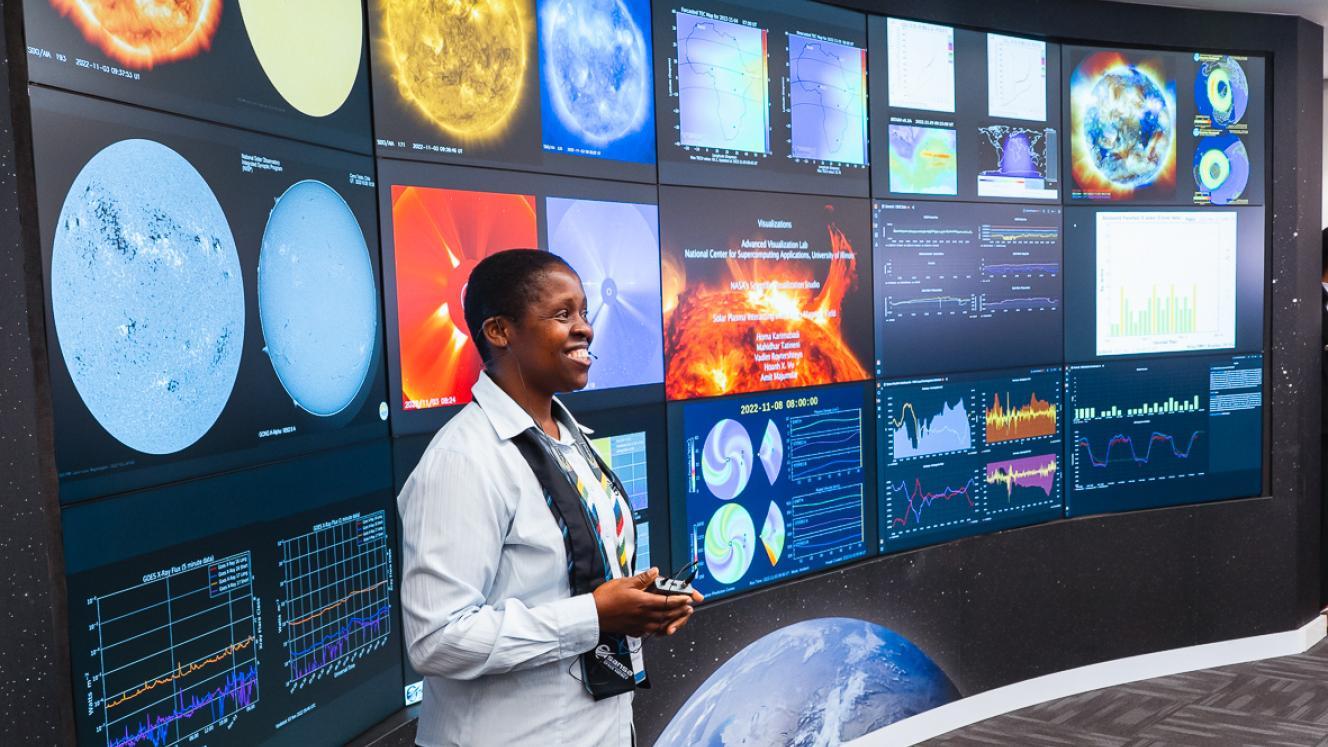
“SANSA’s latest bulletin reports solar-wind speeds ranging from approximately 500 to 660 kilometres per second, with solar activity remaining low and no significant solar flares observed in the preceding 24 hours. Geomagnetic conditions are expected to range from quiet to active over the forecast period, prompting continued monitoring because disturbances can affect high-frequency radio communications and global navigation satellite systems.”
South Africa Tracks Elevated Solar Winds as Space Weather Monitoring Protects Critical Communications
South Africa’s space-weather monitoring programme is tracking elevated solar-wind speeds as scientists assess conditions that could influence radio communications, satellite navigation and other technologies dependent on the near-Earth space environment. The South African National Space Agency (SANSA) reported on 14 October that solar activity remained low, although the solar wind was moving at elevated to strong speeds and geomagnetic conditions could become more active during the forecast period.
The latest bulletin highlights the importance of continuous space-weather monitoring. Although the reported conditions do not indicate a major solar storm currently affecting South Africa, changes in solar activity and the solar wind can influence Earth’s magnetic environment and upper atmosphere. These changes matter because modern societies increasingly depend on satellite positioning, radio communications and space-based infrastructure.
SANSA reports elevated solar-wind speeds
According to SANSA’s daily forecast, solar-wind speeds ranged between approximately 500 and 660 kilometres per second. Solar activity remained low, with background X-ray emissions at upper B-class levels. Scientists observed four sunspot regions on the visible solar disk, displaying relatively simple to slightly complex magnetic configurations.
The agency reported no significant solar flares during the preceding 24 hours. It also reported that coronagraph observations had not identified any Earth-directed coronal mass ejections during that period.
These findings provide important context for interpreting the elevated solar-wind speeds. Solar wind consists of charged particles flowing continuously from the Sun into interplanetary space. Its speed and magnetic properties can change, particularly when Earth encounters high-speed streams originating from coronal holes or material associated with solar eruptions.
SANSA attributed the elevated conditions to high-speed-stream influences associated with regions designated CH99 and CH02. The agency’s bulletin provides a scientific assessment rather than an indication that a severe space-weather emergency is underway.
Understanding the possible effects on Earth
Space weather describes changes in the Sun and the surrounding space environment that can influence Earth and technological systems. Its effects range from relatively minor variations in radio propagation to stronger geomagnetic disturbances capable of affecting satellites, electrical infrastructure and navigation services.
When faster-moving solar wind interacts with Earth’s magnetosphere, energy can enter the near-Earth environment. The resulting disturbances depend on several factors, including the solar wind’s magnetic orientation, speed and density.
A particularly important factor is the direction of the interplanetary magnetic field. Under certain conditions, its interaction with Earth’s magnetic field allows energy to enter the magnetosphere more efficiently, potentially increasing geomagnetic activity.
Consequently, elevated solar-wind speeds do not automatically mean a severe storm will occur. Scientists combine solar observations, magnetic-field measurements and atmospheric monitoring to assess whether conditions are likely to produce significant effects.
For South Africa, this monitoring supports early awareness of changing conditions that could influence systems used by aviation, telecommunications, navigation and other technology-dependent sectors.
Geomagnetic conditions remain under observation
SANSA classified geomagnetic conditions as quiet to unsettled, with observed Kp values around 1 to 3 in its latest bulletin. Its forecast indicates that conditions could range from quiet to active, with a slight possibility of a minor G1 geomagnetic storm, associated with a potential coronal mass ejection and continuing high-speed-stream influences.
The Kp index measures disturbances in Earth’s magnetic field on a scale from 0 to 9. Higher values indicate stronger geomagnetic activity. A G1 storm is the lowest category on the commonly used five-level geomagnetic storm scale.
The possibility of a minor storm should therefore be understood as a forecast, not confirmation that such a storm has occurred. Conditions can change as solar material travels towards Earth and interacts with the planet’s magnetic environment.
SANSA’s assessment illustrates why forecasts must be updated as fresh observations become available. Solar events do not always produce the effects initially expected, and some disturbances can arrive without the strongest warning signals associated with major solar eruptions.
Potential implications for radio communications
High-frequency radio communications can be sensitive to changes in the ionosphere, a region of Earth’s upper atmosphere containing electrically charged particles. The ionosphere influences how radio signals travel over long distances, making it important for communication systems used in aviation, maritime operations, emergency services and remote locations.
Solar radiation and geomagnetic activity can alter the ionosphere’s electron density and structure. Depending on the location, frequency and prevailing conditions, these changes can affect radio-signal propagation, introduce variability or contribute to communication disruptions.
SANSA identifies high-frequency communications among the systems that could be affected by changing space-weather conditions. Its latest forecast indicates that local high-frequency working frequencies are near monthly predicted values.
This observation provides useful operational context: the presence of elevated solar-wind speeds does not mean that radio communications are necessarily experiencing widespread disruption. Instead, monitoring helps operators identify changing conditions and respond when the evidence indicates that adjustments may be needed.
Satellite navigation and positioning
Global navigation satellite systems, commonly known through services such as GPS, depend on signals travelling between satellites and receivers on Earth. These signals pass through the ionosphere, where charged particles can alter their propagation time.
Ionospheric disturbances can therefore affect positioning accuracy, particularly for applications requiring precise measurements. The potential consequences vary according to the intensity of the disturbance, receiver design, correction techniques and the intended use of the positioning information.
Navigation systems support activities including transport, surveying, agriculture, logistics and infrastructure development. For this reason, reliable space-weather information is relevant to organisations that use satellite positioning in their daily operations.
SANSA’s bulletin specifically identifies global navigation satellite system applications among the areas that may warrant attention. However, the available report does not establish that South African navigation services have suffered an outage or measurable degradation on 14 October.
The appropriate conclusion is that monitoring provides advance information about environmental conditions that could affect these systems, allowing users to assess risks against their own operational requirements.
Why South Africa needs space-weather expertise
South Africa occupies an important position in African space science through its research facilities, monitoring capabilities and technical expertise. SANSA operates a Space Weather Centre that contributes to international monitoring arrangements and provides information about solar activity and its potential terrestrial effects.
Space-weather forecasting is particularly valuable because the infrastructure affected by solar activity is distributed across national borders. Satellites orbit Earth, radio signals travel internationally, and disturbances in the upper atmosphere do not respect political boundaries.
International cooperation enables scientists to combine observations, improve forecasting and communicate warnings to organisations that depend on space-based services.
For South Africa, maintaining these capabilities supports scientific research while helping public and private institutions understand environmental risks to technological systems.
Space-weather monitoring also contributes to the development of skills in physics, engineering, atmospheric science, data analysis and satellite technology. These disciplines are increasingly important as African countries expand their use of satellite communications, Earth observation and navigation services.
Distinguishing forecasts from confirmed impacts
A central lesson from the 14 October bulletin is the importance of separating observed conditions from possible future effects.
The reported solar-wind speeds, sunspot regions and geomagnetic measurements describe the environment being monitored. The possibility of a minor geomagnetic storm represents a forecast that depends on evolving solar and interplanetary conditions.
Neither elevated solar-wind speeds nor the presence of sunspots alone proves that a major disruption is imminent. Likewise, identifying a potential impact on radio communications or navigation does not establish that an interruption has already occurred.
Businesses, government agencies and members of the public should therefore consult updated official bulletins rather than treating every increase in solar activity as an emergency.
SANSA’s continuing observations provide a basis for informed decisions, particularly for technical operators who need to evaluate whether changing conditions could affect specific equipment or services.
What to watch in the coming days
SANSA’s forecast for 15 to 17 October indicates continued low solar activity, with geomagnetic conditions forecast to be unsettled on 15 October and quiet on 16 and 17 October. These projections remain subject to revision as new measurements become available.
Scientists will continue examining solar-wind conditions, sunspot activity and the possibility of changes in Earth’s magnetic environment. Any developing disturbance would need to be assessed against updated observations before conclusions could be drawn about its severity or practical effects.
Operators of radio and navigation systems can use official forecasts as part of their normal monitoring and contingency procedures. The public, meanwhile, can follow the agency’s published updates to understand whether conditions are changing significantly.
Conclusion
South Africa’s latest space-weather bulletin demonstrates the practical value of monitoring the Sun and Earth’s surrounding space environment. On 14 October 2026, SANSA reported low solar activity alongside elevated solar-wind speeds and generally quiet-to-unsettled geomagnetic conditions, with the possibility of increased activity in the forecast period.
The report does not confirm a major solar storm or widespread disruption to South African technology systems. Instead, it provides timely scientific information about conditions that can influence high-frequency radio communications and satellite navigation.
As satellite-dependent services become more important to economies and communities, reliable space-weather observations will remain essential for assessing risks and supporting informed operational decisions. South Africa’s continued investment in monitoring, scientific expertise and international cooperation can help strengthen its ability to understand these changing conditions and respond appropriately when significant disturbances develop.



