




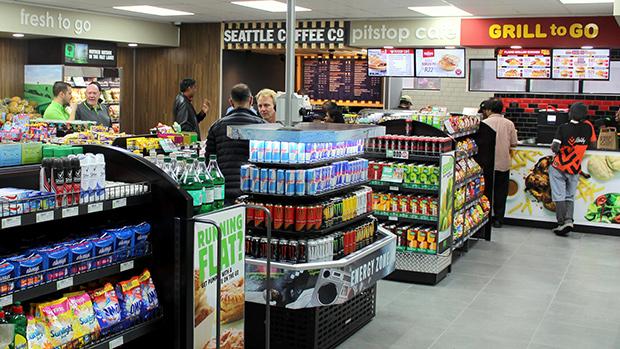
“South African petrol stations are increasingly diversifying into convenience retail, takeaway meals, coffee and grocery partnerships as fuel-price pressures and thin fuel margins encourage operators to seek additional sources of income. The shift is intensifying competition for household spending, with retailers needing to balance convenience, affordability and product quality as consumers adjust their purchasing habits to financial pressure.”
South African petrol stations turn to convenience retail as household budgets tighten
Introduction: A changing business model
South Africa’s petrol station industry is undergoing a significant change as forecourt operators increasingly look beyond fuel sales to generate revenue. Convenience stores, takeaway food, coffee, groceries and other quick-purchase services are becoming important parts of the business model as retailers respond to rising operating costs and changing consumer behaviour.
The development illustrates several important microeconomic principles, including consumer choice, price sensitivity, competition, product differentiation and profit maximisation. Instead of relying primarily on petrol and diesel sales, operators are seeking to increase the amount customers spend during each visit and encourage them to return more frequently.
A report published by Eyewitness News on 26 October 2026 highlighted the growing importance of convenience retail in South Africa. According to figures attributed to Trade Intelligence in the report, the country’s forecourt convenience-store market was worth approximately R42 billion in 2025, while 57% of shoppers visited these stores at least once a week. The report also cited a survey in which 92% of forecourt shoppers said financial pressure had forced them to change their broader spending habits.
These figures point to a market where convenience remains valuable, but customers are increasingly conscious of what they pay and what they receive in return.
1. Why petrol stations are diversifying
Traditionally, fuel has been the central product sold by petrol stations. However, fuel retailing can involve substantial operating expenses, significant price competition and relatively thin margins. As a result, selling larger volumes of fuel does not necessarily guarantee the strongest profitability.
Convenience retail offers an additional source of income. A motorist who stops to refuel may also purchase bottled water, snacks, bread, groceries, a takeaway meal or a cup of coffee. These additional transactions allow businesses to generate revenue from customers who are already visiting their premises.
From a microeconomic perspective, this strategy is an example of complementary purchasing. Consumers may buy several products during the same visit because the combined transaction saves time and effort.
For example, a commuter who needs petrol and breakfast might choose a station offering both rather than making separate journeys to a fuel station and a restaurant. The operator benefits from the additional sale, while the customer benefits from convenience.
However, the outcome depends on price, quality and customer preferences. If convenience-store products are perceived as excessively expensive, customers may purchase fuel but obtain their food and groceries elsewhere.
Consequently, diversification is not simply about adding more products. It requires retailers to understand the products their customers value, the prices they are willing to pay and the circumstances in which convenience outweighs the cost of shopping elsewhere.
2. Household budgets are reshaping demand
The financial pressure described in the EWN report is central to understanding the industry’s transformation. When households face higher transport, food, housing and borrowing costs, they must decide how to allocate limited income among competing needs.
Economists describe this as the problem of scarcity: consumers cannot purchase every product they want, so they prioritise spending according to their budgets and preferences.
A household facing higher fuel costs might continue buying petrol because it needs transport for employment, school or essential activities. At the same time, it may reduce spending on premium coffee, snacks, restaurant meals and other discretionary purchases.
This creates different demand patterns across product categories. Essential purchases may remain relatively resilient, while optional purchases become more sensitive to price changes.
Forecourt retailers therefore face a two-sided challenge. They have an opportunity to attract consumers seeking quick, convenient purchases, but they must also recognise that those consumers may be reducing non-essential expenditure.
A successful business needs to identify the products that fit these changing priorities. Affordable meals, essential groceries and competitively priced refreshments may appeal to customers who want to control spending without sacrificing convenience entirely.
Premium products can still attract some consumers, but relying exclusively on higher-priced offerings risks excluding customers whose budgets have become tighter.
The central microeconomic lesson is that demand depends not only on consumer preferences, but also on purchasing power and the availability of substitutes.
3. Competition extends beyond other petrol stations
Forecourt operators are no longer competing only with nearby fuel stations. Their convenience stores compete with supermarkets, independent shops, takeaway restaurants, coffee outlets and food-delivery services.
Each alternative offers a different combination of price, speed, product range and accessibility.
Supermarkets, for example, may offer lower prices on groceries because they purchase large volumes and operate extensive distribution networks. Independent convenience stores may compete through proximity to residential areas. Restaurants can differentiate themselves through menu variety, while delivery applications compete by saving customers travel time.
Petrol stations possess their own advantages. They are often located on major roads, serve customers already travelling and offer opportunities to combine refuelling with other purchases.
These advantages can make forecourt retail attractive even when some products cost more than comparable items elsewhere.
In economic terms, customers evaluate the total cost of a purchase, not simply its price tag. Travel time, transport expenses, waiting time and convenience can influence the final decision.
Nevertheless, convenience does not eliminate competition. When the price difference between a petrol station and a supermarket becomes too large, consumers may change their shopping habits.
Forecourt businesses must therefore determine which products customers are willing to purchase at convenience-oriented prices and which require closer price competition.
4. Product differentiation and customer loyalty
Retailers can respond to competitive pressure through product differentiation: offering products, services or experiences that customers perceive as distinct from those of competitors.
For South African petrol stations, differentiation might include reliable coffee quality, fresh takeaway meals, locally relevant grocery products, clean facilities, fast service and convenient payment options.
The objective is to give customers a reason to choose one forecourt over another.
However, differentiation must create genuine value. Attractive branding or an extensive product range cannot compensate indefinitely for poor service, inconsistent quality or prices that customers consider unreasonable.
Retailers must also recognise that consumers have different preferences. A long-distance driver may value clean restrooms and quick refreshments, while an urban commuter may prioritise fast coffee and breakfast. A family travelling between towns may prefer accessible food options and basic groceries.
Segmenting customers according to their needs can help businesses develop a more appropriate product mix.
Customer loyalty is particularly valuable because repeat visits can reduce the need to continually attract new buyers. Nevertheless, loyalty remains conditional: consumers may switch providers when prices rise or when a competitor offers a more attractive combination of quality and convenience.
5. Pricing decisions and profit margins
Pricing is one of the most important decisions in the convenience-retail business.
A retailer must cover the cost of purchasing goods, staffing, refrigeration, electricity, rent, security, wastage and other operating expenses. At the same time, prices must remain attractive enough to generate sufficient demand.
Setting prices too high may improve the margin earned on each unit sold but reduce the number of units purchased. Setting them too low may increase sales volume while leaving insufficient profit to cover costs.
The optimal approach depends on the product, the level of competition and the behaviour of consumers.
For example, a frequently purchased item with many close substitutes may require competitive pricing. A product offering unusual convenience or distinctive quality may support a higher price, provided customers consider the additional value worthwhile.
Retailers also need to evaluate profitability across the entire store rather than examining each item in isolation. A product with a relatively low margin may encourage customers to enter the store and purchase additional goods. Conversely, an item with a high margin may perform poorly if few customers want it.
This makes product selection, inventory management and pricing strategy closely connected.
Operators should use sales data to identify fast-moving products, slow-selling inventory, periods of peak demand and differences between customer groups. Such information can improve purchasing decisions and reduce losses from unsold or expired stock.
6. Small businesses and supplier opportunities
The expansion of forecourt retail may create opportunities for food producers, beverage suppliers, local manufacturers and small businesses that can supply products suitable for convenience outlets.
Potential opportunities include packaged snacks, baked goods, prepared meals, beverages and other frequently purchased products.
For smaller suppliers, securing access to a network of petrol-station stores could provide a route to more customers without having to establish an independent retail location.
However, opportunities are not guaranteed. Suppliers must meet retailers’ requirements concerning product quality, food safety where applicable, delivery reliability, packaging, pricing and consistent supply.
Large retailers may also possess considerable bargaining power. Suppliers that depend heavily on a small number of major customers can become vulnerable if purchasing terms change or contracts are not renewed.
Forecourt operators must likewise balance the benefits of supplier partnerships against the risks of inconsistent deliveries, excess inventory and products that fail to sell.
The wider economic benefits will depend on whether the growth of convenience retail creates sustainable commercial relationships and enables smaller businesses to compete on reasonable terms.
7. Technology, payments and operating efficiency
Technology can help petrol stations improve convenience while controlling costs.
Digital payments, loyalty programmes, inventory-management systems and customer-data analysis can make transactions faster and help managers understand purchasing patterns.
For example, sales data may reveal that particular products sell well during morning commuting hours but perform poorly late at night. Retailers can use this information to adjust staffing, stock levels and promotional activities.
Better inventory management can reduce spoilage, unnecessary purchasing and the cost of holding products that sell slowly.
Digital loyalty systems may also help businesses reward repeat customers and communicate relevant offers. However, promotions need to be evaluated carefully. Excessive discounting can reduce margins without creating enough additional sales to justify the expense.
Technology also requires investment, maintenance and employee training. Smaller operators may find these costs more difficult to absorb than larger businesses.
The commercial advantage therefore depends on whether the savings and additional sales generated by technology exceed its total cost.
8. Risks facing the forecourt retail sector
Despite its opportunities, convenience retail is not a guaranteed solution to the pressures facing petrol stations.
First, weak household purchasing power can limit demand for discretionary products. Second, competition from supermarkets and food outlets can constrain prices. Third, higher operating expenses may reduce the profit earned on additional sales.
There is also a risk of overexpansion. Adding restaurants, premium coffee counters or large convenience stores requires capital, staff and management attention. If demand is insufficient, the resulting costs may outweigh the benefits.
Location matters as well. A busy highway station may attract a different customer base from a small urban forecourt. Strategies that work at one site may fail at another.
Businesses should therefore assess local demand, nearby competitors, customer income patterns and the availability of suitable suppliers before investing in additional services.
Careful testing can reduce the risk of expensive mistakes. A retailer might begin with a limited range of popular products, monitor sales and expand only when customer demand supports the investment.
9. Implications for consumers and the South African economy
The expansion of convenience retail could provide consumers with more places to purchase food, drinks and everyday necessities. It may also improve access to products during journeys and create additional retail employment opportunities.
Greater competition could encourage retailers to improve quality, introduce new services and develop more attractive prices.
However, consumers will not automatically benefit from every expansion. If outlets concentrate on premium products, price-conscious households may see limited advantages. Similarly, new stores may redirect spending from existing businesses rather than create entirely new consumer demand.
The wider effect will depend on productivity, competitive conditions, employment opportunities and whether households receive sufficient value from the services offered.
For policymakers and competition authorities, the development illustrates the importance of accessible markets, fair competition and conditions that allow smaller businesses to enter retail supply chains.
For consumers, comparing prices and considering the full cost of purchases remains important. A convenient transaction can save time, but repeated small purchases may add up to a substantial household expense.
Conclusion: Convenience must deliver value
South Africa’s petrol-station industry is adapting to a changing consumer environment. As operators face pressure on fuel-related profitability and households become more selective about spending, convenience retail offers an opportunity to diversify revenue and build stronger customer relationships.
The figures reported by EWN suggest that forecourt stores already occupy a significant place in South African retail. Yet long-term success will depend on more than adding coffee machines, takeaway counters or grocery shelves.
Retailers must understand consumer demand, price products appropriately, control operating expenses and distinguish themselves from competing outlets. They must also recognise that financially pressured customers may welcome convenience while remaining unwilling to pay substantially more for everyday goods.
Ultimately, the most competitive forecourt businesses are likely to be those that combine speed, accessibility, quality and credible value. The industry’s transformation is a practical example of microeconomics in action: businesses respond to incentives and changing demand, while consumers allocate limited budgets among competing products and services.
The decisive question is not simply whether petrol stations can sell more than fuel. It is whether they can offer the right products at prices that make customers want to return.



