




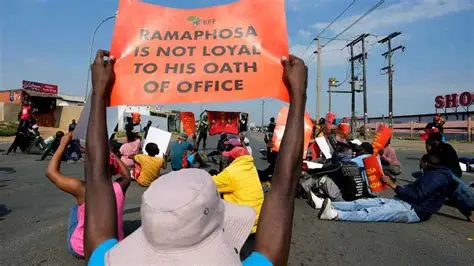
“The latest Social Research Foundation (SRF) polling reveals that the ANC’s national support has dropped to 37%, while the DA has climbed to 30%, narrowing the gap to just seven points. This reflects widespread dissatisfaction with corruption scandals, poor service delivery, and economic stagnation, positioning the November 2026 elections as a historic turning point.”
South Africa’s political landscape is undergoing one of its most dramatic transformations since the dawn of democracy. The ruling African National Congress (ANC), long the dominant force in national politics, is facing unprecedented challenges as public opinion shifts sharply in favor of opposition parties. The latest polling data from the Social Research Foundation (SRF) shows the ANC at 37% support, while the Democratic Alliance (DA) has climbed to 30%, narrowing the gap to just seven points. This development signals a potential realignment in South African politics, with voters increasingly disillusioned by corruption scandals, poor service delivery, and economic stagnation.
Historical Context
For much of the post-apartheid era, the ANC enjoyed comfortable majorities in national and local elections. However, its dominance began to erode after 2019, when corruption scandals such as the Phala Phala controversy and persistent failures in service delivery undermined public trust. Rising unemployment and economic stagnation further compounded voter frustration. The DA, once perceived as a regional force, has capitalized on this discontent, presenting itself as a credible national alternative with promises of efficient governance and economic reform.
Public Opinion Trends
Polling data highlights several key areas of concern among South Africans:
- Corruption Concerns: Widespread disillusionment with the ANC’s handling of corruption, particularly the Phala Phala scandal, has eroded trust in leadership.
- Service Delivery Failures: Citizens in metros like Johannesburg and Tshwane express frustration over collapsing infrastructure, unreliable electricity, and water shortages.
- Immigration & Unity Government: Public opinion remains divided on immigration policies and the effectiveness of the Government of National Unity (GNU), formed in 2024.
These issues have combined to create a political environment where voters are increasingly willing to consider alternatives to the ANC.
DA’s Rising Momentum
The DA’s campaign strategy has focused heavily on Gauteng, where polling places the party ahead of the ANC. Its manifesto emphasizes job creation, reliable service delivery, and anti-corruption measures, resonating with urban voters who feel neglected by the ruling party. The DA’s ability to position itself as a reformist force has allowed it to gain traction among middle-class voters, professionals, and younger demographics who are increasingly skeptical of the ANC’s ability to deliver meaningful change.
ANC’s Struggles
The ANC’s decline in support is not only a reflection of corruption scandals but also of economic stagnation. South Africa’s unemployment rate remains stubbornly high, with millions of citizens struggling to find work. The ANC’s inability to address these challenges has weakened its credibility. Furthermore, internal divisions within the party, particularly over leadership succession, have created uncertainty about its future direction.
Voter Sentiment
Public opinion surveys reveal that South Africans are increasingly prioritizing accountability, transparency, and efficiency in governance. Many voters express frustration that the ANC has failed to deliver on its promises, while others see the DA as a viable alternative capable of restoring confidence in government institutions. Importantly, younger voters—many of whom were born after apartheid—are less attached to the ANC’s liberation legacy and more focused on practical issues like jobs, education, and infrastructure.
Potential Impact on November 2026 Elections
The narrowing gap between the ANC and DA suggests that the upcoming elections could be one of the most competitive in South Africa’s history. If the DA continues to gain momentum, it could force the ANC into coalition arrangements or even challenge its dominance outright. This would mark a significant shift in South Africa’s political trajectory, potentially ushering in a new era of multiparty governance.
Conclusion
South Africa stands at a crossroads. The ANC’s declining support and the DA’s rising momentum reflect a broader shift in public opinion, driven by frustration with corruption, poor service delivery, and economic stagnation. As the November 2026 elections approach, the country faces the possibility of a historic realignment in its political landscape. Whether this leads to a coalition government, a stronger opposition, or a fundamental transformation of governance remains to be seen. What is clear, however, is that South Africans are demanding change—and their voices are reshaping the future of the nation.



