




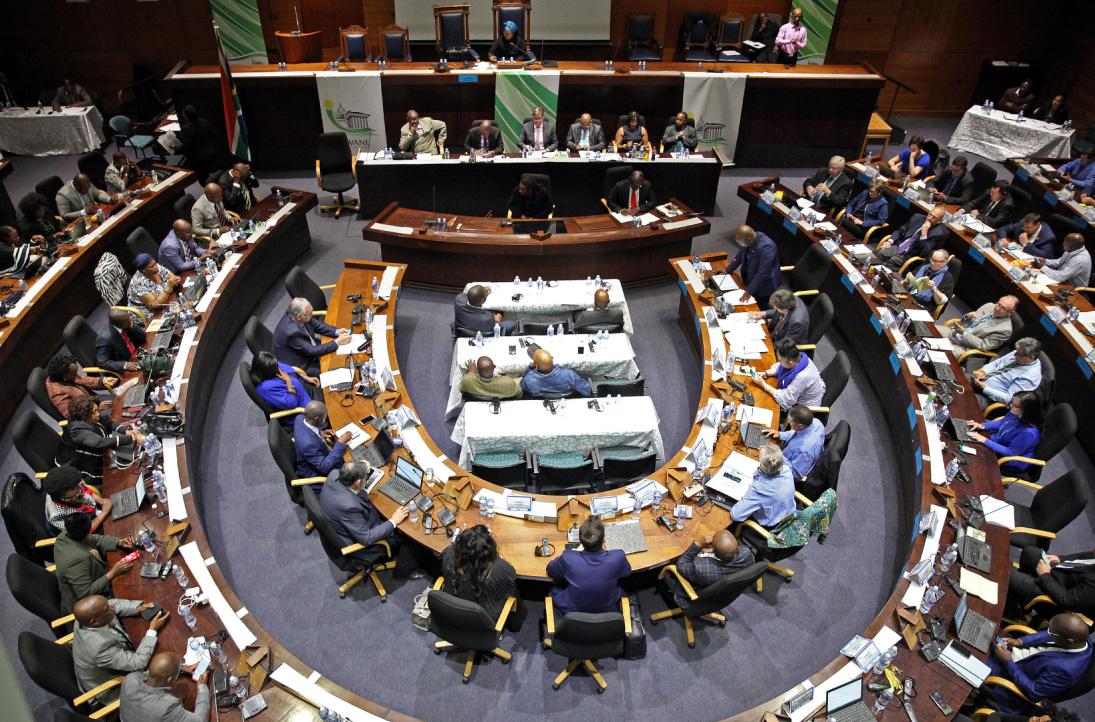
“Research by the Mapungubwe Institute for Strategic Reflection (MISTRA) suggests that coalition governments across South Africa have sometimes proved more resilient than their public reputation indicates, although their ability to remain in power does not necessarily translate into improved municipal services. The findings place renewed attention on coalition agreements, political accountability, administrative capacity and the ability of local governments to deliver reliable water, electricity, sanitation and infrastructure maintenance.”
South Africa’s Coalition Governance Faces a Defining Test as Local Government Elections Approach
South Africa’s local government system is entering a critical period as political parties prepare for the 2026 local government elections, with new research challenging conventional assumptions about coalition governments and raising important questions about accountability, administrative stability and municipal service delivery. Findings from the Mapungubwe Institute for Strategic Reflection (MISTRA) suggest that coalition administrations have sometimes proved more resilient than their reputation suggests, although political survival alone does not guarantee effective governance.
The research, reported by Eyewitness News on 9 October 2026, examines the experience of municipalities operating under coalition arrangements following the 2021 local government elections. Its findings are significant because South Africa’s increasingly fragmented political landscape means that cooperation between parties may remain central to how municipalities are governed after the next elections.
Coalition governance under renewed scrutiny
Coalition governments emerge when no single political party wins enough seats to govern a municipal council independently. Parties must negotiate agreements, share responsibilities and secure sufficient support to elect mayors and approve council decisions.
Although coalition arrangements can create opportunities for cooperation between different political organisations, they can also introduce challenges when parties disagree over leadership, budgets, appointments or policy priorities. In several South African municipalities, changes in political alliances have resulted in new administrations before the end of an electoral term.
However, the MISTRA research indicates that the overall picture is more complicated than frequent reports of political disputes might suggest. The institute examined approximately 80 of the 213 municipalities that became hung at some point following the 2021 elections. These municipalities experienced around 175 administrations, with approximately half lasting fewer than 21 months.
Despite these changes, the research found that in more than half of the municipalities examined, the party that initially led the government did not ultimately lose power. Approximately one-third of the administrations remained in their original form, while another third retained the original leading party’s control.
These findings challenge the assumption that coalition government automatically produces institutional dysfunction. They suggest that political arrangements can remain workable even when disagreements occur, particularly where participating parties find ways to negotiate and preserve governing agreements.
Political stability does not automatically improve services
One of the most important distinctions emerging from the research is the difference between a government remaining in office and a government delivering effectively.
Residents judge municipal performance through everyday experiences, including whether water flows reliably, electricity remains available, rubbish is collected, roads are maintained and wastewater systems operate properly. These responsibilities require functioning institutions, adequate financial resources and competent administrative leadership.
A coalition can survive several years without collapsing while residents continue experiencing service interruptions, deteriorating infrastructure or slow responses to complaints. Conversely, political changes do not necessarily mean that every municipal department will stop functioning.
Governance expert Walker Masungini, a local government researcher at Vaal University of Technology, cautioned against treating political stability as proof of successful service delivery. The research similarly distinguishes the survival of political arrangements from the quality of services provided to communities.
This distinction matters because residents need measurable improvements rather than political assurances alone. Municipal performance should therefore be assessed against practical indicators, such as maintenance schedules, water-loss reduction, financial management, infrastructure repairs and the completion of approved projects.
Councils should also explain why projects are delayed, how public funds are being spent and what corrective measures are being implemented. Such transparency enables residents to evaluate performance using evidence rather than relying exclusively on statements from political parties.
The influence of smaller political parties
South Africa’s coalition landscape has also increased the negotiating power of smaller political parties. When no party controls a majority, a relatively small group of councillors can determine which alliance forms an administration.
MISTRA’s findings illustrate how coalition negotiations have influenced leadership arrangements in municipalities. Following the 2021 elections, political realignments affected Johannesburg, Ekurhuleni and Tshwane, where governing arrangements changed after alliances fractured.
The research also highlights the role of smaller parties in securing mayoral positions and influencing council decisions. The Patriotic Alliance, for example, gained significant influence in coalition negotiations, demonstrating that a party does not necessarily need to be the largest organisation in a council to exercise substantial governing power.
This influence is not inherently inconsistent with democratic government. Coalition arrangements can reflect legitimate negotiations among elected representatives, provided that the resulting administrations comply with the law and remain accountable to their councils and residents.
Nevertheless, the arrangements create responsibilities for every participating party. Parties negotiating executive positions should also establish clear policy priorities, agree on financial oversight procedures and explain how disagreements will be resolved.
Without these safeguards, political negotiations can become dominated by disputes over positions rather than practical plans for improving municipal administration.
Why coalition agreements matter
A coalition agreement can provide a framework for cooperation by specifying the responsibilities of participating parties, their shared policy objectives and procedures for managing disagreements.
Such agreements are particularly important when parties have different priorities or when a municipality faces serious financial and operational difficulties. Clear procedures can reduce uncertainty when councillors disagree about appointments, budgets or the implementation of projects.
MISTRA’s research suggests that coalitions excluding the party with the largest number of seats are more likely to collapse prematurely. However, such arrangements can still be legitimate when participating parties collectively secure the necessary majority. Their sustainability may depend on stronger compromise, greater transparency and workable agreements.
Parties should therefore avoid relying solely on informal understandings. Written agreements should establish how decisions are made, how disputes are escalated and what happens when a party withdraws its support.
They should also protect the municipality’s administrative operations from unnecessary political interference. Essential services must continue even when councillors negotiate new alliances or replace political office-bearers.
Professional administration and accountability
Municipal governance depends on both elected representatives and professional public servants. Councillors determine political priorities, approve budgets and exercise oversight, while municipal officials implement policies, manage operations and ensure compliance with relevant legislation.
When these responsibilities become blurred, administrative decisions may be vulnerable to political pressure. Concerns about appointments, procurement, financial controls and the management of municipal entities can weaken public confidence if they are not addressed transparently.
The national government has also been considering reforms to local government. A revised White Paper on Local Government, discussed by Cooperative Governance and Traditional Affairs Minister Velenkosini Hlabisa in October, places renewed emphasis on implementation, municipal performance and the appointment of senior officials.
Professional appointments should be based on relevant qualifications, experience and demonstrated competence. Recruitment procedures must also be transparent, with clear records showing how candidates were assessed and selected.
Furthermore, councils need effective oversight mechanisms to investigate irregular expenditure, monitor audit findings and ensure that corrective actions are completed. Where investigations identify misconduct, the appropriate legal and disciplinary procedures should be followed.
These measures are important regardless of which party controls a municipality. Strong administrative systems should continue functioning through changes in mayors, councillors and coalition partners.
Financial management remains a central challenge
Political stability cannot compensate for weak financial planning. Municipalities need credible budgets, reliable revenue collection and effective controls over expenditure to maintain infrastructure and provide services.
South Africa’s National Treasury has previously highlighted serious municipal financial management concerns, including unfunded budgets, irregular expenditure and outstanding payments to essential service providers. Its July 2026 statement described measures intended to improve compliance and strengthen accountability for public funds.
These challenges demonstrate why coalition negotiations should include clear commitments on financial oversight. Councils must ensure that budgets reflect realistic revenue expectations and that spending decisions support approved priorities.
Municipal administrations also need to monitor debts owed to electricity suppliers, water boards and other service providers. Persistent non-payment can place additional pressure on public institutions and threaten the continuity of services.
Audit findings should lead to practical action rather than simply being acknowledged in council meetings. Management should identify the underlying causes of recurring problems, assign responsibility for corrective measures and report progress against defined deadlines.
Residents should also be able to access understandable information about municipal spending and performance. Public participation becomes more meaningful when communities can examine budgets, raise concerns and assess whether promised improvements have been delivered.
Preparing for the 2026 local government elections
The approaching local government elections will test how political parties respond to the experiences of the past five years. Voters will have an opportunity to assess their representatives’ records, compare policy proposals and consider the practical implications of different governing arrangements.
The MISTRA research suggests that coalition governments may be more resilient than some public narratives imply. Nevertheless, it does not establish that every coalition is stable or that coalition arrangements consistently produce better services.
Instead, the findings point to the importance of examining each municipality individually. Local circumstances, administrative capacity, financial resources and the quality of political cooperation can all affect performance.
Political parties seeking council representation should explain how they intend to manage coalitions, protect municipal institutions and improve service delivery. They should also describe how they will respond when negotiations fail or governing partners disagree.
For voters, evaluating these commitments requires looking beyond campaign promises. Relevant questions include whether parties have published realistic plans, whether their previous commitments were fulfilled and whether their proposals include measurable objectives.
The coming elections may produce councils in which several parties must cooperate to establish a majority. If that happens, the ability to negotiate transparent agreements and maintain professional administration will remain important to effective government.
The road ahead for municipal governance
South Africa’s coalition experience demonstrates that political stability and effective service delivery are related but separate questions. An administration that remains in power may still struggle to maintain infrastructure, manage finances or respond to community needs. Equally, a change in political leadership does not necessarily mean that every municipal institution will fail.
The challenge for political parties is to turn cooperation into measurable improvements in residents’ lives. That requires clear agreements, accountable leadership, capable officials, credible budgets and reliable oversight.
The findings reported by EWN provide a useful contribution to the governance debate ahead of the 2026 local government elections. They challenge simplistic conclusions about coalition government while emphasising the need to assess political arrangements against their actual performance.
Ultimately, municipal governance must be measured by more than how long a coalition survives. Its value depends on whether public institutions operate lawfully, whether public money is managed responsibly and whether residents receive the services to which they are entitled.
As South Africa approaches another local electoral cycle, political parties, municipal officials and communities will face a shared responsibility: ensuring that the democratic process produces accountable administrations capable of addressing local needs. The coming period will reveal whether lessons from the previous five years translate into stronger cooperation, more transparent decision-making and better outcomes for residents.



