




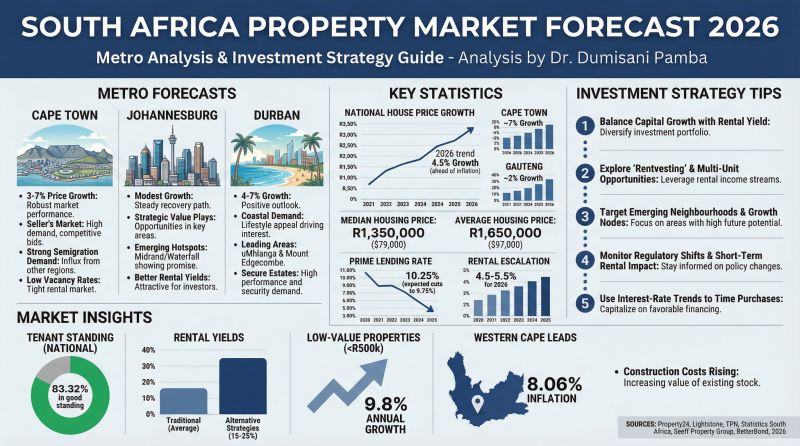
“South Africa’s land and property market is experiencing renewed confidence in September 2026, driven by the South African Reserve Bank’s decision to hold interest rates steady. This stability has encouraged buyers and developers to invest in land, particularly in mid-to-high value regions where growth is strongest.”
The South African land and real estate market has entered September 2026 with a renewed sense of optimism. After years of volatility shaped by global economic pressures, local policy shifts, and affordability challenges, the sector is now stabilizing. At the heart of this transformation lies the land market, where buyers, developers, and investors are recalibrating strategies to capitalize on steady interest rates and emerging regional hotspots.
Interest Rate Stability as a Catalyst
The South African Reserve Bank (SARB) has maintained the repo rate at 7.00% and the prime lending rate at 10.50%, a decision that has injected predictability into the market. This stability is crucial for land transactions, as it reduces borrowing uncertainty and allows developers to plan long-term projects with confidence. Mortgage applications have increased, signaling that serious buyers are ready to commit to land purchases and development ventures.
Regional Hotspots Driving Land Demand
Land demand is not uniform across South Africa. Certain regions are emerging as hotspots:
- Mid-Market Zones (R1.5m–R3.5m properties): These areas are seeing 4–5% annual growth, fueled by middle-income households and semi-gration trends.
- High-End Urban Land (R2.5m–R5m): Growth rates of 8–10% are being recorded in established urban centers, where land scarcity is pushing values upward.
Semi-Gration and Lifestyle Shifts
A notable trend is semi-gration, where families and professionals are relocating from major metros to smaller towns and peri-urban areas. This has created demand for residential land in regions like the Western Cape and KwaZulu-Natal, where lifestyle appeal and infrastructure development intersect. Developers are responding by acquiring land for mixed-use projects that combine housing, retail, and green spaces.
Affordable Land Challenges
While mid-to-high value land markets thrive, the entry-level segment (below R1.2m) continues to face affordability hurdles. Strict lending criteria and deposit requirements limit access for first-time buyers. Despite strong demand, transactional volumes remain subdued, highlighting the need for policy interventions to unlock affordable land opportunities.
Investor Confidence and Development Projects
Institutional investors and developers are increasingly confident in land acquisitions. Infrastructure spending by government, particularly in transport and logistics, has boosted the attractiveness of land near development corridors. Industrial land, especially for warehousing and logistics, is experiencing record-low vacancy rates, underscoring its resilience.
Risks and Considerations
Despite the optimism, risks remain:
- Affordability constraints for lower-income buyers.
- Regional disparities in growth, with some provinces lagging.
- Global economic uncertainties that could affect lending conditions.
Conclusion
South Africa’s land market in September 2026 reflects a sector in transition. Stable interest rates have created fertile ground for investment, while regional hotspots and lifestyle shifts are reshaping demand. For developers and buyers alike, the message is clear: patience, research, and strategic land acquisition are the keys to unlocking value in this evolving landscape.



