




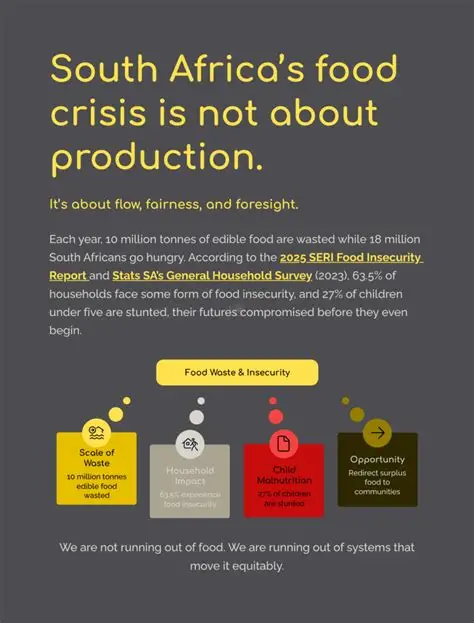
“Food prices in South Africa showed a modest month-on-month decline in August 2026, but wage shortfalls, rising municipal costs, and inadequate social grants continue to push low-income households into deeper nutritional insecurity. Despite some drops in fresh produce prices, staples like potatoes (+7%), beef (+5%), and butternut (+8%) surged, worsening affordability.”
South Africa’s food affordability crisis has reached a critical juncture. Despite headline inflation showing marginal relief, the lived reality for millions of low-income households is worsening. The latest Household Affordability Index from the Pietermaritzburg Economic Justice & Dignity Group (PMBEJD) paints a stark picture: food basket costs remain stubbornly high, structural wage deficits persist, and essential non-food expenses erode household purchasing power.
Inflation vs. Affordability
While Statistics South Africa reported headline inflation at 4.3% in July 2026, with food inflation easing slightly, affordability remains elusive. The paradox lies in aggregate numbers masking the microeconomic reality: households are squeezed between rising fixed costs (electricity, transport, municipal services) and volatile food prices.
Price Dynamics
The August 2026 data reveals a dual trend:
- Staple foods like potatoes, beef, and butternut surged in price, directly impacting household nutrition.
- Fresh produce such as tomatoes and oranges saw steep declines, but these are often supplementary rather than core staples.
This divergence underscores the vulnerability of households reliant on starches and proteins, which continue to climb.
Regional Disparities
Food affordability is not uniform across South Africa. Urban hubs such as Pietermaritzburg and Durban recorded increases, while rural towns like Mtubatuba and Mthatha saw declines. This reflects supply chain dynamics, transport costs, and localized demand pressures.
Wage Deficits and Social Grants
The minimum wage shortfall remains a critical barrier. Workers earning the statutory minimum cannot afford the average food basket, particularly when factoring in electricity and transport costs. Social grants, while vital, are insufficient to bridge the gap.
Structural Challenges
Persistent farm-gate inflation (9.3% for live animals and animal products) highlights upstream pressures. Producers face rising input costs, which cascade down to consumers. Without structural reforms in agriculture, logistics, and wage policy, affordability will remain elusive.
Policy Implications
The crisis demands urgent policy intervention:
- Strengthening wage policies to align with food affordability benchmarks.
- Expanding social grants to cover nutritional needs.
- Investing in agricultural efficiency to stabilize farm-gate prices.
- Addressing municipal cost burdens that erode disposable income.
Conclusion
South Africa’s food affordability crisis is not merely about inflation metrics—it is about survival. The August 2026 data underscores the widening gap between statistical relief and lived reality. Unless structural reforms are enacted, millions will remain trapped in nutritional insecurity, with long-term consequences for health, productivity, and social stability.



