




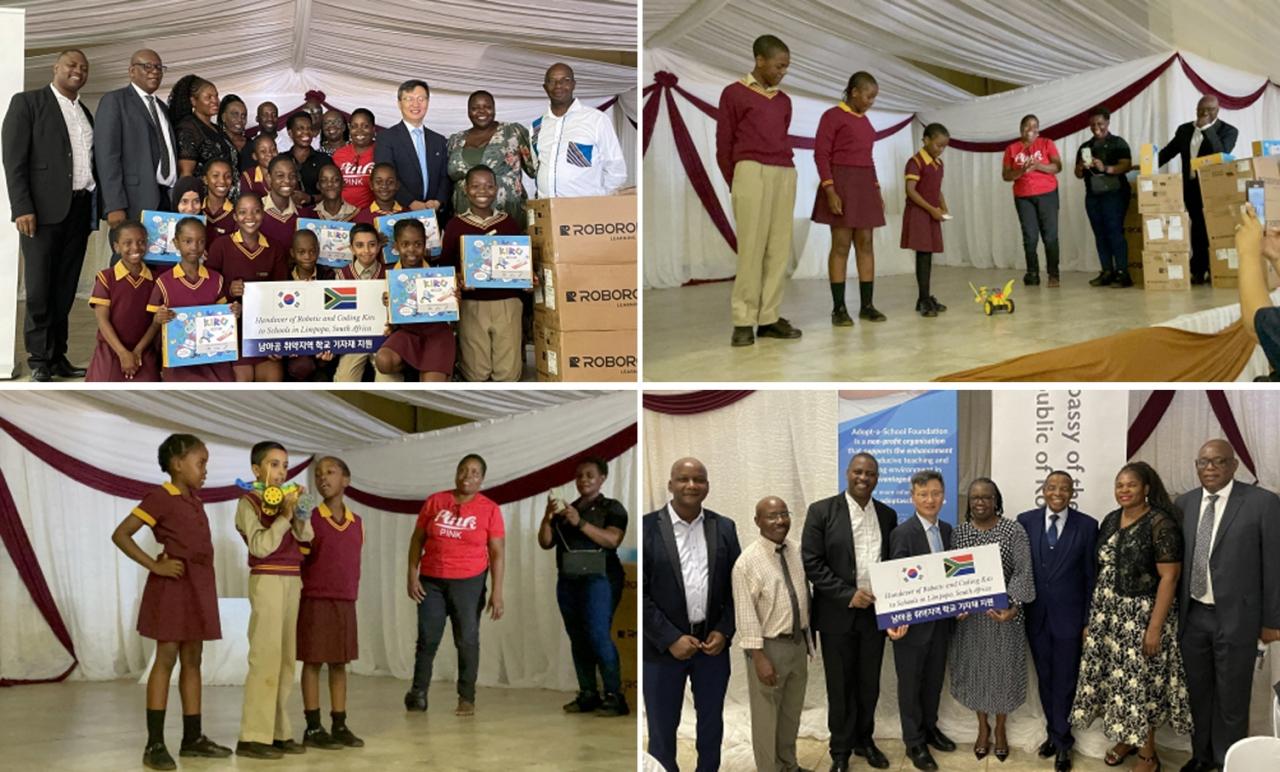
“The University of Venda has distributed robotics kits to participating schools across Limpopo Province, with 24 schools collecting equipment during a handover ceremony at Nirvana Primary School. The initiative, implemented through partnerships involving the university and the South African Robotics and E-Sports Agency, aims to strengthen practical science, technology, engineering and mathematics (STEM) education while introducing more learners to robotics, coding and technological innovation.”
University of Venda Expands Robotics Education to 24 Schools Across Limpopo
The University of Venda (UNIVEN) has strengthened efforts to expand robotics education in South Africa by supporting schools across Limpopo Province with robotics kits designed to encourage practical learning, technological creativity and problem-solving. The initiative represents an important step towards improving young people’s access to emerging technologies and preparing learners for a future increasingly shaped by automation, artificial intelligence and digital innovation.
According to the university’s announcement published on 15 October 2026, representatives from participating schools collected robotics kits during a handover ceremony at Nirvana Primary School. Twenty-four schools took part in the collection, demonstrating growing interest in introducing robotics and coding activities into school education. Additional schools that could not collect their equipment during the event were expected to make alternative arrangements with programme organisers.
The programme, titled Empowering Young Minds Through Robotics, Innovation and STEM Education, reflects a broader commitment to making technological learning more accessible beyond university campuses. By connecting higher education institutions, schools and community partners, the initiative seeks to give learners opportunities to engage with technology through experimentation rather than relying exclusively on classroom theory.
Robotics education moves closer to learners
Robotics combines several disciplines, including mechanical engineering, electronics, computer programming and mathematics. Educational robotics kits allow learners to explore these subjects by assembling components, programming movements, testing sensors and solving practical challenges.
For pupils encountering these concepts for the first time, the opportunity to build and operate a simple robot can make technical subjects more understandable. Instead of studying programming as an abstract exercise, learners can observe how instructions affect a machine’s behaviour, identify mistakes and modify their code to achieve a particular outcome.
This practical approach can also encourage collaboration. When learners work in teams to construct a robot or complete a coding challenge, they must communicate their ideas, divide responsibilities and evaluate alternative solutions. These activities can strengthen analytical thinking, creativity and persistence.
UNIVEN’s initiative therefore has implications beyond the immediate distribution of equipment. It creates opportunities for schools to introduce learning experiences that help pupils understand how scientific knowledge can be applied to real-world problems.
Partnerships support technological development
The university’s programme involves collaboration through its existing memorandum of understanding with the South African Robotics and E-Sports Agency (SARESA). UNIVEN identified its Faculty of Science, Engineering and Agriculture, the Vuwani Science Resource Centre and the Green Technology Confucius Institute among the university structures involved in the initiative.
Such partnerships can be valuable because effective robotics education requires more than providing schools with equipment. Teachers need guidance on how to use the kits, learners require structured activities, and schools benefit from access to mentors who can help troubleshoot technical difficulties.
Universities can contribute subject expertise, laboratory experience and opportunities for advanced learning. Community organisations and other partners can help connect schools with additional resources and activities. When these contributions are coordinated, robotics programmes have a stronger chance of developing into sustained educational opportunities.
The initiative also illustrates how higher education institutions can extend their public role. Universities are not only places where specialised research is conducted; they can also share knowledge and resources with communities and help younger learners prepare for further education.
Addressing unequal access to technology
Access to modern learning resources remains an important consideration in South Africa’s education system. Schools do not all have the same access to computers, reliable internet connections, specialised equipment or educators with experience in programming and engineering.
For learners with limited exposure to these technologies, robotics kits can provide an introduction to fields they might otherwise encounter only later in their education. Early exposure may also help pupils recognise their interests and consider future study in engineering, computer science, mechatronics and related disciplines.
However, equipment distribution alone cannot eliminate educational inequality. Schools need sufficient time, appropriate learning spaces and trained educators to integrate robotics activities into their teaching programmes.
Electricity, computer availability, maintenance and access to technical support can also affect how frequently equipment is used. If these practical requirements are overlooked, donated kits may be used less often than intended.
For this reason, the long-term success of the UNIVEN initiative will depend partly on what happens after the handover. Regular lessons, teacher development, practical workshops and opportunities for learners to demonstrate their projects could help convert the initial distribution into lasting educational benefits.
Building skills for a changing economy
Robotics is becoming increasingly relevant to industries that use automation to improve productivity, safety and precision. Manufacturing facilities, warehouses, agricultural operations, mining companies and research laboratories use robotic technologies for different tasks, although the equipment and level of automation vary considerably.
South Africa’s future workforce will need people who can understand these systems, maintain machinery, interpret data and develop technological solutions. Robotics education at school level can provide an early foundation for these capabilities.
Learners do not necessarily need to become professional roboticists to benefit from the experience. Understanding basic programming logic, sensors, control systems and systematic problem-solving can be useful across a wide range of technical careers.
The educational value also extends to entrepreneurship. Students who learn to identify problems and develop prototypes may eventually explore ways to apply technology to local challenges, such as water management, agricultural monitoring, environmental observation or the automation of repetitive tasks.
Nevertheless, a school robotics programme should not be presented as a guarantee of future employment. Its immediate contribution is to build knowledge, confidence and familiarity with technology. Further education, practical experience and access to advanced training remain important for developing professional expertise.
The importance of supporting teachers
Teachers will play a central role in determining whether the initiative achieves its objectives. Even when robotics kits are supplied, educators need suitable training to design lessons, guide learners through technical challenges and connect practical activities with curriculum objectives.
Professional development can help teachers introduce programming concepts progressively. Beginners might start with simple instructions and movements before advancing to sensor-based tasks, obstacle avoidance and more complex automated behaviour.
Training should also address common technical problems, equipment storage, safe handling and ways to adapt activities for learners with different levels of experience.
Schools could strengthen their programmes by establishing robotics clubs, arranging inter-school challenges and inviting university students or engineers to mentor participants. These activities would give learners opportunities to practise regularly and receive feedback outside ordinary lessons.
Teachers could also document projects and track learner progress, helping schools identify which activities are effective and where additional support is needed.
From classroom experiments to local innovation
One of the most promising aspects of robotics education is its potential to connect classroom learning with problems in the surrounding community.
For example, learners could investigate how sensors measure environmental conditions or how automated systems respond to changes in their surroundings. With suitable supervision and equipment, these exercises could introduce principles relevant to agriculture, water conservation and environmental monitoring.
Projects should remain appropriate to learners’ ages and available resources. The objective is not necessarily to build sophisticated industrial machines, but to encourage learners to ask questions, test ideas and improve their designs through evidence.
Local challenges can make these experiences more meaningful because learners can see a direct relationship between technical knowledge and everyday life.
The programme could also help schools develop stronger relationships with universities and technical institutions. Such connections may provide pathways to science exhibitions, engineering competitions, further study and mentorship.
Measuring the programme’s long-term impact
The number of schools receiving robotics kits provides a useful initial measure of participation, but it does not reveal how extensively the equipment will be used or what learners will achieve.
A longer-term evaluation could examine how many schools establish regular robotics activities, how frequently kits are used and whether teachers receive continuing support. Learner participation, completed projects and improvements in practical programming skills could provide additional indicators.
Feedback from teachers and pupils would help organisers identify obstacles, including insufficient equipment, limited teaching time or difficulties maintaining the kits.
Transparent reporting would also help partners understand where further investment is needed. If certain schools require additional computers, replacement components or advanced training, this information could guide future support.
It is important to distinguish the immediate outputs of the initiative from its eventual outcomes. Distributing kits creates an opportunity for learning; sustained participation and demonstrable improvements in knowledge require continued implementation and evaluation.
A foundation for inclusive technological learning
UNIVEN’s robotics initiative highlights the importance of introducing young people to technology through accessible, practical education. By bringing robotics equipment to participating schools, the university and its partners are creating opportunities for learners to experiment with engineering concepts, explore programming and develop problem-solving skills.
The handover at Nirvana Primary School is an encouraging development, particularly because it links university expertise with schools and communities. Its wider significance will depend on whether participating institutions can maintain the momentum through teacher training, regular activities and meaningful opportunities for learners to apply their knowledge.
South Africa’s technological future will require both advanced research and a broad foundation of digital and engineering skills. School-level robotics programmes can contribute to that foundation by helping young people become more confident in understanding and using technology.
The next challenge is to ensure that the kits become active learning tools rather than one-time resources. With continued support, effective teaching and opportunities for collaboration, the initiative could help more learners in Limpopo discover the possibilities of robotics and prepare for further participation in the country’s evolving innovation economy.



