




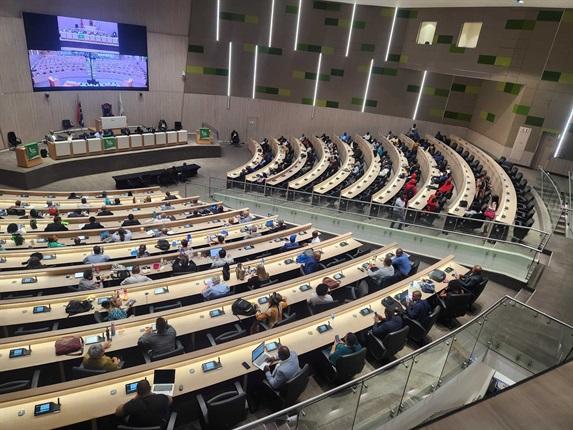
“The ANC, ActionSA, EFF and uMkhonto weSizwe (MK) Party have reportedly reached a coalition agreement to govern the City of Tshwane, with ActionSA’s Nasiphi Moya expected to return as mayor. The reported arrangement also allocates important municipal leadership positions to coalition partners, as South Africa’s political parties continue negotiations over the governance of hung municipalities following the local government elections.”
ANC, ActionSA, EFF and MK Party reportedly reach Tshwane coalition deal as Gauteng political negotiations intensify
Coalition negotiations reshape municipal political leadership in South Africa
South Africa’s municipal political landscape is entering another important phase following reports that the African National Congress (ANC), ActionSA, the Economic Freedom Fighters (EFF) and the uMkhonto weSizwe (MK) Party have reached a coalition agreement to govern the City of Tshwane. The reported agreement, published by Eyewitness News on 26 November 2026, could shape the leadership and administration of South Africa’s capital city for the next five years. It also reflects the changing relationships between political parties as they negotiate positions and responsibilities following the 2026 local government elections.
The negotiations are taking place against the background of a fragmented municipal political environment in which no single political organisation can necessarily secure control of every municipality independently. Consequently, parties have had to consider cooperation with organisations that may hold different political positions, electoral priorities and approaches to local government.
The reported Tshwane arrangement is particularly significant because it brings together four political organisations: the ANC, ActionSA, the EFF and the MK Party. Their cooperation demonstrates how municipal governance negotiations can create political partnerships that differ from the relationships parties maintain in other municipalities or at national level.
Reported agreement places ActionSA’s Nasiphi Moya in the mayoral position
According to Eyewitness News, the agreement would see ActionSA’s Nasiphi Moya re-elected as mayor of Tshwane. The report also indicates that an EFF representative is tipped to become deputy mayor, while the ANC is expected to nominate Naeem Patel for the position of council speaker.
These positions are important because municipal leadership involves more than political representation. The mayoral office has responsibilities relating to executive leadership, municipal priorities and the implementation of council decisions. The speaker, meanwhile, presides over council proceedings and has an important role in ensuring that council business is conducted according to applicable rules and procedures.
The deputy mayor’s responsibilities depend on the municipality’s arrangements and delegated functions. Nevertheless, the position can provide an important political and administrative link within a coalition government.
The distribution of these positions illustrates how coalition partners may negotiate leadership responsibilities in exchange for supporting a common administration. Such agreements can help establish a governing majority, but their success depends on whether the parties can maintain cooperation after the initial negotiations have ended.
The EWN report states that 214 councillors are being sworn in during the council’s first sitting on Thursday, 26 November. These councillors will serve for the next five years. Following the swearing-in process, council members are expected to participate in the election of the mayor, deputy mayor, speaker and council whip.
The council’s decisions will therefore determine the political leadership structure responsible for overseeing the municipality during the new electoral term.
Four political parties face the challenge of working together
Although the reported coalition agreement represents an important development, cooperation between political parties does not automatically guarantee administrative stability.
The ANC, ActionSA, EFF and MK Party have distinct political histories, organisational structures and public policy priorities. Their ability to govern together will depend on how effectively they manage differences while agreeing on municipal priorities.
The ANC has a long history of governing South African municipalities and remains a major political organisation in the country’s local government environment. ActionSA, meanwhile, has sought to establish itself as an alternative political force, with municipal governance and service delivery among its important areas of political engagement.
The EFF has consistently placed economic transformation, employment, land and the expansion of public services at the centre of its political programme. The MK Party, which has become an important participant in South African politics, has also entered municipal coalition negotiations as parties seek governing arrangements across the country.
The reported Tshwane agreement requires these organisations to identify common ground on municipal administration, financial management, infrastructure, public services and political accountability.
Their cooperation will be tested when council decisions require compromises between different party positions. For example, disagreements could emerge over budget priorities, appointments, procurement oversight, municipal borrowing, infrastructure investment and the allocation of responsibilities among coalition representatives.
A successful coalition will therefore need more than an agreement concerning leadership positions. It will require clearly defined responsibilities, transparent decision-making arrangements and mechanisms for resolving disagreements.
ActionSA’s negotiations with the ANC extend beyond Tshwane
The reported agreement is also important because it forms part of wider political negotiations involving Gauteng’s three major metropolitan municipalities: Tshwane, Johannesburg and Ekurhuleni.
A separate Eyewitness News report published on 26 November indicates that ActionSA has been seeking leadership positions in all three metropolitan areas through negotiations with the ANC.
According to the report, ActionSA is interested in mayoral positions in Johannesburg and Tshwane, as well as a deputy mayoral position in Ekurhuleni. However, the party’s ambitions depend on whether the ANC is prepared to formalise the proposed coalition arrangements.
ActionSA reportedly indicated that it had reached an agreement in principle with the ANC but was still waiting for the arrangement to be formally concluded.
This distinction is important. An agreement in principle indicates that political organisations may have found common ground during negotiations, but it does not necessarily mean that every leadership position, policy commitment and administrative responsibility has been finalised.
The uncertainty surrounding the Gauteng negotiations also demonstrates the complexity of forming municipal governments after elections in which political representation is divided among several organisations.
The Democratic Alliance (DA) has also maintained its interest in municipal leadership, particularly in Ekurhuleni. EWN reported that the party had not abandoned its efforts to lead that municipality and was continuing discussions with other political organisations.
Consequently, the Tshwane agreement should not automatically be interpreted as a final settlement for every metropolitan municipality in Gauteng.
Political competition continues in KwaZulu-Natal municipalities
The coalition negotiations in Gauteng are taking place alongside significant political developments elsewhere in South Africa.
On 26 November, the Mail & Guardian reported that the ANC, DA, Inkatha Freedom Party (IFP) and EFF had joined forces to form a governing arrangement in Mandeni Local Municipality in KwaZulu-Natal, leaving the MK Party outside the new municipal leadership agreement.
The report stated that the MK Party had secured 17 seats in the 35-seat council, while the IFP and ANC had eight seats each. The DA and EFF each held one seat. At least 18 seats were required to establish a governing majority.
The negotiations reportedly broke down after disagreements over the allocation of leadership positions. According to the Mail & Guardian, the EFF wanted a deputy mayoral position, while the MK Party proposed a portfolio committee chairperson position instead.
The eventual arrangement saw IFP representative Andile Biyela become mayor, ANC representative Zamile Mdletshe become speaker and the EFF receive the deputy mayoral position.
This development illustrates an important feature of coalition politics: the number of seats a political party wins does not automatically determine whether it will lead a municipality.
Parties with smaller council representation can become important negotiating partners when their support is necessary to establish a majority.
Mandeni and Tshwane also demonstrate that political alliances can differ considerably between municipalities. The ANC and EFF, for example, are reportedly working with ActionSA and the MK Party in Tshwane, while the ANC, EFF and DA are cooperating with the IFP in Mandeni.
Such differences underline the importance of local political circumstances when parties negotiate governing arrangements.
Municipal service delivery becomes the central test
While political parties negotiate mayoral positions and council leadership structures, residents will ultimately judge the new administrations through their performance.
Tshwane faces the responsibility of providing reliable municipal services to households, businesses and communities across a large metropolitan area. These responsibilities include water provision, electricity infrastructure, sanitation, waste collection, road maintenance, public transport planning and the management of municipal facilities.
The coalition will also need to address the municipality’s financial and administrative responsibilities. These include improving revenue collection, managing expenditure, maintaining infrastructure and ensuring that public funds are used according to applicable financial regulations.
Coalition disagreements can create uncertainty when political partners fail to agree on budgets, administrative appointments or development priorities. Such disagreements can delay decisions and affect the implementation of municipal programmes.
For this reason, the parties will need to establish clear procedures for handling disputes and maintaining continuity in municipal operations.
The council must also ensure that political competition does not interfere with the professional responsibilities of municipal officials. Administrative decisions should follow relevant legislation, procurement requirements and oversight procedures.
Residents from different political constituencies should receive municipal services according to their needs rather than their political affiliations.
Accountability and transparency remain essential
Another important responsibility for the incoming administration will be strengthening accountability.
Coalition governments distribute political authority among different organisations. This can create opportunities for broader representation, but it can also make responsibility less clear when decisions are delayed or municipal targets are not achieved.
A transparent coalition agreement can help address this problem by identifying the responsibilities of each political organisation and setting out procedures for monitoring performance.
The council should also maintain effective oversight of municipal expenditure, infrastructure contracts and service delivery programmes.
Public participation will be equally important. Residents need accessible opportunities to raise concerns, participate in municipal planning processes and receive information about council decisions.
The coalition partners will have to demonstrate that their cooperation is based on an agreed programme for municipal governance rather than simply an arrangement for distributing political positions.
Johannesburg and Ekurhuleni negotiations remain important
The political situation in Tshwane could have implications for negotiations in Johannesburg and Ekurhuleni, where parties are also working to establish municipal leadership structures.
EWN reported that the coalition arrangement involving the ANC, ActionSA, EFF and MK Party could potentially extend to the other two Gauteng metropolitan municipalities. However, their leadership arrangements remained subject to further negotiations at the time of publication.
The political parties will need to consider local council numbers, available support and the responsibilities each organisation is prepared to accept.
The DA’s continued involvement in negotiations demonstrates that the political landscape remains fluid. Different parties may pursue different combinations depending on their electoral representation and the conditions attached to potential agreements.
The coming council decisions will provide greater clarity about the direction of municipal governance across Gauteng.
Conclusion: Coalition negotiations enter a decisive municipal phase
The reported agreement between the ANC, ActionSA, EFF and MK Party in Tshwane represents a significant development in South Africa’s post-election political negotiations.
The proposed return of Nasiphi Moya as mayor, the expected EFF deputy mayoral position and the ANC’s anticipated nomination for council speaker demonstrate how the four parties are seeking to distribute municipal leadership responsibilities.
However, the durability of the arrangement will depend on more than the successful allocation of political positions. The coalition partners must work together on municipal budgets, infrastructure, service delivery, administrative accountability and long-term development priorities.
Developments in Mandeni further demonstrate how different political combinations are emerging across South Africa’s municipalities. Meanwhile, negotiations in Johannesburg and Ekurhuleni show that Gauteng’s broader political arrangements remain an evolving process.
For Tshwane residents, the most important question will be whether the new council can translate its political agreement into effective municipal administration and measurable improvements in public services.
The next five years will provide an opportunity to assess whether the coalition partners can maintain cooperation, manage their differences and fulfil the responsibilities entrusted to them through the democratic local government system.
Ultimately, the success of the reported Tshwane arrangement will be measured not simply by which political parties occupy leadership positions, but by the transparency, accountability and quality of governance delivered to the people of the capital city.



