




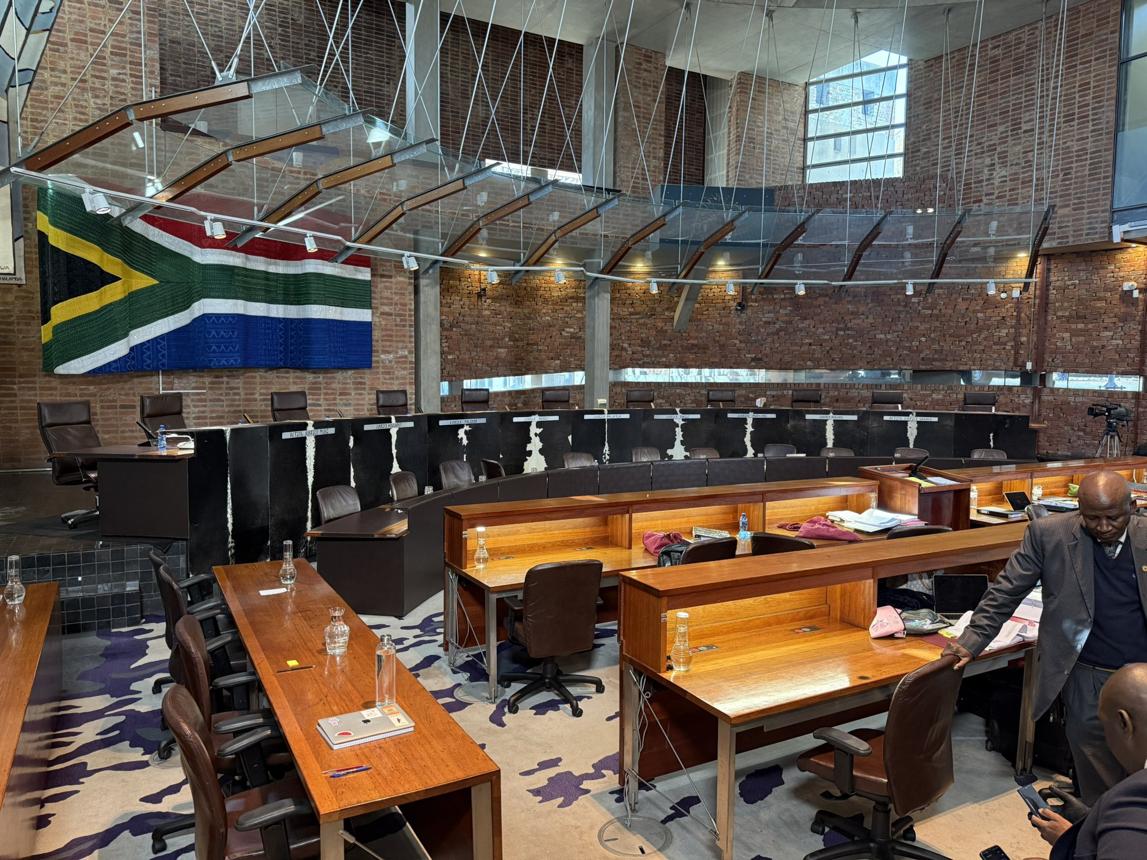
“South Africa’s Constitutional Court is scheduled to deliver judgment on Friday, 27 November 2026, in two challenges concerning Parliament’s public participation process when it considered the National Health Insurance (NHI) Bill. The ruling could have significant consequences for the future of the NHI Act, potentially requiring legislators to reconsider aspects of the legislation if the court finds constitutional shortcomings in the legislative process.”
South Africa’s NHI Legislation Faces Crucial Constitutional Court Test as Public Participation Comes Under Scrutiny
South Africa’s National Health Insurance (NHI) legislation is approaching a defining moment as the Constitutional Court prepares to deliver a major judgment on Friday, 27 November 2026. The case concerns whether Parliament complied with its constitutional responsibilities to facilitate meaningful public participation before passing the National Health Insurance Bill, which President Cyril Ramaphosa signed into law in May 2024.
The judgment is particularly important because it could influence the future of one of the most ambitious healthcare reforms in South Africa’s democratic history. It also raises broader questions about Parliament’s legislative responsibilities, public consultation, constitutional accountability and the extent to which citizens must be allowed to influence decisions that affect their lives.
According to reporting published by Business Day on 26 November, two separate legal challenges have placed Parliament’s handling of the NHI Bill under judicial examination. The applicants are the Board of Healthcare Funders (BHF), representing medical schemes and administrators, and the Western Cape provincial government. Both challenges question whether the legislative process provided adequate opportunities for meaningful public involvement.
Background to South Africa’s National Health Insurance legislation
The National Health Insurance Act represents the government’s proposed framework for transforming the country’s healthcare financing system. Its central objective is to move towards universal health coverage by establishing a national fund intended to finance healthcare services for qualifying members of the population.
South Africa has a healthcare system characterised by significant inequalities. Public healthcare facilities serve a large proportion of the population, while private healthcare services are largely accessed through medical schemes or direct payments. Differences in financial resources, infrastructure, staffing and access to specialised treatment have contributed to longstanding concerns about unequal healthcare opportunities.
The government has presented the NHI as an important instrument for addressing these inequalities and improving access to healthcare services.
However, implementing such a substantial reform requires more than passing legislation. It involves complex questions concerning funding, administration, healthcare infrastructure, professional participation, medical services and the relationship between public and private healthcare providers.
The NHI Bill was signed into law in May 2024. Nevertheless, signing the legislation did not mean that the entire system immediately became operational. The Act has not yet been brought into effect, and the legal challenges have become a significant obstacle to its implementation.
The forthcoming Constitutional Court judgment will therefore address an important preliminary question: whether the legislative process through which the NHI Bill was passed complied with the Constitution.
Why the Board of Healthcare Funders challenged Parliament
One of the central applicants in the case is the Board of Healthcare Funders, an industry association representing medical schemes and administrators.
The organisation argues that Parliament did not adequately consider concerns raised during the public participation process.
Although public hearings were conducted, the BHF maintains that allowing members of the public and interested organisations to make submissions is not necessarily sufficient to satisfy constitutional requirements.
The central issue is whether Parliament genuinely considered the concerns presented and provided a reasonable opportunity for affected stakeholders to influence the legislative process.
The organisation also raised concerns about the practical implications of the proposed healthcare reforms. These included questions about affordability, financial modelling, implementation arrangements and the potential consequences for the existing healthcare industry.
A particularly important argument concerns whether stakeholders had sufficient information to evaluate the proposed system and provide informed submissions.
The BHF’s position raises a fundamental question about democratic lawmaking: can Parliament properly consult the public when important practical and financial questions remain insufficiently explained?
This issue is especially relevant when legislation could substantially change the operation of an entire economic and public service sector.
Parliament, however, has defended its approach. The dispute therefore requires the Constitutional Court to examine the constitutional obligations of the legislature rather than simply deciding whether the government’s healthcare policy is desirable.
The Western Cape government’s separate legal challenge
The second challenge was brought by the Western Cape government.
Unlike the BHF’s broader challenge concerning Parliament’s legislative process, the provincial government’s argument focuses on the National Council of Provinces (NCOP).
The NCOP plays an important constitutional role in ensuring that provincial interests are represented in national legislative decision-making.
South Africa’s constitutional system recognises that national legislation can have significant consequences for provincial governments and the communities they serve. Consequently, provincial participation is an important component of the country’s legislative framework.
The Western Cape government argues that the NCOP did not adequately facilitate meaningful public participation during its consideration of the NHI Bill.
Its concerns include whether appropriate provincial consultation took place, whether submissions were properly considered and whether the legislative process adequately reflected the views of affected communities.
The dispute is significant because it demonstrates that constitutional participation requirements apply to different stages and institutions within Parliament.
The National Assembly and the NCOP have distinct responsibilities. Compliance with the requirements of one institution does not automatically establish that the other has fulfilled its constitutional duties.
The Constitutional Court must therefore consider the arguments relating to both legislative institutions.
The constitutional importance of public participation
The legal foundation of this dispute is South Africa’s Constitution.
Section 59(1)(a) requires the National Assembly to facilitate public involvement in its legislative and other processes.
Section 72(1)(a) establishes a corresponding obligation for the NCOP.
These provisions recognise that democratic participation extends beyond voting during elections. Citizens must also have reasonable opportunities to express their views on proposed laws and participate in important public decision-making processes.
Public participation is particularly important when legislation affects essential services such as healthcare, education, housing, employment and social protection.
Meaningful participation involves more than organising meetings or collecting written submissions. The process must provide reasonable opportunities for interested individuals and organisations to understand proposed legislation and communicate their concerns.
Parliament must also take its constitutional responsibilities seriously when considering the submissions received.
This does not mean legislators must accept every recommendation or agree with every stakeholder. Parliament retains the responsibility to make political and legislative decisions.
However, the public must have a genuine opportunity to influence the process.
The NHI case is therefore about the constitutional quality of lawmaking. Its implications extend beyond healthcare and could influence how future legislation is developed, debated and adopted.
Why the judgment could affect the future of the NHI Act
The Constitutional Court’s decision could produce several important outcomes.
If the applicants are unsuccessful, the existing legislative process will survive this particular challenge. However, this would not automatically resolve every legal dispute concerning the NHI Act.
Other challenges concerning the constitutionality and practical operation of the legislation remain relevant.
If the BHF succeeds, the court could find that Parliament failed to comply with its constitutional public participation obligations. This could result in the Act being declared invalid and referred back to the National Assembly for reconsideration.
If the Western Cape government’s challenge succeeds without the BHF succeeding, the legislative process could be referred back to the NCOP.
If both applicants succeed, the implications could extend across both stages of Parliament’s consideration of the legislation.
These possible outcomes demonstrate why the judgment is being closely watched by government, healthcare organisations, medical professionals, provincial authorities and the public.
It is important to distinguish between a judgment about the legislative process and a final determination of every substantive constitutional objection to the NHI policy.
The court is considering whether Parliament fulfilled its constitutional duties when passing the legislation. It is not simply being asked to choose between public and private healthcare systems.
Implications for healthcare providers and medical schemes
The outcome could have significant consequences for healthcare providers and medical schemes.
Medical schemes operate within an established regulatory environment and provide healthcare financing for millions of South Africans. The proposed NHI framework could substantially change the relationship between medical scheme funding and publicly financed healthcare services.
Healthcare providers are also concerned about how the proposed arrangements could affect professional independence, service delivery, financial sustainability and patient access.
For hospitals, doctors, specialists and other healthcare professionals, uncertainty surrounding the implementation of the NHI Act makes long-term planning more difficult.
A ruling requiring Parliament to reconsider the legislation could extend the period of uncertainty. However, it could also create an opportunity to address concerns through a more comprehensive legislative process.
A judgment favouring Parliament would provide an important procedural victory for the government, although it would not eliminate the possibility of subsequent constitutional challenges.
Businesses operating within the healthcare sector will therefore continue monitoring developments.
Consequences for ordinary South Africans
The case also matters to ordinary citizens who depend on public and private healthcare services.
For people relying on public hospitals and clinics, the proposed NHI system has been presented as an opportunity to improve access to healthcare and reduce inequalities.
For individuals who currently use private medical schemes, the legislation raises questions about future healthcare financing arrangements and the availability of services.
The Constitutional Court’s judgment will not immediately change the healthcare arrangements experienced by patients. Instead, it will determine an important legal question concerning the validity of the legislative process.
Nevertheless, the decision could influence the timetable and direction of future healthcare reforms.
Citizens should also recognise that constitutional public participation is not merely a technical legal requirement. It is a mechanism through which communities can communicate concerns about policies that affect access to essential services.
A transparent process can improve public confidence and help lawmakers identify practical problems before legislation is implemented.
Lessons for Parliament and future legislation
The NHI case comes at a time when South Africa’s legislative processes are receiving increasing constitutional scrutiny.
A particularly relevant example is the Constitutional Court’s September 2026 judgment concerning the Public Procurement Act 28 of 2024.
In that case, the court found that Parliament had failed to meet its constitutional obligation to facilitate public involvement. The legislation was consequently declared invalid.
The procurement judgment demonstrates that Parliament’s responsibility is not simply to pass legislation through the appropriate voting procedures. It must also ensure that constitutional participation requirements are satisfied.
The judgment reinforces the importance of giving affected communities reasonable opportunities to understand proposed legislative changes and communicate their views.
This background makes the NHI proceedings especially significant.
Parliament may need to consider whether its consultation procedures provide sufficient time, information and opportunities for meaningful engagement.
Government departments and parliamentary committees must also ensure that public submissions are properly documented and considered.
These practices can help reduce legal uncertainty and improve the quality of future legislation.
What happens next?
The Constitutional Court is scheduled to hand down judgment on Friday, 27 November 2026, at 10:00.
The decision will clarify whether the National Assembly and the NCOP fulfilled their respective constitutional obligations during the public participation process for the NHI Bill.
If the court finds constitutional shortcomings, Parliament may be required to reconsider the relevant legislative process.
If the applicants are unsuccessful, further legal challenges concerning the NHI Act could continue.
Either way, the judgment represents an important moment for South Africa’s constitutional democracy and healthcare policy.
The central issue is whether a major national reform can proceed without meaningful public participation. The Constitutional Court’s decision will help define the standards Parliament must meet when passing legislation that affects millions of people.
Editorial significance and conclusion
South Africa’s NHI legislation debate illustrates the relationship between constitutional democracy, public accountability and national development. Although universal healthcare remains an important policy objective, the government must pursue it through constitutionally compliant legislative procedures.
The forthcoming judgment will be important not only for healthcare stakeholders but also for future lawmakers, provincial governments, civil society organisations and ordinary citizens.
Ultimately, legislation gains democratic legitimacy when people have a meaningful opportunity to participate in its development. The Constitutional Court’s ruling could therefore become an important reference point for how South Africa approaches public consultation and constitutional accountability in the years ahead.



