




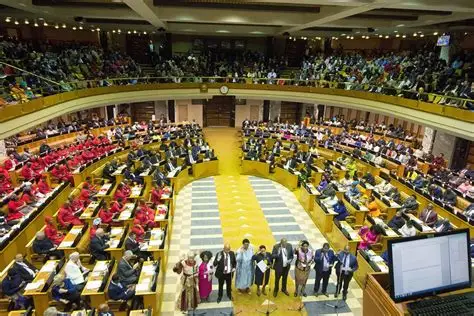
“The ANC has lost its parliamentary majority for the first time since 1994, prompting a coalition with the DA to form a Government of National Unity. This coalition reshapes South Africa’s governance, introducing shared decision-making and heightened accountability.”
South Africa’s political landscape has undergone its most dramatic transformation since the dawn of democracy in 1994. The African National Congress (ANC), long the dominant force in national politics, has lost its majority in the July 2026 elections. In response, the ANC has entered into a coalition with the Democratic Alliance (DA), forming a Government of National Unity (GNU). This development signals both the end of ANC’s unilateral dominance and the beginning of a new era of shared governance.
Historical Context
Since Nelson Mandela’s presidency, the ANC has held majority control, shaping state institutions, procurement processes, and resource distribution. However, decades of corruption scandals, service delivery failures, and economic stagnation steadily eroded public trust. High-profile scandals such as state capture, Eskom mismanagement, and healthcare delivery failures became symbols of governance decay. By 2026, voters demanded accountability and alternatives, paving the way for the DA’s rise.
Election Results
The Independent Electoral Commission confirmed that the ANC secured less than 50% of the vote. The DA emerged as the second-largest party, buoyed by urban middle-class support and disillusioned ANC voters. Smaller parties, including the Economic Freedom Fighters (EFF) and regional movements, gained modest support but now hold critical leverage in coalition negotiations. The GNU was formed to prevent political paralysis and to block what the DA described as “destructive populist forces” from capturing state power.
The DA’s Role
DA leader Geordin Hill-Lewis framed the coalition as both defensive and proactive. On one hand, it prevents instability by sidelining radical populist movements. On the other, it allows the DA to showcase its governance capacity. Hill-Lewis emphasized that the state “does not belong to the ANC, nor to any single party—it belongs to citizens.” This rhetoric signals a deliberate shift toward citizen-centered governance.
Implications for Governance
The GNU introduces a new dynamic in decision-making. Unlike the ANC’s unilateral control, coalition politics require negotiation across party lines. This could foster greater accountability but also risks gridlock if consensus proves elusive. The coalition agreement reportedly includes commitments to strengthen parliamentary oversight, reform procurement processes, and prioritize service delivery in struggling municipalities.
Challenges Ahead
- Policy Alignment: The ANC and DA differ significantly on economic policy, land reform, and social welfare. Reconciling these differences will test the coalition’s durability.
- Public Trust: Citizens expect tangible improvements in service delivery, job creation, and anti-corruption measures. Failure to deliver could erode confidence in coalition governance.
- Opposition Pressure: The EFF and smaller parties may exploit disagreements within the GNU to position themselves as alternatives in future elections.
Opportunities for Reform
The coalition presents opportunities to modernize governance structures. Procurement reform could reduce corruption, while enhanced parliamentary oversight may strengthen accountability. Service delivery improvements in municipalities could restore faith in government institutions.
International Reactions
Global observers have welcomed the coalition as a stabilizing force in South Africa’s democracy. Investors view the GNU as a potential safeguard against populist economic policies, while regional partners see it as a model for coalition governance in Africa.
Conclusion
The ANC-DA coalition represents a watershed moment in South Africa’s democratic journey. It reflects both the electorate’s demand for accountability and the necessity of compromise in a diverse political landscape. Whether this GNU becomes a beacon of reform or succumbs to internal divisions will shape South Africa’s governance for years to come.



