




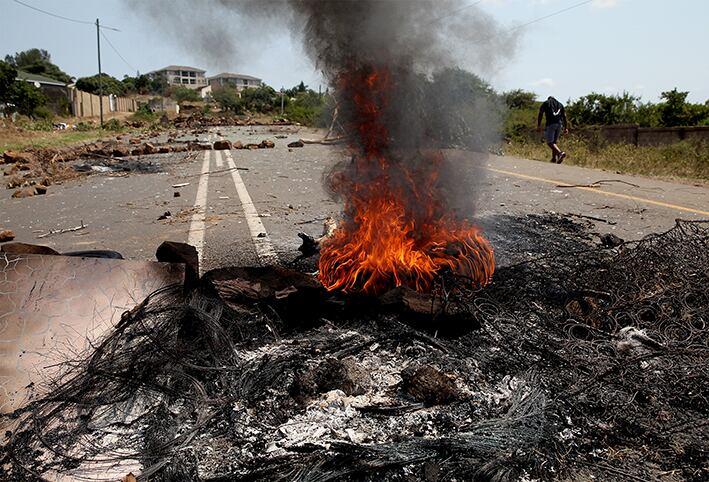
“Residents in Jozini, KwaZulu-Natal, protested local election results by placing stones across the P522 Machini Road, disrupting traffic and drawing the attention of the provincial Road Traffic Inspectorate. The demonstration highlights growing political dissatisfaction following South Africa’s November 2026 local government elections, particularly in communities where contested ward outcomes and fragmented municipal representation have intensified political tensions.”
Jozini Election Results Protest Disrupts Traffic as Residents Challenge Ward Outcomes
JOZINI, KwaZulu-Natal, South Africa – 9 November 2026
A protest over local government election results disrupted traffic along the P522 Machini Road in Jozini, KwaZulu-Natal, after residents placed stones across the roadway to express dissatisfaction with the outcome of ward elections. The incident, reported on Monday, November 9, highlights continuing political tensions following South Africa’s November 4 local government elections and the challenges facing communities navigating a highly competitive electoral environment.
According to Central News South Africa, members of the Jozini Congress Political organisation participated in the demonstration, using a road barricade to communicate their dissatisfaction with the election outcome. The provincial Road Traffic Inspectorate responded to the scene and worked to maintain traffic movement while monitoring the situation.
The protest occurred against the backdrop of a fragmented political landscape in Jozini Local Municipality, where several parties secured representation but none obtained an outright majority.
Election Results Become a Source of Community Discontent
The Jozini Congress contested the November 4 local government elections but secured two seats on the municipality’s 49-seat council, representing approximately 4.7% of the ward ballot, according to the Central News report.
The reported council composition reflects the increasingly competitive nature of municipal politics in KwaZulu-Natal. The Inkatha Freedom Party secured 18 seats, uMkhonto weSizwe obtained 15, while the African National Congress won 13. No political organisation reached the 25 seats required for an outright majority.
The electoral outcome has created a situation in which smaller political organisations may have limited representation individually but can potentially influence political negotiations and municipal decision-making.
However, the Jozini Congress protest illustrates how election outcomes can generate dissatisfaction among political supporters, particularly when local organisations believe their electoral performance or ward results do not adequately reflect community expectations.
The precise ward result that triggered the demonstration was not fully detailed in the published report. Consequently, the protest should be understood as a reported expression of dissatisfaction rather than evidence of an established electoral irregularity.
Road Barricade Disrupts Traffic
The demonstration affected motorists travelling along the P522 Machini Road, where stones were placed across the route.
Road barricades can quickly disrupt movement in rural and semi-rural communities, particularly where alternative routes are limited or transportation networks are less developed.
In Jozini, the disruption required the attention of traffic authorities, who monitored the affected area and worked to manage the flow of vehicles.
Central News reported that no injuries linked to the protest were recorded in the official traffic update.
The incident nevertheless demonstrated how political demonstrations can create immediate consequences for ordinary residents, motorists, transport operators and businesses that depend on accessible roads.
For commuters, even a temporary obstruction can affect travel schedules, deliveries and access to essential services.
The Road Traffic Inspectorate’s intervention was therefore significant in maintaining movement while monitoring developments around the demonstration.
A Wider Political Context Following Local Elections
The Jozini protest comes during a particularly consequential period in South African politics.
The November 2026 local government elections have produced substantial changes in political representation, with the African National Congress experiencing a major electoral setback and opposition parties gaining greater influence in several municipalities.
Reuters reported on November 9 that the ANC received less than one-third of the national vote in the local elections, marking its worst-ever electoral performance.
The outcome has intensified coalition negotiations, particularly in municipalities where no party secured enough seats to govern independently.
These developments have created a more competitive environment in which political organisations must negotiate alliances, demonstrate accountability and respond to community expectations.
The election results also provide an important context for understanding local demonstrations. Political participation does not end when voting stations close. Citizens and political organisations frequently continue engaging with elected representatives, municipal institutions and public authorities after elections.
However, peaceful demonstrations, electoral complaints and formal dispute-resolution processes serve different purposes and should not be treated as interchangeable.
Where political organisations believe results are incorrect, electoral mechanisms provide avenues for raising objections and seeking clarification. Where communities express broader dissatisfaction, public engagement and peaceful protest can communicate grievances to political leaders.
The Jozini demonstration illustrates the continuing relationship between electoral competition and public mobilisation.
Activism and Democratic Participation
Political activism remains an important feature of South Africa’s democratic system.
Since the country’s transition to democracy, public demonstrations have frequently been used to demand accountability, express dissatisfaction and draw attention to political or social concerns.
Activism can take many forms, including organised marches, community meetings, petitions, peaceful demonstrations and public campaigns.
In local government, activism often reflects the direct relationship between political representation and community expectations.
Municipalities are responsible for essential functions such as water provision, sanitation, waste management, local roads and community infrastructure. Consequently, residents frequently engage in public demonstrations when they believe political institutions are failing to respond adequately to their concerns.
Election-related protests can also emerge when political organisations or their supporters believe ward outcomes deserve further attention.
Nevertheless, democratic activism requires respect for the rights of other residents, including freedom of movement, access to public services and the ability to participate in elections without intimidation.
The Jozini incident raises these competing considerations because the protest disrupted a public road while expressing political dissatisfaction.
Authorities Face the Challenge of Balancing Protest Rights and Public Safety
The response by the Road Traffic Inspectorate highlights the responsibilities of public authorities during demonstrations.
Traffic officials must manage disruptions while considering the safety of motorists, pedestrians and protesters.
Law enforcement agencies also have responsibilities to protect lawful political participation and respond appropriately when demonstrations create risks to public safety.
The balance is particularly important in politically sensitive periods, when tensions can escalate quickly.
South Africa’s constitutional framework protects freedom of expression, association and peaceful assembly. These protections allow citizens to communicate political opinions and participate in collective action.
At the same time, public demonstrations must operate within applicable legal requirements and cannot justify violence, intimidation or the unlawful restriction of other people’s rights.
The Jozini incident underscores the importance of dialogue between community representatives, political organisations and authorities to prevent disputes from escalating.
Coalition Politics and the Future of Jozini Municipality
The fragmented council composition in Jozini presents an additional political challenge.
With no party securing an outright majority, political organisations will need to consider cooperation, negotiations and possible coalition arrangements.
Such negotiations can determine leadership positions, governing priorities and the direction of municipal administration.
Smaller political organisations may become important participants in discussions about governance, although their influence will depend on the circumstances and the agreements reached.
For residents, the most important question is whether the new political arrangements can translate representation into effective municipal services.
Coalition governments can create opportunities for broader participation, but they also require cooperation, transparency and consistent decision-making.
The Jozini Congress and other political organisations will therefore face expectations to demonstrate that their electoral participation contributes meaningfully to community development.
Community Grievances Require Constructive Engagement
The protest also reinforces the importance of communication between political organisations and communities.
When election outcomes generate dissatisfaction, timely explanations, transparent procedures and accessible dispute-resolution mechanisms can help reduce tensions.
Political leaders have an opportunity to engage residents, clarify the electoral process and encourage peaceful participation.
Community organisations can also contribute by identifying grievances, facilitating dialogue and ensuring that concerns are communicated through appropriate channels.
Such engagement is particularly important in municipalities where political competition is intense and electoral outcomes produce divided councils.
Residents should be able to express dissatisfaction without fear of intimidation, while other community members should retain safe access to roads, workplaces and essential services.
The Importance of Peaceful Political Participation
The Jozini demonstration serves as a reminder that South Africa’s democratic institutions operate within a broader environment of public participation.
Elections provide a mechanism for citizens to choose representatives, but democratic accountability also depends on continuing engagement between communities and those elected to govern.
Peaceful activism can strengthen democracy by bringing neglected concerns into public discussion and encouraging political organisations to respond.
However, demonstrations that disrupt essential movement or create safety risks can also impose costs on communities and undermine public confidence.
The challenge is therefore to ensure that political dissatisfaction is addressed constructively, through dialogue, lawful protest and transparent institutional processes.
Conclusion
The protest in Jozini following local election results represents an important example of political mobilisation during South Africa’s changing municipal landscape.
The placement of stones across the P522 Machini Road disrupted traffic and prompted a response from provincial authorities, while the demonstration communicated dissatisfaction with electoral outcomes.
As municipalities navigate coalition negotiations and changing political representation, maintaining peaceful public participation and protecting community interests will remain essential.
The incident highlights the need for political organisations, public authorities and residents to engage constructively, respect democratic processes and prioritise the rights and welfare of communities.
South Africa’s local democracy will ultimately be judged not only by election results but also by the ability of political institutions to respond to public concerns, maintain accountability and deliver meaningful improvements in people’s lives.



