




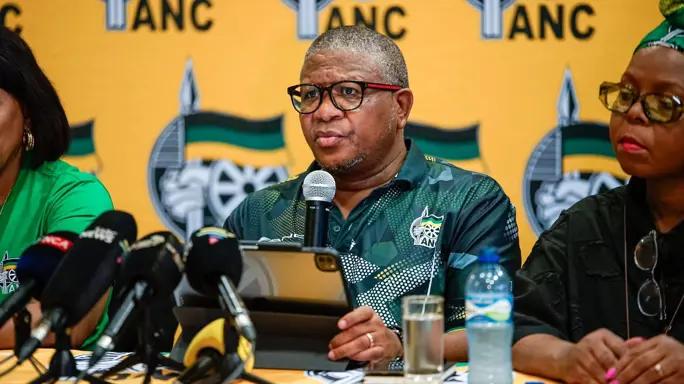
“The African National Congress (ANC) has confirmed that it will not participate in an upcoming Council of the Left meeting involving the South African Communist Party, Economic Freedom Fighters, uMkhonto weSizwe Party and other left-leaning political organisations, as political parties intensify negotiations following South Africa’s 2026 municipal elections. The decision comes amid a dramatic decline in ANC electoral support, increasing competition from opposition parties and mounting pressure to establish stable coalition governments capable of improving municipal service delivery.”
ANC Skips Council of the Left Meeting as South Africa’s Coalition Politics Enter a Defining Phase
South Africa’s political landscape is entering a consequential period following the African National Congress’s decision to stay away from an upcoming Council of the Left meeting, as political parties prepare for intensive coalition negotiations after the country’s 2026 local government elections.
The decision by the ANC, confirmed by secretary-general Fikile Mbalula, highlights the growing strategic complexity confronting the governing party after its electoral support fell to approximately 30.76%, its weakest performance in local government elections since the end of apartheid.
The Council of the Left meeting, expected to involve the South African Communist Party (SACP), Economic Freedom Fighters (EFF), uMkhonto weSizwe (MK) Party and other left-oriented political formations, is expected to discuss coalition possibilities and the broader political direction following the municipal vote.
However, the ANC has indicated that it will not participate.
Mbalula said the party had not attended previous Council of the Left meetings and would maintain that position. The decision comes as the ANC leadership centralises its coalition strategy and considers multiple governing arrangements across municipalities where election results failed to produce outright majorities.
Electoral setback reshapes political calculations
The municipal elections held on November 4, 2026, produced a substantial shift in South Africa’s political balance.
According to final election figures reported by Reuters, the ANC secured approximately 30.76% of the national vote, compared with 45.59% in the 2021 municipal elections.
The Democratic Alliance (DA) followed with approximately 24.64%, while the MK Party secured 9.76% and the EFF 6.22%.
The results reinforced a political trend that became unmistakable during the 2024 national elections, when the ANC lost its parliamentary majority for the first time since taking power in 1994.
Although the ANC remains South Africa’s largest political party nationally, its declining support has fundamentally altered its ability to govern independently.
The electoral outcome also strengthened opposition parties and increased the importance of smaller political organisations, particularly in municipalities where coalition arrangements will determine political leadership.
For the ANC, the immediate challenge is no longer simply electoral recovery. It is determining how to govern effectively while negotiating with political organisations that increasingly challenge its authority.
Coalition negotiations become the central political priority
The election results have created an extensive coalition landscape.
Cape Town remains the principal metropolitan exception, where the DA secured an outright majority. However, Johannesburg, Tshwane, Ekurhuleni, Nelson Mandela Bay, Buffalo City, Mangaung and eThekwini require coalition arrangements or other negotiated governing structures.
These negotiations will determine who becomes mayor, who occupies council leadership positions and how municipal executive responsibilities are distributed.
The ANC has established a central coalition negotiating structure led by Mbalula. The team includes senior party figures such as Parks Tau, Enoch Godongwana and Gwede Mantashe.
The centralisation of negotiations indicates that the party leadership intends to exercise greater control over coalition decisions rather than allowing individual provincial or municipal structures to independently determine political partnerships.
ANC deputy secretary-general Nomvula Mokonyane has indicated that the party’s approach will be informed by the National Executive Committee and the specific circumstances of each municipality.
She has also stated that the ANC will consider different governing arrangements, including minority administrations and opposition positions where appropriate.
The party maintains that its objective should be political stability and improved service delivery rather than securing positions simply for the sake of remaining in government.
ANC faces difficult relationships with opposition parties
The ANC’s coalition decisions will be influenced by its relationships with competing political organisations.
The DA, its principal electoral rival, remains a partner in South Africa’s Government of National Unity at national level. However, cooperation within the national government does not automatically translate into agreement at municipal level.
The two parties have competing political objectives and disagreements over governance, economic policy and institutional priorities.
Meanwhile, the EFF and MK Party have expressed willingness to engage in coalition arrangements with the ANC in some municipalities.
Their potential participation introduces another dimension to the negotiations.
The ANC must balance ideological compatibility, political credibility, electoral mandates and the practical requirements of municipal administration.
The decision to avoid the Council of the Left meeting does not necessarily mean that the ANC has ruled out cooperation with individual left-wing parties.
Instead, it indicates that the party intends to approach coalition negotiations through its own institutional structures rather than through a broader political gathering.
MK Party strengthens its position
The MK Party, founded by former president Jacob Zuma, emerged as an important political force in the 2026 municipal elections.
Its strongest performance came in KwaZulu-Natal, particularly eThekwini, where it secured approximately 38.3% of the vote, according to figures reported by Business Day.
The result strengthened the party’s position in municipal negotiations and demonstrated its ability to attract voters previously associated with the ANC.
The MK Party has indicated that it is prepared to negotiate with political organisations willing to work towards improving the lives of South Africans.
Its coalition negotiator, Dali Mpofu, has signalled that intensive discussions are expected during the week.
The party’s electoral success creates both opportunities and challenges.
While it has gained influence, it must now demonstrate that its political representation can translate into effective municipal governance.
Its coalition decisions will also influence its future relationship with the ANC and other opposition parties.
DA and ActionSA emerge as influential negotiating partners
The DA has strengthened its position in several major municipalities.
It emerged as the leading party in Johannesburg, Tshwane and Ekurhuleni, while maintaining its outright majority in Cape Town.
The party’s improved performance places it in a stronger position to negotiate municipal governing arrangements.
ActionSA has also emerged as an influential player, particularly in Gauteng.
Led by Herman Mashaba, the party performed strongly in Johannesburg, Tshwane and Ekurhuleni.
Its support gives it potential leverage in coalition discussions, particularly where larger parties cannot independently secure governing majorities.
Mashaba has indicated that ActionSA is willing to consider arrangements that could allow the DA to govern Johannesburg and Ekurhuleni, subject to political conditions.
However, relations between ActionSA and the DA remain complicated by previous disagreements and political tensions.
The two organisations must determine whether their shared opposition to ANC dominance is sufficient to overcome their differences.
IFP positions itself as an experienced coalition partner
The Inkatha Freedom Party has also highlighted its experience in coalition politics.
IFP leader Velenkosini Hlabisa has indicated that his organisation is prepared to engage with different political parties.
The party intends to establish a negotiating team capable of securing arrangements that support stable municipal administrations.
Hlabisa has argued that mayors should generally come from larger coalition partners to ensure that municipal leadership has sufficient political authority.
The IFP’s experience in coalition negotiations could make it an important participant in municipalities where competing parties require additional support to establish governing majorities.
Its position also reflects a wider political reality: smaller parties may exercise considerable influence when election results prevent larger organisations from governing independently.
Service delivery remains the central public concern
Despite the political competition surrounding coalition negotiations, municipal service delivery remains the principal issue facing residents.
South African municipalities are responsible for essential services including water provision, electricity distribution, refuse collection, sanitation and local infrastructure.
The decline in ANC electoral support has been widely associated with public dissatisfaction over unreliable services, corruption allegations and governance failures.
Residents increasingly expect political parties to demonstrate measurable improvements rather than rely on historical political loyalty.
The coalition negotiations therefore present an opportunity for parties to develop practical agreements around municipal performance.
Such agreements could include commitments to transparent procurement, improved financial management, stronger accountability systems and better infrastructure maintenance.
However, coalition arrangements that focus primarily on distributing political positions risk undermining public confidence.
Municipal administrations must also avoid instability caused by disagreements between coalition partners.
Frequent leadership changes can disrupt budgets, planning and implementation of essential services.
Political consequences extend beyond local government
The implications of the municipal elections are not confined to local councils.
The ANC’s declining support could influence its internal leadership contest expected in 2027, when President Cyril Ramaphosa is expected to leave the party leadership.
Coalition negotiations may become an important measure of the influence of competing ANC factions.
Those who secure effective governing arrangements could argue that their political strategies offer a path towards rebuilding public confidence.
The DA, MK Party, EFF and ActionSA also face important strategic decisions.
Each organisation must determine whether coalition participation strengthens its political identity or risks alienating supporters.
Successful municipal governance could provide opposition parties with evidence of their administrative capabilities ahead of the 2029 national elections.
Conversely, unstable coalitions could reinforce public frustration with the political system.
A decisive test for South African democracy
The ANC’s decision to skip the Council of the Left meeting represents one development in a much broader political transition.
South Africa is moving towards a more fragmented party system in which political organisations must increasingly negotiate governing arrangements rather than rely on electoral dominance.
The country’s coalition negotiations will test the ability of political parties to place public interests above partisan competition.
The ANC must confront its declining electoral support while rebuilding credibility and determining how it can remain politically relevant.
Opposition parties must demonstrate that electoral gains can translate into responsible government.
Smaller parties must exercise their negotiating influence without undermining municipal stability.
Ultimately, the success of the coalition process will depend on whether political agreements produce functioning administrations capable of addressing residents’ needs.
The 2026 municipal elections have demonstrated that South African voters are willing to reconsider established political loyalties.
The coming negotiations will determine whether political parties can respond to that message with meaningful changes in governance, accountability and service delivery.
The ANC’s absence from the Council of the Left meeting is therefore more than a procedural decision. It is an indication of the difficult strategic choices confronting South Africa’s political organisations as they enter a new era of coalition government.



