




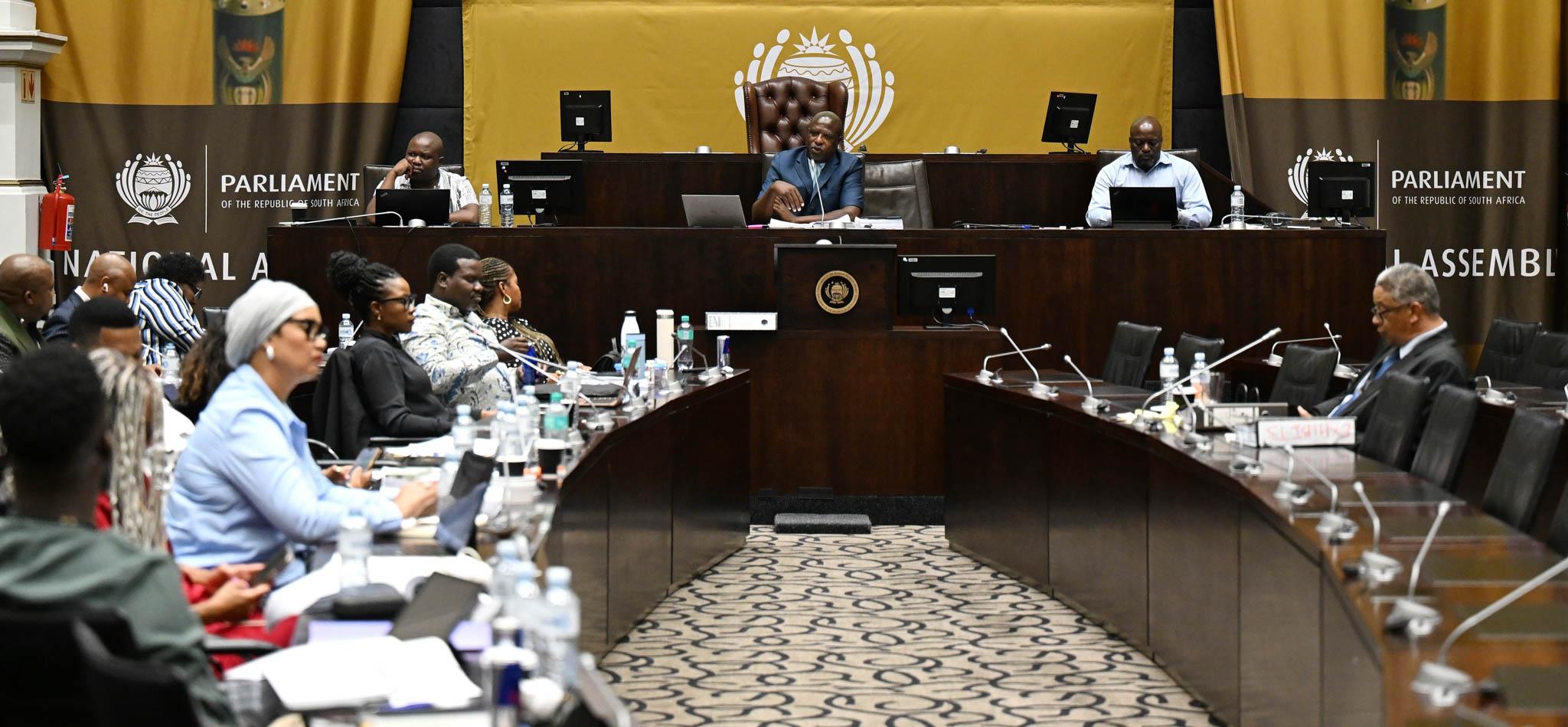
“South Africa’s Parliament resumed committee activities on 10 November following the constituency period, with lawmakers preparing to scrutinise important legislation covering education, policing, public finances, justice and local government. The parliamentary programme highlights the continuing implementation of the BELA Act, consideration of the SAPS Amendment Bill, deliberations on justice-related legislation and preparations for public hearings on appropriation and revenue-sharing measures.”
South African Parliament Resumes Legislative Work as Major Bills Face Committee Scrutiny
South Africa’s Parliament has resumed committee activities following its constituency period, bringing several important legislative and governance matters back into focus. The parliamentary programme for the week beginning 10 November highlights renewed scrutiny of legislation concerning education, policing, justice, public finances and local government administration.
The return of lawmakers comes at a significant moment for South African politics. Following the November local government elections, political institutions face renewed pressure to strengthen governance, improve public accountability and ensure that legislation responds effectively to the country’s administrative and constitutional challenges.
According to Parliament’s weekly programme, more than 30 committee meetings are scheduled between Tuesday and Friday. These meetings include legislative briefings, consideration of committee reports, departmental accountability sessions and preparations for public hearings on financial legislation.
Parliament Returns to Legislative and Oversight Responsibilities
Parliament’s return marks the resumption of committee work after members spent time in their constituencies. The National Assembly and National Council of Provinces are scheduled to undertake parliamentary business, including legislative deliberations and oversight of government departments.
The National Assembly Programme Committee is expected to consider the draft programme of the House, committee reports and bills awaiting parliamentary attention. This planning process is important because it determines how legislative matters progress through Parliament and how parliamentary responsibilities are coordinated.
Meanwhile, the National Council of Provinces is scheduled to hold a plenary sitting to discuss the report on Provincial Week conducted in August.
The programme also provides for President Cyril Ramaphosa to answer questions from NCOP delegates on Thursday, 12 November. Among the issues expected to feature are youth employment initiatives and South Africa’s engagement with the United States regarding the African Growth and Opportunity Act.
Although these discussions are not exclusively legislative, they form part of Parliament’s broader constitutional responsibilities to oversee the executive and assess government policy implementation.
BELA Act Implementation Under Parliamentary Examination
One of the most significant legislative oversight developments scheduled for Tuesday concerns the Basic Education Laws Amendment Act, commonly known as the BELA Act.
The Portfolio Committee on Basic Education is expected to receive a detailed briefing from the Department of Basic Education concerning implementation of the Act.
The committee’s agenda calls for a section-by-section account of implementation progress, including administrative arrangements, guidelines issued, compliance benchmarks and provincial implementation developments.
Furthermore, lawmakers are seeking detailed information concerning financial allocations supporting implementation.
The requested information includes medium-term expenditure framework allocations, infrastructure costs and personnel budgets associated with the Act. Particular attention is expected to be given to provisions requiring additional financial resources.
The committee also intends to examine implementation timeframes for regulations and the current readiness of individual provinces.
These issues are significant because legislative implementation requires coordination between national government, provincial authorities and education institutions.
The effectiveness of education legislation depends not only on parliamentary approval but also on whether departments possess the resources, administrative capacity and institutional arrangements necessary to implement its requirements.
Consequently, parliamentary scrutiny of the BELA Act provides an opportunity to identify implementation difficulties and establish whether government planning is sufficiently comprehensive.
The scheduled briefing should not be confused with a final parliamentary determination. Rather, it represents an oversight process intended to obtain information, assess progress and identify outstanding responsibilities.
SAPS Amendment Bill and the Future of Police Accountability
Another important legislative development involves the South African Police Service Amendment Bill, B18-2026.
The Portfolio Committee on Police is scheduled to receive a briefing from Parliament’s legal adviser and content adviser on Wednesday, 11 November, with a continuation planned for Friday.
The Bill proposes extensive amendments to the South African Police Service Act of 1995.
Among its provisions are measures addressing police management, professionalisation, integrity testing, lifestyle audits, municipal policing and public order policing responsibilities.
The proposed legislation also seeks to strengthen arrangements governing police leadership and establish clearer institutional structures for policing oversight.
Parliament’s consideration of the Bill is particularly important given continuing public concerns about corruption, criminality and political interference within the criminal justice system.
The legislation provides an opportunity for lawmakers to consider whether existing police governance arrangements adequately support accountability and professional conduct.
In August, the Portfolio Committee on Police indicated that the Bill presented an opportunity to strengthen integrity management within SAPS and improve its alignment with constitutional requirements and findings from commissions of inquiry.
The committee also emphasised the importance of meaningful public participation.
The legislative process therefore remains an important platform through which Parliament can examine police accountability, institutional effectiveness and the relationship between national and municipal policing structures.
However, the Bill remains subject to parliamentary consideration, and its final provisions will depend on the legislative process.
Justice Legislation and Legal Reform
The Portfolio Committee on Justice and Constitutional Development is scheduled to undertake several important legislative activities on Wednesday.
These include a briefing on the Extradition Bill and deliberations on the Judicial Matters Amendment Bill and General (Family) Laws Amendment Bill.
Parliamentary Legal Services will provide input during the deliberations.
These legislative initiatives demonstrate the continuing importance of legal reform within South Africa’s constitutional democracy.
The Extradition Bill concerns legal arrangements governing the surrender of individuals between jurisdictions for criminal proceedings or other legally recognised purposes.
The Judicial Matters Amendment Bill forms part of broader efforts to amend legislation affecting judicial administration and related legal matters.
Meanwhile, the General (Family) Laws Amendment Bill concerns aspects of family law and the legal framework governing family relationships.
Committee deliberations allow lawmakers to examine proposed provisions, consider legal advice and identify issues requiring clarification before legislation advances.
This process is particularly important where amendments may affect constitutional rights, legal procedures or the administration of justice.
Public Finance Legislation and Government Spending
Financial legislation also features prominently in Parliament’s programme.
The Standing Committee on Appropriations is scheduled to receive a briefing from the Parliamentary Budget Office concerning the Division of Revenue Amendment Bill, Adjustments Appropriation Bill and Special Appropriation Bill.
These measures concern public expenditure and the allocation of resources across government.
The Division of Revenue Amendment Bill is particularly relevant to relations between national, provincial and local government.
South Africa’s intergovernmental financial framework determines how nationally collected revenue is distributed among different spheres of government.
These allocations influence the ability of provinces and municipalities to finance infrastructure, provide public services and implement development programmes.
The Appropriations legislation, meanwhile, concerns government spending requirements and adjustments to financial allocations.
Parliamentary examination of these measures provides an opportunity to evaluate expenditure priorities and assess whether public resources are being managed within the applicable legal framework.
Public hearings scheduled for Friday on financial legislation will further support parliamentary engagement with relevant stakeholders.
Electoral and Local Government Legislative Challenges
South Africa’s local government environment continues to place attention on legislation governing municipal administration and coalition arrangements.
The proposed Municipal Structures Amendment Bill seeks to establish clearer rules for coalition governance in municipalities without majority parties.
The legislation proposes compulsory coalition agreements, greater transparency in governing arrangements and restrictions on repeated motions of no confidence against municipal office-bearers.
However, the bill experienced delays before the November local government elections and was expected to continue through Parliament after the electoral period.
The proposed reforms are significant because unstable coalitions can affect municipal administration, budget approval and service delivery.
Legislative clarity could potentially strengthen accountability and reduce uncertainty in municipalities governed through coalition arrangements.
Nevertheless, the effectiveness of such reforms will depend on the final legislation, political cooperation and the ability of municipalities to implement the applicable requirements.
Public Participation and Legislative Accountability
An important feature of South Africa’s legislative process is public participation.
Parliamentary committees provide opportunities for citizens, civil society organisations, professional bodies and other stakeholders to contribute to legislative development.
Public submissions can identify practical difficulties, constitutional concerns and implementation challenges that lawmakers may otherwise overlook.
This participation is particularly important in legislation affecting education, policing, electoral administration and public finances.
The quality of legislative outcomes depends partly on whether parliamentary processes provide sufficient opportunities for informed engagement.
Furthermore, public participation can strengthen transparency and encourage government institutions to explain their policy decisions.
Conclusion
South Africa’s parliamentary programme for the week beginning 10 November 2026 highlights the importance of legislative oversight and continued legal reform.
The examination of the BELA Act, SAPS Amendment Bill, justice legislation and public finance measures demonstrates the breadth of Parliament’s responsibilities.
These proceedings will contribute to ongoing discussions concerning government accountability, institutional effectiveness and constitutional governance.
While scheduled committee meetings do not automatically translate into new laws or immediate policy changes, they represent important stages in the legislative process.
Ultimately, the effectiveness of South Africa’s legislation will depend on careful parliamentary scrutiny, meaningful public participation, adequate implementation resources and sustained accountability across government institutions.



