




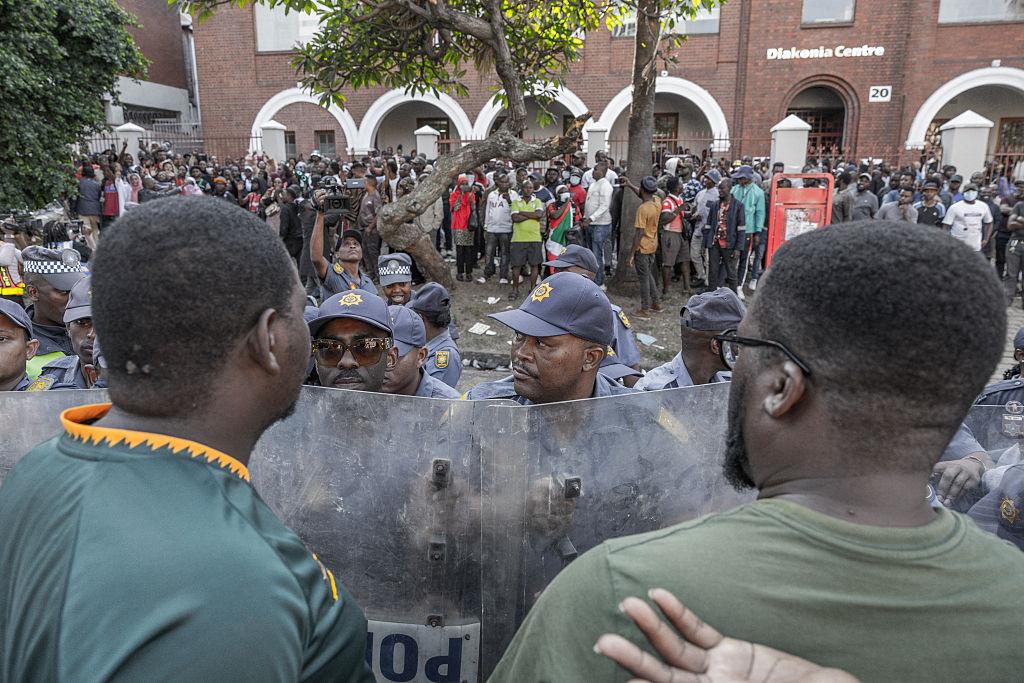
“Anti-illegal-immigration activists in Durban have vowed to continue disrupting operations at the Department of Home Affairs Refugee Reception Centre after protesters prevented foreign nationals from accessing asylum application services. The confrontation follows a Constitutional Court ruling that reopened access to South Africa’s asylum system and has intensified a politically sensitive debate over immigration enforcement, constitutional rights, public safety and the responsibilities of government.”
Durban Activism Puts South Africa’s Immigration Debate Under Pressure
A growing confrontation in Durban has emerged as one of South Africa’s most significant activism and politics stories on 8 October 2026, with anti-illegal-immigration groups vowing to return to the city’s Refugee Reception Centre and continue opposing the processing of asylum applications. The protests have placed activists, asylum seekers, police and government officials at the centre of an increasingly tense national debate over migration and the implementation of a recent Constitutional Court judgment.
The immediate flashpoint is the Department of Home Affairs Refugee Reception Centre on Che Guevara Road in Berea, Durban. On Wednesday, groups including March and March and other anti-illegal-immigration organisations gathered outside the facility after large numbers of foreign nationals arrived seeking to apply for asylum. Reports indicated that about a thousand foreign nationals were present or had approached the centre, creating a tense atmosphere in the surrounding area.
The activists’ intervention was not simply a conventional political march or symbolic demonstration. According to reports, protesters blocked access to the facility and prevented people from entering or leaving. Some demonstrators were carrying sticks, sjamboks and other objects, prompting a substantial police presence and raising concerns about possible violence. The protesters subsequently said they would return if foreign nationals continued arriving at the centre.
The activism is rooted in wider concerns about illegal immigration, employment, pressure on public services, crime and the government’s management of South Africa’s borders. Activist groups argue that immigration policy must be enforced more strictly and that communities should have a stronger voice in decisions affecting migration. Their arguments have gained visibility during a year in which immigration has become one of the country’s most contentious political issues.
However, the Durban confrontation has also raised an important constitutional question: who has the authority to determine whether an individual may enter the asylum system? Home Affairs has made clear that it is implementing a binding Constitutional Court judgment rather than creating a new immigration policy independently. The department has instructed Refugee Reception Offices to accept applications from people seeking asylum, including people whose circumstances previously prevented them from accessing the process.
The Constitutional Court judgment is therefore central to understanding the current activism. The court found that parts of the Refugees Act created unconstitutional barriers for people attempting to claim asylum. Among the issues affected were requirements that could prevent people without the necessary documentation, or those who had failed to meet prescribed reporting requirements, from accessing the asylum process. Home Affairs consequently had to adjust its procedures to comply with the ruling.
The change has produced an immediate practical consequence. People who previously could not enter the asylum system are now presenting themselves at refugee reception offices. In Durban, hundreds of people from countries including Ethiopia, Somalia, Bangladesh and Pakistan were reported to be waiting to have applications processed. The sudden increase has placed significant pressure on an already politically sensitive administrative system.
For asylum seekers, the reopening of the process represents an opportunity to obtain formal documentation and have their claims considered. One foreign national interviewed by TimesLIVE said he had come to South Africa after fleeing conflict and wanted documentation that would allow him to live and work legally. The situation illustrates the human dimension behind the political dispute: people seeking asylum are not necessarily confirmed refugees, because their claims still have to be assessed through the legal system.
For activists, however, the scale of the arrivals has reinforced their concerns about the country’s migration system. Protest leaders have questioned whether government has sufficient capacity to vet applicants, track applications and enforce immigration laws. March and March leader Jacinta Ngobese-Zuma has called for the Constitutional Court decision to be reconsidered, arguing that communities affected by migration should have greater input into decisions that shape their neighbourhoods.
The confrontation has also exposed the limits of activism when protest action begins to interfere with the rights or safety of other people. South Africa’s Constitution protects peaceful assembly, demonstration and protest, but those rights operate within a broader constitutional framework. Blocking access to a government service or intimidating people attempting to use that service can create a conflict between political expression and the rights of those seeking assistance.
Police have consequently been deployed to the Durban centre to prevent the situation from escalating. Reports indicate that officers carrying shields confronted crowds while the road leading to the centre was closed. Businesses in the surrounding area were also affected as tensions increased. The police response demonstrates the difficult balancing act facing authorities: protecting protesters’ rights while simultaneously ensuring that asylum seekers can access a government service and that public order is maintained.
Home Affairs has also warned against misinformation surrounding the Constitutional Court judgment. The department has rejected claims that the ruling automatically gives asylum seekers South African citizenship or grants blanket legal status to foreign nationals. Instead, the judgment concerns access to the asylum process, after which individual applications must still be dealt with according to the applicable legal framework.
That distinction is particularly important because misinformation can intensify political tensions. Home Affairs has said it is concerned about what it describes as a disinformation campaign that could inflame tensions and violence. At the same time, the government has acknowledged the need to explain how it will manage the practical consequences of the court judgment while maintaining the integrity of the country’s immigration system.
The Inter-Ministerial Committee on Migration is expected to play an important role in the government’s response. Officials are under pressure to explain how Home Affairs will handle potentially increased asylum applications while continuing efforts to address irregular migration. The government has said it remains committed to the rule of law and the national interest, making the issue both a legal and political challenge.
The Durban protests also need to be viewed against the background of months of immigration-related mobilisation. Earlier in 2026, anti-immigration groups organised demonstrations and demanded tougher action against undocumented migrants. Those protests produced significant security concerns and contributed to an atmosphere in which migration became closely associated with questions of public order, employment and national identity.
What makes the latest Durban activism especially significant is the direct collision between political mobilisation and constitutional implementation. Activists are attempting to influence how the country responds to migration, while government departments are legally required to comply with court decisions. The resulting dispute cannot be resolved simply by protest or enforcement; it requires government to communicate clearly, process applications efficiently and enforce immigration law consistently.
The events also highlight a broader question about democracy in South Africa. Activism can provide communities with a powerful mechanism to express dissatisfaction, challenge government policy and demand accountability. However, democratic activism depends on participation that respects the rights of others and operates within the law. The Durban confrontation demonstrates how quickly legitimate political grievances can become a public-order crisis when tensions between communities rise.
For the government, the challenge is now twofold. It must ensure that people who genuinely need international protection can access the asylum system, while also maintaining credible immigration controls and addressing legitimate concerns about undocumented migration. For activists, the challenge is to ensure that their demands for stronger immigration enforcement do not undermine the constitutional rights of asylum seekers or create conditions for intimidation and violence.
The immediate situation in Durban remains fluid. Anti-illegal-immigration groups have indicated that they intend to return to the Home Affairs facility if foreign nationals continue to arrive, while authorities are expected to maintain a security presence. The government’s forthcoming response to the Constitutional Court judgment will therefore be closely watched, particularly as it seeks to balance constitutional obligations with growing political pressure over immigration.
Ultimately, the Durban confrontation is about more than one Home Affairs office. It reflects a wider national struggle over migration policy, constitutional rights, community concerns and the meaning of political activism in a democratic South Africa. As asylum applications resume, the government will need to demonstrate that the asylum system can function effectively, while activists will need to decide how far they can push their campaign without crossing legal and constitutional boundaries.
The events of 8 October show that immigration remains one of South Africa’s most politically explosive issues. With activists promising further action and government officials working to implement a major court ruling, Durban has become an important test of whether political activism, public order and constitutional rights can coexist during a period of intense national debate.



