




“South Africa is monitoring an Earth-directed coronal mass ejection (CME) produced by solar activity from sunspot region AR4549, with the South African National Space Agency (SANSA) forecasting minor geomagnetic storm conditions for 9 October. The event is important because strong changes in space weather can affect radio communications, satellite systems, navigation and other technologies that depend on the near-Earth space environment.”
South Africa monitors approaching solar storm
South Africa’s space community is closely watching the Sun as an Earth-directed cloud of solar material moves through the solar system. The development is currently the most significant space-weather issue directly relevant to South Africa, particularly because the country’s national space agency operates one of Africa’s key space-weather monitoring and warning centres.
The South African National Space Agency (SANSA) reported that solar activity had been moderate, with X-ray activity fluctuating between B- and C-class levels. The largest flare recorded in its latest bulletin was an M1.8 flare, produced by active region AR4549 on 6 October. SANSA said the flare was associated with a halo coronal mass ejection expected to reach Earth on 9 October.
SANSA’s latest observations show that conditions were relatively calm on 8 October, but its three-day prediction points to a change on Friday. The agency forecasts quiet conditions on 8 October, minor storm conditions on 9 October, and unsettled to active conditions on 10 October.
That forecast makes the approaching CME important for South African space and technology users. Although the expected disturbance is not being presented as a severe threat to the public, geomagnetic storms demonstrate how activity on the Sun can influence technological systems on Earth.
What caused the event?
The story begins approximately 150 million kilometres away on the Sun. Solar activity is driven by magnetic fields generated inside the Sun and concentrated in regions known as sunspots. When magnetic energy is suddenly released, the Sun can produce a solar flare.
In this case, the active region designated AR4549 became particularly important. According to EarthSky, AR4549 produced two significant M-class flares on 6 October, including an M1.4 flare and an M1.8 flare. Analysis of observations indicated that the eruptions were accompanied by CMEs travelling toward Earth.
A CME is a huge cloud of magnetised plasma expelled from the Sun. Unlike the electromagnetic radiation from a solar flare, which reaches Earth in about eight minutes, a CME takes considerably longer to travel across the roughly 150-million-kilometre distance between the Sun and Earth.
The approaching CME is therefore giving scientists time to monitor its trajectory, estimate its arrival and prepare forecasts about its potential impact.
The exact intensity of the resulting geomagnetic disturbance cannot be known with certainty until the CME reaches Earth’s space environment. NOAA’s Space Weather Prediction Center has issued a G1 to G2 geomagnetic storm watch for 9 October, while SANSA’s South African forecast currently indicates minor storm conditions for that date.
Why South Africa is paying attention
Space weather might sound distant from everyday life, but modern economies increasingly depend on technologies that operate either in space or through systems affected by conditions in the upper atmosphere.
SANSA explains that its space-weather services are particularly relevant to communication, navigation, defence, aeronautics and related sectors.
That makes monitoring important for South Africa, a country with significant infrastructure connected to satellites, telecommunications, navigation systems and aviation.
Space weather can influence radio communications by changing the ionosphere, the electrically charged region of the upper atmosphere. High-frequency radio signals can be absorbed, refracted or otherwise affected during periods of increased solar activity.
Navigation systems can also experience disturbances. Satellite-based positioning technologies rely on signals travelling through the atmosphere, and changes in the ionosphere can introduce errors or reduce reliability.
Satellites themselves operate in an environment directly exposed to solar activity. Stronger geomagnetic disturbances can increase atmospheric drag on satellites in low-Earth orbit, alter radiation conditions and potentially complicate satellite operations.
For South Africa, therefore, space-weather monitoring is not simply an astronomy exercise. It forms part of the country’s technological and infrastructure resilience.
SANSA’s role in African space weather
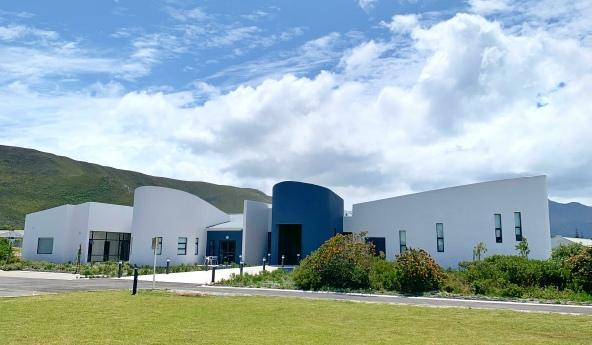
South Africa has an unusually important position in African space science because SANSA operates a dedicated Space Weather Centre in Hermanus.
SANSA describes its centre as Africa’s only Space Weather Regional Warning Centre operating within the International Space Environment Service. The agency is one of 22 regional warning centres worldwide participating in that international system.
Its responsibilities include monitoring solar activity, observing conditions around Earth and issuing information that can help affected sectors prepare for changes in the space environment.
The importance of this capability becomes clearer during events such as the current CME. Rather than waiting for a disturbance to affect technological systems, scientists can monitor solar activity and issue forecasts ahead of time.
SANSA’s current measurements on 8 October showed solar-wind speeds around 375–381 kilometres per second, with the Hermanus T-index at 6 in the latest displayed observations.
The agency’s three-day forecast provides another indication of how conditions could develop. It gives an estimated planetary Ap value of 5 for 8 October, rising to 30 on 9 October before falling to 15 on 10 October. It also identifies 9 October as the day with minor storm conditions.
What could happen on October 9?
The most likely outcome is a temporary increase in geomagnetic activity rather than a major technological emergency.
NOAA’s forecast calls for G1, or minor, to G2, or moderate, geomagnetic storm conditions when the CME arrives.
Geomagnetic storms occur when disturbances in the solar wind interact with Earth’s magnetosphere. The strength of the resulting storm depends partly on the magnetic orientation of the incoming solar material.
This is one reason forecasts can change. Scientists can track the CME as it approaches Earth, but some of the most important information about how strongly it will interact with Earth’s magnetic field becomes available only as the CME reaches space near Earth.
For South Africa, the most relevant concerns involve potential effects on communications, navigation and satellite-dependent services. SANSA’s forecast currently describes South African high-frequency communications as fair and indicates that radio fadeouts are unlikely.
That distinction is important. A geomagnetic storm watch does not automatically mean that telecommunications will fail, satellites will stop functioning or electricity supplies will collapse.
Instead, the forecast gives technical users an opportunity to remain alert and assess conditions.
A wider international space-weather event
The approaching CME is not only a South African story. Scientists and space-weather agencies around the world are monitoring it.
NOAA’s Space Weather Prediction Center issued its G2 watch after determining that a CME associated with the M1.4 flare from AR4549 was likely to reach Earth on 9 October. NOAA also noted a high chance of further M-class flare activity from the region.
Space.com similarly reported that the CME could arrive early on 9 October, with G1-to-G2 conditions possible. The publication noted that the exact arrival time could shift because predicting the precise propagation and interaction of CMEs remains challenging.
EarthSky’s latest solar report also identifies 9 October as the important date, with G1 to G2 geomagnetic storm conditions possible as material from AR4549 reaches Earth.
Consequently, the event is a useful demonstration of international cooperation in space weather. Observatories and agencies across different countries contribute observations that are combined to improve forecasts.
What it means for ordinary South Africans
For most people in South Africa, there is no reason to panic about the approaching event.
A G1-to-G2 geomagnetic storm is considerably below the most extreme categories of space-weather activity. The practical importance is primarily for operators of infrastructure that can be affected by changes in the space environment.
People may nevertheless become interested in the event because geomagnetic storms can produce auroras at unusually low latitudes during sufficiently strong events.
However, the northern lights are much more commonly associated with high-latitude regions, and the current G1-to-G2 forecast does not mean that spectacular auroras will automatically become visible from South Africa.
The more important South African story is therefore the country’s ability to monitor and interpret the event.
SANSA’s work provides an example of how space science connects directly to national infrastructure. The agency monitors the Sun not only because scientists want to understand our nearest star, but because solar activity can influence the technological environment surrounding Earth.
South Africa’s broader space ambitions
The latest space-weather alert also comes at a time when South Africa is strengthening its position in the global space sector.
SANSA’s latest news highlights South Africa’s participation at the International Astronautical Congress 2026, while the agency has also been involved in African youth Mars rover programmes and space exploration initiatives.
The country’s space ambitions extend beyond satellites and space-weather monitoring. South African researchers and engineers are involved in Earth observation, satellite technology, astronomy, space science and lunar exploration.
One notable programme is Africa2Moon, which is planned to involve South African-developed technology on China’s Chang’e-8 lunar mission. Stellenbosch University researchers are playing a role in the mission’s electronics, highlighting the country’s ability to contribute specialised technology to international space exploration.
These developments place the current solar event into a larger context. As South Africa expands its use of satellites and develops more space-related expertise, understanding the space environment becomes increasingly important.
Why monitoring will continue
The current solar event is unlikely to be the last space-weather challenge facing South Africa.
Solar activity changes continuously, and active sunspot regions can produce additional flares and CMEs. NOAA has indicated that AR4549 could continue producing M-class flares, meaning scientists will continue watching the region even after the current CME passes.
SANSA’s role is consequently ongoing rather than limited to a single event. Its monitoring systems provide regular information about the Sun, solar wind and Earth’s magnetic environment.
The agency’s current forecast suggests that conditions should remain relatively quiet on 8 October before becoming more disturbed on 9 October. By 10 October, conditions are expected to move toward unsettled to active levels.
For South Africa’s technology-dependent economy, that continuous monitoring provides an important layer of preparedness.
Conclusion
The most important current Space development relevant to South Africa is the approaching CME associated with solar activity from sunspot region AR4549. SANSA is monitoring the event from its Hermanus Space Weather Centre and currently forecasts minor geomagnetic storm conditions for 9 October, while international agencies including NOAA are watching for possible G1-to-G2 activity.
The event demonstrates why space is increasingly a practical national issue rather than a subject limited to astronomy. Communications, navigation, satellites, aviation and other technologies can all depend on an increasingly busy near-Earth space environment.
For the public, the message is one of awareness rather than alarm. The CME is being tracked, forecasts are being updated and South Africa has specialised scientific infrastructure capable of monitoring conditions as they develop.
As the CME approaches Earth on 9 October, SANSA’s observations will be particularly important for determining how strongly the solar disturbance interacts with Earth’s magnetic field and whether the current minor-storm forecast needs to be adjusted.



