




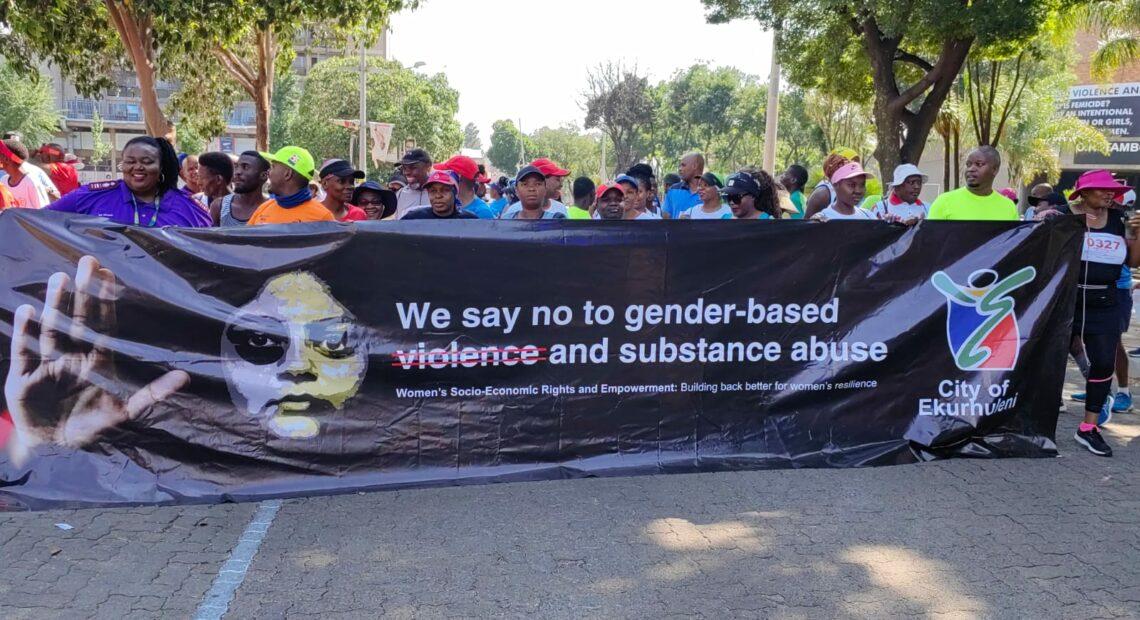
“Communities in Ekurhuleni are taking part in another public demonstration against gender-based violence and femicide after the deaths of 12 women in the municipality since July, with churches, NGOs and students expected to participate. The march, beginning at the Kempton Park Civic Centre and heading to the Kempton Park police station, is expected to demand stronger protection for women, greater accountability and progress in investigations into the deaths.”
Ekurhuleni Activists and Communities Demand Action on Gender-Based Violence
Communities in Ekurhuleni, Gauteng, are once again taking their concerns over gender-based violence and femicide to the streets, as public pressure grows following the deaths of 12 women in the municipality since July. The latest mobilization is taking place on Saturday, 3 October 2026, with residents, churches, non-governmental organisations and students expected to participate.
According to SABC News, participants are gathering at the Kempton Park Civic Centre before marching towards the Kempton Park police station. The demonstration is intended to express anger about violence against women and to call for increased action by authorities.
The mobilisation represents another chapter in a series of community and civil-society actions that have taken place across Ekurhuleni in recent weeks. Earlier demonstrations included marches in Kwa-Thema and a picket organised by feminist groups outside the Kempton Park police station. These actions have consistently focused on demands for justice, effective investigations and greater protection for women.
A Growing Community Mobilization
The immediate background to Saturday’s demonstration is the discovery of 12 women’s bodies in different parts of Ekurhuleni since July. The cases have generated widespread concern because several of the victims were found in circumstances that raised questions about gender-based violence and the safety of women travelling or walking through public spaces.
Police have cautioned that the cases have not been conclusively established as being connected. Gauteng Provincial Police Commissioner Lieutenant-General Tommy Mthombeni said on 2 October that three of the 12 cases had been resolved, while investigators had identified persons of interest in three other cases. Three of the recovered bodies remained unidentified at that point, according to SABC News.
Investigators have deployed specialised personnel, including forensic experts and an investigative psychologist. A reward of R400,000 has also been made available for information that could assist with outstanding investigations.
For residents, however, the investigations are taking place against a backdrop of fear and uncertainty. The latest community march therefore combines demands for justice in individual cases with broader calls for safer neighbourhoods.
Previous Protests Have Increased Pressure
The latest action follows several demonstrations in Ekurhuleni during September.
On 17 September, residents of Kwa-Thema marched against gender-based violence after nine women’s bodies had been found in the region at that stage. Organisers called for more effective investigations, prosecution of perpetrators and adequate support for victims.
A day later, the Black Womxn Caucus and other organisations held a picket outside Kempton Park police station. The feminist organisations demanded justice and accountability and called on authorities to act urgently in response to the killings.
The demonstrations have also involved different sections of society. On 25 September, men led a march against femicide in Kwa-Thema, with the Gauteng Community Safety Department describing the initiative as part of efforts to encourage men and bystanders to take greater responsibility in preventing gender-based violence.
Abahlali baseMjondolo subsequently marched to the Kempton Park police station on 28 September, giving police seven days to account for investigations into the deaths. The organisation said communities needed clearer information about the status of cases and stronger responses when women report violence.
These successive demonstrations demonstrate how activism has become an important part of the public response to the Ekurhuleni killings.
Demands for Police Accountability
A central issue in the demonstrations has been the relationship between communities and law-enforcement agencies.
Activists have questioned whether existing systems are sufficiently responsive when women report threats or violence. The concerns extend beyond the investigation of the 12 deaths to broader issues such as protection orders, police response times, victim support and communication with families.
At the 28 September demonstration, Abahlali baseMjondolo called for police to provide information about individual investigations. The organisation alleged that some victims of gender-based violence experience difficulties obtaining effective protection and that families can struggle to receive information about investigations. These are claims made by the organisation and are not equivalent to an independent finding about every police station or case.
Police, meanwhile, have provided updates about the investigations and the resources being deployed. Commissioner Mthombeni said specialised investigators and forensic personnel were working on the cases and that some cases had already been resolved.
The difference between these positions highlights one of the central issues surrounding the protests: communities are demanding visible results and communication while authorities are pointing to ongoing investigative work.
Government Announces Additional Measures
The protests have coincided with increased government action at national and provincial level.
President Cyril Ramaphosa announced a four-point response after the deaths of women in Ekurhuleni. Among the measures are efforts to review unresolved cases involving murder, attempted murder, rape and serious sexual offences involving women and children, as well as interventions involving public safety and forensic processes.
Gauteng authorities have also introduced safety audits in areas considered high-risk for gender-based violence and femicide. According to Eyewitness News, municipalities were given seven days to begin identifying hazards such as broken streetlights, abandoned buildings, overgrown areas and unsafe transport routes.
These environmental factors have become part of the public discussion because community safety is not limited to policing alone. Lighting, transport infrastructure, abandoned buildings, open spaces and access to emergency assistance can all affect how residents experience their neighbourhoods.
The Gauteng government has said it intends to accelerate the safety-audit process and report on progress during the annual 16 Days of Activism period in November.
Activism Keeps the Issue in the Public Eye
Community activism has played a significant role in keeping the Ekurhuleni killings in national public discussion.
Rather than limiting the response to government announcements, residents and civil-society organisations have organised marches, vigils and pickets. These actions provide spaces for families, community leaders, activists and residents to publicly express concerns and demand answers.
Earlier in September, a candlelight service in Kwa-Thema brought residents together to remember women who had died through gender-based violence. Participants called for perpetrators to face the law and said communities should not remain silent.
Other initiatives have focused on men and boys. The men-led march in Kwa-Thema reflected the argument that preventing gender-based violence requires participation from people who may otherwise see the issue as primarily a concern for women.
The involvement of churches, NGOs, students, feminist organisations and community movements in Saturday’s march similarly illustrates the broad range of groups participating in the response.
The Importance of Investigative Transparency
One of the immediate challenges for authorities is communicating what is known about the 12 deaths without compromising investigations.
Police have repeatedly stated that they have not established that all the cases are connected. SABC News reported that investigators had identified persons of interest in several cases while three cases had been resolved.
This distinction is important because the public discussion has sometimes raised the possibility that the deaths could be the work of one perpetrator. Police have not confirmed such a conclusion. Earlier in September, authorities said investigations had not conclusively established a serial-killer link and noted differences between some of the cases.
For families and communities, however, uncertainty itself contributes to anxiety. Regular factual updates can therefore play an important role in maintaining public confidence while investigations continue.
A Broader National Crisis
Although Saturday’s march is focused on Ekurhuleni, its significance extends beyond the municipality.
Gender-based violence and femicide remain major public-policy and human-rights concerns in South Africa. The African Commission on Human and Peoples’ Rights said on 3 October that South Africa needs a multifaceted response to GBVF, arguing that policing and security measures alone are not sufficient. The commission said its fact-finding mission had engaged government, civil society, NGOs and other stakeholders.
This broader perspective is reflected in the growing number of community initiatives addressing the issue through different approaches. Some focus on policing and justice, others on prevention, community mobilisation, survivor support, environmental safety and changing social attitudes.
The deaths in Ekurhuleni have therefore become a focal point for a much larger national debate about how South Africa responds to violence against women.
What Saturday’s March Represents
The Ekurhuleni march is both a protest and a demand for engagement.
For participating communities, marching to the police station places their concerns directly before the institution responsible for investigating serious crimes and protecting residents. The planned participation of churches, NGOs and students also indicates that the response extends beyond individual neighbourhood structures.
The central demands reported by SABC News are increased protection for women and information about progress in the investigations.
Whether the march leads to further meetings, commitments or additional community actions will depend on developments after the demonstration. What is already clear is that residents have continued to use public mobilisation to demand attention to the safety of women.
As investigations proceed, authorities face pressure to provide credible information, identify perpetrators where evidence supports prosecution, support affected families and address environmental and institutional factors that communities identify as contributing to insecurity.
For Ekurhuleni residents, the immediate concern remains straightforward: women should be able to move through their communities without fear, and families whose relatives have been killed or disappeared need answers.
The Saturday demonstration therefore places activism at the centre of the current political and social response to the crisis. It connects grief and public anger with demands for accountability, while also placing pressure on government institutions to translate announced measures into visible action.
The developments will continue to be closely watched as police investigations proceed and Gauteng authorities implement their safety measures. For now, Ekurhuleni communities are using one of South Africa’s most established democratic tools — peaceful public mobilisation — to demand greater attention to gender-based violence and the protection of women.



