




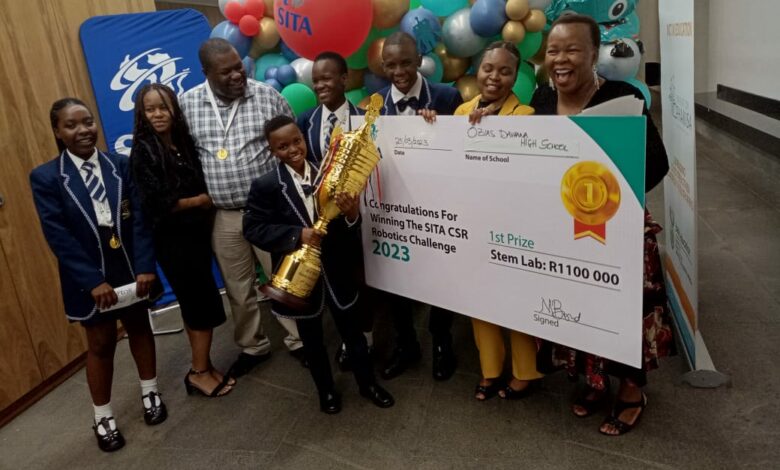
“Two learner teams from Limpopo, Robo-Kidz and Roborise, are proudly representing South Africa at the prestigious Robotics for Good Youth Challenge Grand Finale in Geneva, Switzerland. Their success underscores the impact of South Africa’s national investment in coding and robotics education, positioning the country as a rising force in global STEM innovation.”
South Africa’s robotics education reached a historic milestone this week as two learner teams from Limpopo province—Robo-Kidz from Mashupye Tladi Primary School and Roborise from Bokamoso Secondary School—competed at the Robotics for Good Youth Challenge Grand Finale in Geneva, Switzerland. Their participation not only symbolizes the country’s growing capabilities in science, technology, engineering, and mathematics (STEM) but also reflects the government’s sustained investment in preparing learners for careers in the digital economy.
The Global Stage
The competition, hosted at the Palexpo International Exhibition and Convention Centre from 7–10 July 2026, brought together some of the world’s brightest young innovators. Teams were tasked with developing technological solutions to real-world challenges, ranging from healthcare and environmental sustainability to cultural preservation. South Africa’s presence at this event signals its emergence as a serious contender in global robotics education.
Journey to Geneva
Both Limpopo teams earned their spots after excelling in local, provincial, and national rounds of the Robotics for Good Youth Challenge. Their journey reflects the strength of South Africa’s education pipeline, which has increasingly emphasized coding and robotics through the Curriculum and Assessment Policy Statement (CAPS) introduced in 2021. This curriculum integrates computational thinking, digital technologies, and structured problem-solving into classrooms nationwide.
Government Support
The Department of Basic Education (DBE) hailed the learners’ achievement as a “significant milestone,” noting that it validates years of investment in STEM education. The DBE’s Mathematics, Science and Technology (MST) Conditional Grant has been instrumental in equipping schools with resources, training teachers, and ensuring learners gain exposure to robotics from an early age.
Educational Impact
The inclusion of robotics in school curricula is designed not only to improve digital literacy but also to foster creativity, innovation, and critical thinking. By encouraging learners to design, code, and build robotic systems, South Africa is cultivating a generation capable of thriving in industries increasingly shaped by automation and artificial intelligence.
Limpopo’s Role
Limpopo province has emerged as a leader in implementing robotics education. The success of Robo-Kidz and Roborise is attributed to strong provincial support and effective rollout of STEM initiatives. Their projects demonstrated ingenuity and problem-solving skills, earning them recognition on the international stage.
Broader Implications
South Africa’s representation at the Geneva finals carries broader implications for the country’s economic and social development. By nurturing robotics talent, the nation is laying the groundwork for future entrepreneurs, engineers, and innovators who can contribute to sectors such as manufacturing, healthcare, and renewable energy.
Challenges Ahead
Despite these successes, challenges remain. Access to resources is uneven across provinces, and many rural schools still lack the infrastructure to fully implement robotics programs. Ensuring equitable access will be critical if South Africa is to sustain its momentum in STEM education.
Global Recognition
International observers praised South Africa’s efforts, noting that the country is among the few African nations making significant strides in robotics education. The Geneva finals provided a platform for South African learners to showcase their skills alongside peers from Europe, Asia, and the Americas, reinforcing the country’s growing reputation in global innovation circles.
Conclusion
The achievements of Limpopo’s learners at the Global Robotics Finals represent more than just a competition victory—they symbolize South Africa’s determination to prepare its youth for the demands of the Fourth Industrial Revolution. With continued investment, policy support, and grassroots innovation, South Africa is poised to become a continental leader in robotics and STEM education.



