




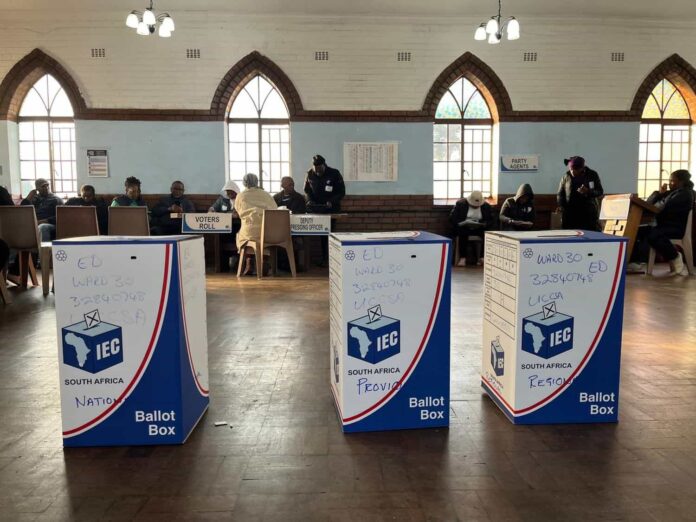
“South Africa’s major political parties, led by the ANC and DA, are actively engaging voters during the voter registration weekend, seen as a crucial step toward the November 2026 local government elections. With voter trust at historic lows, parties are intensifying grassroots campaigns to reconnect with citizens and secure electoral gains.”
South Africa entered a pivotal political moment today as voter registration stations opened nationwide for the weekend drive ahead of the November 2026 local government elections. The event has drawn intense activity from political parties, who view this as a decisive opportunity to reconnect with citizens amid growing disillusionment with democracy and declining trust in institutions.
The African National Congress (ANC), once the dominant force in South African politics, is leaving nothing to chance. Having lost its parliamentary majority for the first time in three decades during the 2024 national elections, the ANC is determined to rebuild its base. President Cyril Ramaphosa personally led the party’s campaign in Kwa-Thema, Ekurhuleni, where he visited registration sites and engaged directly with residents. His presence underscores the ANC’s recognition that its survival hinges on reconnecting with grassroots communities. Ramaphosa’s message was clear: the ANC must demonstrate that it remains capable of delivering services and representing the aspirations of ordinary South Africans.
Meanwhile, the Democratic Alliance (DA) is equally focused on consolidating its stronghold in Cape Town. Mayor and DA leader Geordin Hill-Lewis spent the morning in Bonteheuwel and Langa, speaking to supporters and undecided voters. Hill-Lewis emphasized the DA’s governance record, pointing to lower unemployment rates in Cape Town compared to the national average and improved service delivery across the city. His pitch was straightforward: the DA has proven its ability to govern effectively, and voters should continue to entrust it with leadership in the Western Cape.
Other parties are also seizing the moment. The Patriotic Alliance (PA) and the National Coloured Congress (NCC) are mounting challenges to the DA in Cape Town, while smaller parties across the provinces are mobilizing activists to monitor registration stations and encourage participation. The Electoral Commission of South Africa (IEC) has deployed resources to ensure smooth operations at more than 23,000 voting stations nationwide. Despite logistical readiness, the IEC has warned of a “high-risk” political climate, citing declining voter confidence and widespread dissatisfaction with democracy.
Recent IEC research revealed stark trends: trust in government has plummeted from 69% in 2004 to just 19% in 2026, while trust in political parties has collapsed to 11%. Even the IEC itself has seen confidence fall from 74% to 32%, though trust rises significantly among those who have just voted. This erosion of faith in institutions poses a serious challenge to parties, as voter turnout is no longer guaranteed. Participation has dropped from 76% in 2015 to 64% in 2025, raising fears of further disengagement in November.
Against this backdrop, the voter registration weekend is more than a procedural exercise—it is a test of whether political parties can inspire citizens to re-engage with democracy. For the ANC, it is a chance to prove relevance after years of declining support. For the DA, it is an opportunity to defend its governance record and fend off challengers. For emerging parties, it is a moment to expand their footprint and capitalize on voter disillusionment with traditional powerhouses.
Observers note that the stakes are high. The November elections will not only determine control of municipalities but also signal the trajectory of South Africa’s democracy in an era of fragmentation and mistrust. If parties succeed in mobilizing voters this weekend, they may lay the groundwork for renewed legitimacy. If they fail, the elections could be marked by apathy and further erosion of democratic confidence.
As registration continues through Sunday, millions of South Africans are expected to update their details or sign up for the first time. The outcome of this weekend will shape the campaigns ahead and, ultimately, the balance of power in local government. For now, the message from parties is unanimous: democracy depends on participation, and every registration counts.



