




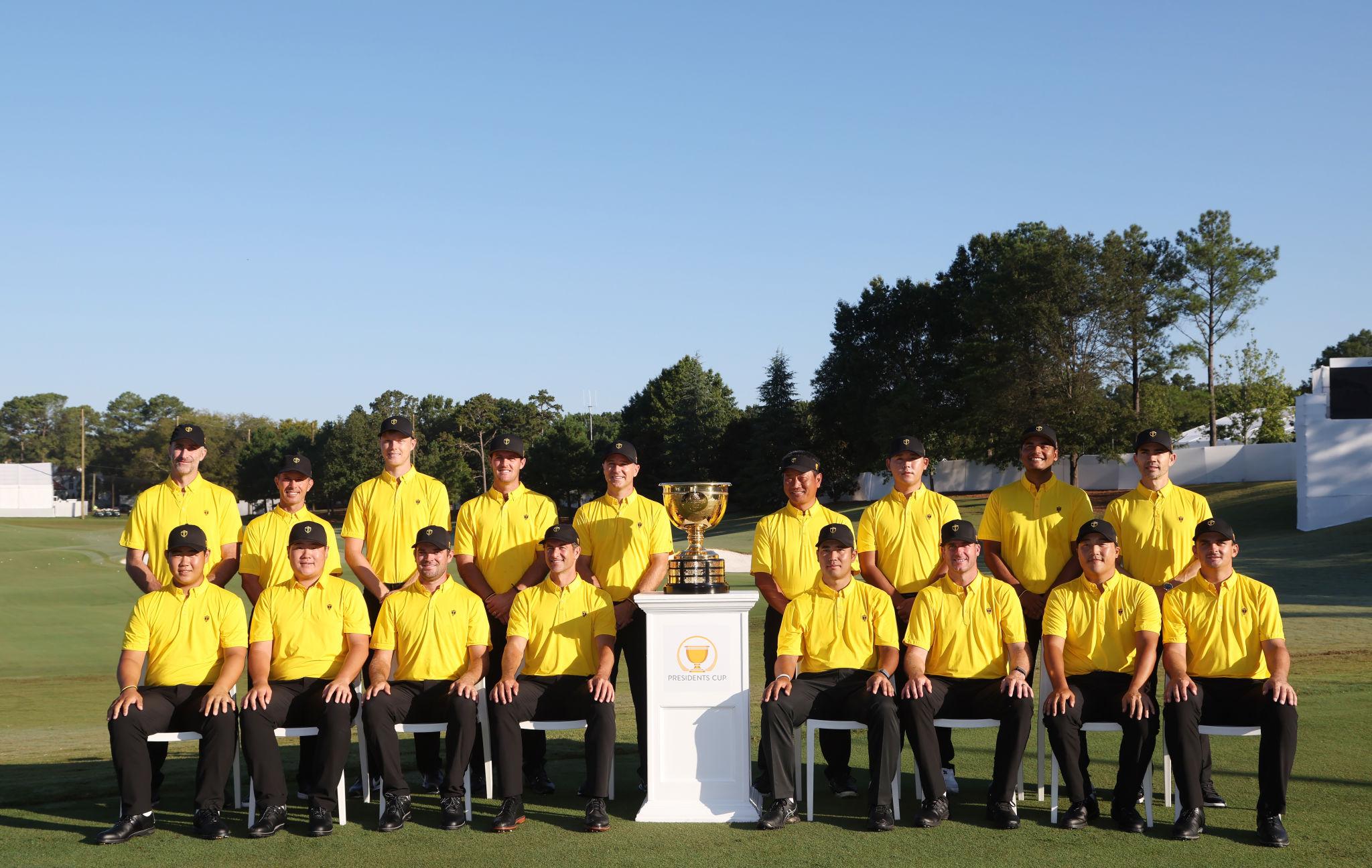
“The 2026 Presidents Cup has again placed the long-standing gap between the United States and the International Team under the spotlight, with South African Christiaan Bezuidenhout among the players attempting to change the pattern at Medinah Country Club. IOL reports that the International Team entered the weekend facing a substantial historical challenge, having won the competition only once since its establishment, while South Africa’s most memorable Presidents Cup moment remains the dramatic 2003 tie at Fancourt”
The Presidents Cup has reached another decisive stage, with the 2026 tournament at Medinah Country Club in the Chicago area bringing together the United States and an International Team made up of players from outside Europe. For South African golf fans, the competition has an additional point of interest because Christiaan Bezuidenhout is once again representing the International side.
The latest South Africa-focused golf report from IOL examines the remarkable historical imbalance in the competition. According to the report, the International Team has won the Presidents Cup only once, with that victory coming in 1998 in Australia. Since then, the United States has maintained a sustained run of success, making every edition an enormous challenge for the non-US team.
That history provides the backdrop for Bezuidenhout’s third consecutive Presidents Cup appearance. The South African was selected for the International Team after his performances earned him one of captain Geoff Ogilvy’s six captain’s picks. He is the only South African in the 2026 International squad, giving his participation particular significance for followers of golf in the country.
A familiar challenge for the International Team
The Presidents Cup is different from ordinary individual golf tournaments because players compete as part of teams. The 2026 competition consists of 28 matches spread across four days, with foursomes, four-ball and singles match-play formats forming the tournament structure.
That format creates opportunities for individual players to make a major contribution, but it also places considerable importance on team depth. Players have to adapt to partners, match-play pressure and the tactical demands of each format rather than simply concentrating on their individual score over four rounds.
The International Team’s challenge is therefore not limited to defeating individual American stars. It must find a way to accumulate enough match victories across the tournament to overturn a historical pattern that has heavily favoured the United States. IOL’s report highlights that American strength is reflected in the depth of the world’s leading professional players, with seven of the current top 10 in the Official World Golf Ranking coming from the United States at the time of the report.
The early stages of the 2026 competition again illustrated how quickly momentum can develop in match play. According to Golf Australia, the International Team produced a strong second day and moved into a 7-3 lead after sweeping the five foursomes matches. Australian players Adam Scott and Min Woo Lee were among those contributing to the International surge.
That result transformed the tournament’s immediate picture, although the historical record remains an important part of the wider story.
Bezuidenhout’s growing Presidents Cup experience
For South Africa, much of the focus is naturally on Bezuidenhout. His selection means that he has now become a regular presence in the Presidents Cup, following appearances in the previous two editions. IOL describes him as the lone South African representative for the third successive tournament.
His route into the team also illustrates the importance of consistent professional performance. Although he did not qualify automatically through the standings, his form was sufficient for Ogilvy to select him as one of the captain’s picks.
The South African’s participation also connects the current competition to the country’s longer history in the Presidents Cup. South Africa has produced some of the most recognisable figures in the tournament’s history, including Ernie Els and Gary Player.
The 2003 Presidents Cup at The Links at Fancourt in George remains particularly significant. It was held on South African soil and featured a memorable contest between an International Team led by Els and a United States side that included Tiger Woods. Gary Player captained the International Team, while Jack Nicklaus led the Americans.
The unforgettable 2003 tie
The 2003 tournament occupies a unique place in Presidents Cup history because it ended without a winner.
After the scheduled matches, the two teams remained level, forcing Els and Woods into a sudden-death playoff. The two players could not be separated after three playoff holes, while fading daylight made it increasingly difficult to continue.
Player and Nicklaus subsequently agreed to share the trophy, producing the only tied Presidents Cup in the competition’s history. The episode became one of the defining moments in the event’s South African history.
The 2003 contest also demonstrated how closely matched the two teams could be when the International side combined experienced players with home-course conditions and strong team performances. More than two decades later, that tournament remains an important reference point whenever the International Team attempts to challenge American dominance.
Why match play changes the tournament
One of the defining characteristics of the Presidents Cup is its match-play structure. Unlike stroke-play tournaments, where every player’s total score contributes to an individual result, match play rewards winning individual holes and securing matches.
This creates opportunities for momentum shifts. A player or partnership can fall behind early but recover through a sequence of holes. Conversely, a team leading a match can suddenly find itself under pressure after losing several holes in succession.
The 2026 tournament has again demonstrated that feature. Golf Australia reported that the International Team’s five foursomes victories on Friday helped produce a 7-3 overall lead after two days.
Golf Digest also noted the scale of the International performance, reporting that US pairings held the lead for only a small number of holes during the Friday foursomes session.
For Bezuidenhout and his teammates, that kind of momentum can be important as the competition moves towards the weekend sessions and eventually Sunday’s singles matches.
Medinah provides the setting for another chapter
Medinah Country Club in Illinois is hosting the 2026 Presidents Cup, bringing the competition to the United States. The official Presidents Cup site identifies Medinah as the host venue for this year’s event.
Playing on American soil adds another dimension to the International challenge. The United States has traditionally enjoyed considerable success in the event, and home support forms part of the atmosphere surrounding the competition.
Nevertheless, the International team’s early performances have shown why the tournament cannot simply be decided by history. The four-point lead after the second day, reported by multiple golf publications, demonstrated that the current contest can develop differently from previous editions.
That does not erase the historical record, but it does underline one of match play’s central characteristics: previous results do not determine the result of an individual match.
A significant weekend for South African golf
Bezuidenhout’s presence also provides South African golf with an important international platform. The country has a long association with elite professional golf, from Player and Els to the current generation competing on the PGA Tour, DP World Tour and other major circuits.
His third consecutive Presidents Cup appearance places him among the South Africans who have contributed to the country’s presence at one of international golf’s major team events. IOL’s earlier profile of Bezuidenhout’s 2026 selection noted that his consistency had earned him the captain’s confidence despite not qualifying automatically.
The 2026 competition therefore carries two connected stories. One concerns the continuing historical dominance of the United States. The other concerns whether a new generation of International players can produce a different outcome.
For South African followers, Bezuidenhout provides a direct connection to that challenge.
What comes next
As the Presidents Cup moves deeper into the weekend, the remaining matches will determine whether the International Team can maintain the momentum generated during the second day. The Saturday programme includes additional team matches before the competition concludes with Sunday’s singles.
For Bezuidenhout, the opportunity is another chance to compete at the highest level of international team golf. For the International Team, the task is to convert its strong start into a sustained performance across the remaining matches.
The wider historical context will continue to dominate discussion, particularly because the International Team’s only outright Presidents Cup victory came in 1998. Yet the events at Medinah demonstrate why the competition remains compelling: match play can create rapid changes in momentum, and individual partnerships can have an outsized influence on the overall result.
For South Africa, meanwhile, the spotlight remains firmly on Bezuidenhout. As the country’s sole representative at Medinah, his performances will be closely followed as the 2026 Presidents Cup reaches its decisive stages.



