




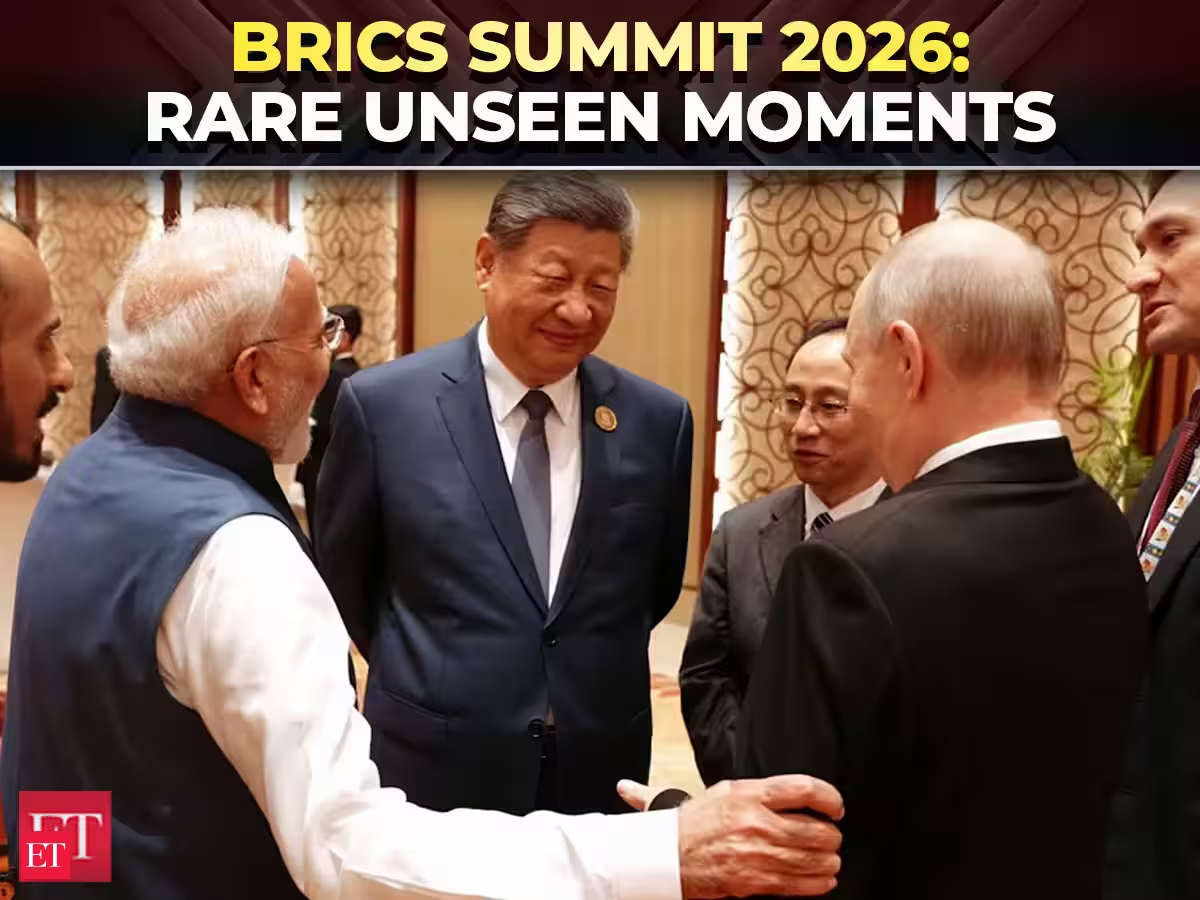
“President Cyril Ramaphosa, speaking at the BRICS Summit in New Delhi, called for accountability over atrocities in Palestine, Sudan, and Iran, stressing that international law cannot be applied selectively. His remarks underscore South Africa’s growing role in advocating for the Global South and reforming global governance structures.”
South Africa’s President Cyril Ramaphosa has once again placed his country at the center of international diplomacy, using the BRICS Summit in India to call for accountability in global conflicts. His remarks, delivered on September 13, 2026, emphasized the need for consistency in applying international law, particularly in relation to Palestine, Sudan, and Iran. This intervention reflects Pretoria’s broader ambition to position itself as a moral and political leader for the Global South.
Context of the BRICS Summit
The BRICS Summit, hosted in New Delhi, brought together leaders from Brazil, Russia, India, China, and South Africa, alongside newly admitted members such as Egypt, Ethiopia, Iran, Saudi Arabia, and Indonesia. Against the backdrop of escalating global tensions—including the US-Iran conflict, the Gaza crisis, and instability in Sudan—the summit provided a platform for Ramaphosa to articulate South Africa’s foreign policy priorities.
Ramaphosa’s Key Message
Ramaphosa’s central argument was that international law must be applied consistently. He condemned what he described as the “ongoing genocide against the people of Palestine,” the “crimes committed against the people of Sudan,” and the “illegal war against Iran.” By framing these conflicts as examples of selective enforcement of international norms, Ramaphosa sought to highlight the hypocrisy of global governance structures dominated by Western powers.
South Africa’s Legal Action Against Israel
South Africa has already taken concrete steps to advance this agenda. In December 2023, Pretoria instituted proceedings against Israel at the International Court of Justice (ICJ), accusing it of violating the Genocide Convention in Gaza. Although Israel denies the allegations, the ICJ has issued provisional measures recognizing the imminent risk of genocide faced by Palestinians. Ramaphosa’s remarks at BRICS reaffirmed South Africa’s commitment to pursuing justice through international institutions.
Reforming Global Governance
Beyond specific conflicts, Ramaphosa also called for United Nations reform, warning that the UN risks irrelevance if it fails to reflect contemporary global realities. He argued that the UN Charter must remain central to international law, but insisted that violations of sovereignty and territorial integrity undermine its credibility. His appeal for reform aligns with broader BRICS efforts to challenge Western dominance in global governance.
South Africa’s Strategic Position
South Africa’s stance is not merely rhetorical. By leveraging its BRICS membership, Pretoria aims to strengthen trade, investment, and infrastructure development across Africa. Ramaphosa emphasized that South Africa serves as a gateway to African markets, positioning itself strategically within the bloc. This dual focus—advancing international justice while promoting economic diplomacy—illustrates the complexity of South Africa’s foreign policy.
Domestic and Global Implications
Domestically, Ramaphosa’s assertive diplomacy comes at a time when South Africa faces economic challenges, including a deteriorating current account balance and severe congestion at Durban’s port. Internationally, his remarks resonate with many Global South nations that feel marginalized by Western-led institutions. By championing accountability and reform, South Africa seeks to build solidarity among developing countries while enhancing its own global stature.
Risks and Challenges
However, South Africa’s position is not without risks. Aligning with contentious issues such as Iran’s conflict with the US could strain relations with Western partners. Moreover, pursuing legal action against Israel has already drawn criticism from some quarters. Balancing these tensions while maintaining credibility as a mediator will be a key challenge for Pretoria.
Conclusion
President Ramaphosa’s intervention at the BRICS Summit underscores South Africa’s determination to reshape global governance and demand accountability for international crimes. By insisting that international law must be applied consistently, Pretoria is positioning itself as a principled advocate for the Global South. Whether this strategy will yield tangible reforms remains uncertain, but South Africa’s voice is increasingly difficult to ignore in the evolving landscape of international relations.



