




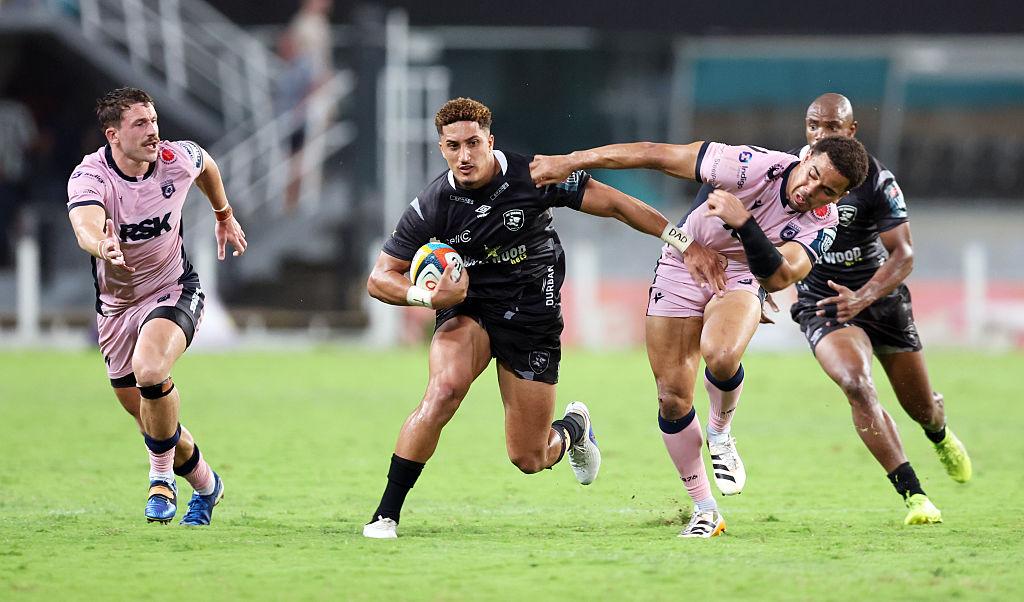
“The Sharks produced an impressive 36–21 away victory over Cardiff in the United Rugby Championship, overcoming an early setback when captain Andre Esterhuizen was forced off with a suspected foot injury after only 52 seconds. Ethan Hooker scored an early try, and the Durban-based side went on to demonstrate attacking quality and resilience, giving the team a valuable confidence boost while raising questions about Esterhuizen’s availability for upcoming fixtures.”
A strong away performance puts the Sharks in the spotlight
The Hollywoodbets Sharks delivered a significant performance in the United Rugby Championship by defeating Cardiff 36–21 away from home on Friday, 23 October 2026. The victory was particularly notable because the South African side had to reorganise almost immediately after losing captain Andre Esterhuizen to an injury in the opening minute. Despite the disruption, the Sharks maintained their composure, attacked effectively and finished the contest with a convincing 15-point winning margin.
For South African rugby supporters, the result offers encouraging evidence of the Sharks’ capacity to compete under difficult circumstances. Winning away from home in a demanding European competition requires more than individual brilliance. Teams must adapt to unfamiliar conditions, manage pressure, maintain discipline and take advantage of opportunities when they arise.
The Sharks achieved the most important objective by securing the victory. Nevertheless, the injury to Esterhuizen introduces an important concern as the team continues its campaign and prepares for a demanding schedule of domestic and international rugby.
An early setback tests the Sharks’ preparation
The match began dramatically when Esterhuizen was forced off after just 52 seconds with a foot injury. Losing an experienced captain so early can disrupt a team’s tactical structure, particularly when the player occupies a central role in organising the midfield defence and coordinating attacking movements.
The timing of the incident left the Sharks with little opportunity to settle into their planned approach before making adjustments. Coaches and players had to respond immediately, ensuring that the replacement could integrate into the system without compromising the team’s organisation.
However, the visitors responded positively. Ethan Hooker crossed for the opening try in the second minute, giving the Sharks an immediate attacking breakthrough. Cardiff subsequently answered through Josh Adams, whose try was converted by Jarrod Evans. The home side therefore demonstrated that it would not allow the visitors to control the contest without resistance.
The opening exchanges illustrated how quickly rugby matches can change. A significant injury can force tactical adjustments, while an early try can restore confidence and create momentum. For the Sharks, the challenge was to prevent the loss of their captain from becoming a wider distraction.
Their response was encouraging because they continued to execute their attacking plans rather than allowing the disruption to dictate the match.
Attacking execution makes the difference
The Sharks’ 36-point total demonstrates the effectiveness of their performance in Cardiff. Although the final score does not tell the entire story of the match, it highlights the visitors’ ability to turn attacking opportunities into points.
The South African side needed to balance direct running with intelligent distribution, ensuring that Cardiff’s defence could not concentrate on a single attacking threat. Effective attacking rugby depends on timing, support lines, communication and the ability to recognise space before defensive structures are fully established.
Hooker’s early try provided a foundation for the visitors, but maintaining that advantage required continued concentration. Cardiff had its own attacking opportunities and demonstrated its threat through Adams’ response.
For the Sharks, the important factor was their ability to recover from the home side’s challenge and continue building their performance. Teams that succeed away from home frequently have to withstand periods when their opponents enjoy territorial or scoreboard momentum.
The Sharks’ eventual 36–21 victory indicates that they managed those challenges sufficiently well to emerge comfortably ahead. The result also gives their coaching staff material to assess as they seek greater consistency throughout the competition.
Cardiff’s resistance keeps the contest competitive
Despite the defeat, Cardiff contributed to an entertaining contest. Adams’ try and Evans’ conversion demonstrated the home side’s ability to respond when the Sharks initially threatened to take control.
Playing against a South African opponent can present particular tactical challenges. South African teams are often associated with physical confrontation, powerful ball carrying and an emphasis on winning the contest around the breakdown. Nevertheless, successful opposition requires more than simply matching physical intensity.
Cardiff needed to defend accurately, limit the Sharks’ opportunities and capitalise on mistakes. Its response after conceding the opening try showed that the home side remained competitive during the early exchanges.
However, the final result favoured the visitors by 15 points. That margin reflects the Sharks’ ability to generate sufficient attacking output to move beyond Cardiff’s initial resistance.
The defeat will provide Cardiff with areas for review, particularly regarding how it managed the Sharks’ attacking pressure. The Welsh side can examine its defensive alignment, the effectiveness of its tackling and whether it converted enough opportunities into points.
For South African observers, Cardiff’s resistance also provides useful context. The Sharks were not simply handed a comfortable result; they had to respond to an opponent that showed it could score and compete.
The significance of the result for South African rugby
The URC provides South African franchises with an opportunity to measure themselves against leading clubs from Ireland, Wales, Scotland, Italy and other competing rugby nations. Results away from home can be particularly valuable because they test a team’s ability to maintain performance beyond familiar surroundings.
The Sharks’ win therefore represents more than two points or a positive headline. It reinforces the importance of depth, preparation and tactical adaptability within a long competition.
South African franchises face the additional challenge of managing travel, player workloads and competing priorities. Their squads must be capable of delivering results while avoiding excessive dependence on a small group of established players.
The early loss of Esterhuizen brought that issue into sharp focus. When a captain and experienced international leaves the field almost immediately, the remaining players must demonstrate leadership collectively.
The Sharks’ victory suggests that they were able to keep their overall performance on track despite the disruption. However, one result cannot establish that all their underlying challenges have been resolved. Consistency across successive fixtures remains the more important test.
Andre Esterhuizen’s injury becomes a major concern
Although the scoreline provides positive news for the Sharks, Esterhuizen’s condition is an important development for the franchise and potentially for the Springboks.
The centre was forced off after 52 seconds with a foot injury, according to the match report. The precise diagnosis, severity and expected recovery period should not be assumed without further medical information.
Esterhuizen’s availability matters because experienced midfield players contribute to both defensive organisation and attacking continuity. Centres must communicate with their inside and outside teammates, make decisions under pressure and help prevent opponents from creating gaps through the defensive line.
If Esterhuizen requires time away from competition, the Sharks will need to assess their available midfield combinations. Replacement players may bring different strengths, but changes can require time for combinations and communication patterns to develop.
The medical assessment will therefore be important in determining the next steps. Supporters should distinguish between the confirmed fact that Esterhuizen left the field with an injury and any speculation about the length of his absence.
The situation also illustrates a broader issue in professional rugby: even the most carefully prepared match plans can be altered by injuries in the opening moments. Squad depth and adaptable coaching remain essential throughout the season.
What the Sharks must improve next
A convincing victory should provide confidence, but the Sharks cannot afford to treat one successful performance as proof that future matches will be straightforward.
First, they must continue developing reliable attacking structures. Scoring 36 points away from home is encouraging, yet maintaining that productivity against different opponents requires accuracy and variation.
Second, defensive discipline will remain essential. Cardiff scored 21 points, demonstrating that the Sharks still faced periods of opposition success. Reviewing those moments can help the coaching staff identify opportunities to improve communication, positioning and defensive decision-making.
Third, the team must manage player fitness carefully. The injury to Esterhuizen highlights how quickly squad plans can change. Maintaining appropriate cover across key positions will be particularly important as the schedule becomes more demanding.
Finally, the Sharks need to build consistency. Strong teams establish their competitiveness through repeated performances rather than isolated victories. Their ability to reproduce the energy, organisation and attacking efficiency shown in Cardiff will determine how much value they ultimately gain from this result.
A timely boost ahead of the next challenge
The Sharks’ 36–21 win over Cardiff is an encouraging outcome for South African rugby. The visitors overcame an early injury setback, responded to Cardiff’s scoring effort and produced enough attacking quality to secure a clear victory.
Nevertheless, the result comes with an important qualification: Esterhuizen’s condition requires clarification, and the team must continue improving in defence and consistency.
For supporters, the immediate message is positive. The Sharks demonstrated that they could withstand disruption and remain focused on their objective. Their performance also underlined the competitive value of the United Rugby Championship as a platform for South African franchises to test their depth and tactical adaptability.
The next stage will be to build on the victory without overlooking the lessons it provides. If the Sharks can maintain their attacking threat, strengthen their defensive execution and manage player availability effectively, this result could become a useful foundation for the weeks ahead.
Ultimately, the Cardiff match delivered both encouragement and a reminder of professional rugby’s unpredictability. The Sharks earned a valuable away win, but their longer-term progress will depend on what follows.



