




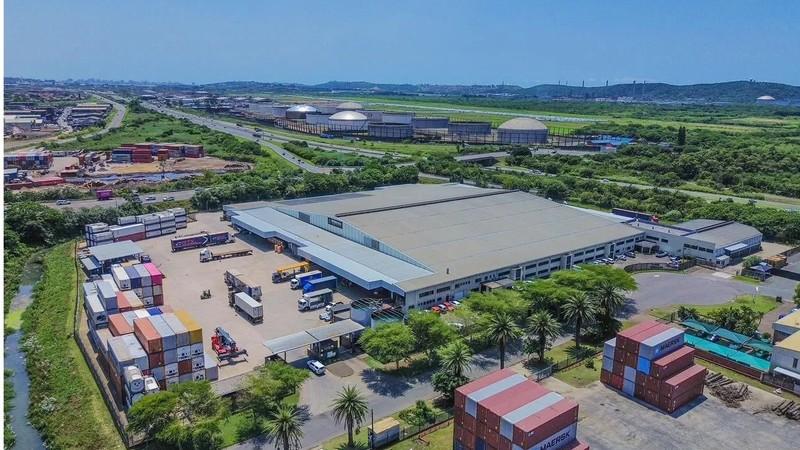
“Shree Property Holdings plans to invest approximately R1.6 billion in redeveloping two former industrial properties on South Coast Road in Durban into modern logistics and warehousing facilities, forming part of a wider R2 billion investment commitment in KwaZulu-Natal. The project is expected to deliver approximately 80,000 square metres of warehouse space, reinforcing the strategic importance of Durban’s port-connected industrial property market amid demand for modern logistics infrastructure.”
Introduction: Major investment signals confidence in Durban’s industrial property market
South Africa’s industrial real estate sector continues to attract investment as businesses seek strategically located warehouses, distribution centres and logistics facilities that can support increasingly demanding supply chains. A significant example is the planned redevelopment of two industrial properties in Durban’s South Industrial Basin by Shree Property Holdings, a privately owned property development group with an established presence in KwaZulu-Natal.
According to a report published by Moneyweb on 20 October 2026, the company intends to invest approximately R1.6 billion in the two properties acquired on South Coast Road. The sites previously accommodated industrial operations associated with Plascon and Tiger Brands. Their redevelopment is expected to create modern logistics facilities close to the Port of Durban, one of South Africa’s most important gateways for international trade.
The planned investment is part of a broader R2 billion commitment to industrial property development in the province over three years. The announcement highlights how established industrial locations can be repositioned to meet changing commercial requirements without necessarily moving economic activity away from existing industrial corridors.
Redeveloping established industrial properties
The two acquired properties, identified as 1236 South Coast Road and 1400 South Coast Road, each occupy approximately 60,000 square metres of land, according to the report. Shree Property intends to transform them into modern distribution hubs, with approximately 40,000 square metres of covered warehouse space at each location.
The proposed facilities will also include reinforced external yards designed to accommodate shipping containers and the movement of heavy vehicles. These features are important for logistics operators handling large cargo volumes, because effective distribution depends on more than the size of the warehouse itself. Vehicle circulation, loading access, storage arrangements and connections to transport infrastructure all influence operational efficiency.
The two sites have histories linked to South Africa’s manufacturing economy. One previously housed a Plascon factory, while the other was associated with the Beacon confectionery business under Tiger Brands. Their planned conversion illustrates the potential for industrial land to remain economically productive even as the needs of occupiers change.
Rather than treating former factory sites as redundant assets, developers can assess whether their location, land area and existing infrastructure make them suitable for alternative industrial uses. Such redevelopment may also reduce the need to establish entirely new industrial developments in undeveloped areas, although the environmental and structural suitability of each site must be assessed individually.
Why proximity to the Port of Durban matters
The location of the properties is central to the investment strategy. Durban’s port serves importers, exporters, manufacturers, retailers and logistics businesses that depend on the movement of goods between maritime terminals and inland markets.
For these businesses, distance from the port can influence transport costs, turnaround times and the reliability of cargo distribution. Warehouses situated near major freight gateways can offer practical advantages, particularly for companies managing containerised imports, export consignments or high-volume distribution operations.
The South Durban Industrial Basin also has an established industrial ecosystem. Businesses operating in the area can benefit from existing transport connections, industrial services and proximity to other commercial occupiers. Consequently, redeveloping strategically positioned sites may provide greater value than developing warehouse space in locations with weaker freight connections.
Moneyweb reported that industrial property demand around Durban’s port was particularly strong. Property professionals quoted in the article also pointed to demand for existing industrial properties, illustrating the competition for suitable locations within the established port corridor.
Nevertheless, location alone cannot guarantee commercial success. The performance of the new facilities will depend on construction quality, tenant demand, operating costs, transport conditions and the ability to secure occupiers under commercially sustainable lease agreements.
An R2 billion investment programme across KwaZulu-Natal
The South Coast Road developments represent the largest portion of Shree Property Holdings’ announced R2 billion investment commitment. The remaining approximately R400 million is earmarked for a new warehouse facility at Woodmead Industrial Park in Shakaskraal, on the North Coast.
Together, the projects indicate a strategy focused on strengthening the company’s industrial property portfolio across key economic nodes in KwaZulu-Natal. The investment programme also demonstrates that industrial development is not confined to major metropolitan centres. Locations connected to ports, highways, manufacturing clusters and regional distribution networks can all provide opportunities for specialised industrial property.
According to Moneyweb, Shree Property’s existing portfolio in KwaZulu-Natal exceeds one million square metres. The company also indicated that it was considering the acquisition and development of an additional 200,000 square metres of high-grade industrial space across its strategic locations. These figures represent the company’s reported portfolio and intentions, rather than completed future developments.
For the provincial economy, capital expenditure of this scale can support activity across several sectors, including construction, engineering, security, building materials, transport and facilities management. The ultimate employment and economic effects, however, will depend on project execution, procurement decisions and the operational requirements of future tenants.
Construction timelines and project delivery
The redevelopment of the two South Coast Road properties is planned in separate phases. The first facility, at 1236 South Coast Road, is expected to be completed by March 2028, while the second, at 1400 South Coast Road, has a target completion date of December 2028.
These dates mean that the planned warehouse capacity will enter the market over a multiyear period rather than immediately. Construction schedules can be affected by planning approvals, contractor availability, material costs, utility connections and other development risks.
For prospective tenants, the lead time creates an opportunity to negotiate requirements before occupation. Companies may need to specify loading configurations, yard layouts, security systems, fire protection, power capacity and office accommodation before facilities are completed.
Developers, in turn, need to balance the advantages of constructing purpose-built facilities against the risks of delivering space without sufficient tenant commitments. Pre-leasing, phased construction and detailed engagement with prospective occupiers can help align supply with actual demand.
The development’s success will therefore depend not simply on completing the buildings, but also on ensuring that their specifications suit the operational needs of logistics and distribution businesses.
Modern warehousing and the evolution of industrial property
Industrial real estate is increasingly shaped by the need for facilities that can accommodate modern supply chains. Traditional factory premises may not always offer the layout, loading access or yard capacity required by contemporary distribution operators.
Modern warehouses are designed to support the efficient receipt, storage, sorting and dispatch of goods. Depending on the intended use, important characteristics can include adequate internal clearance, durable flooring, appropriate loading facilities, reliable utilities and safe vehicle circulation.
For distribution businesses, these features can reduce operational bottlenecks and make better use of available space. For property owners, well-designed facilities may appeal to a broader range of tenants and provide flexibility when occupiers’ requirements change.
The South Coast Road project is consistent with this broader transition from conventional industrial premises towards specialised logistics infrastructure. However, the available report does not establish that every proposed specification has been finalised, nor does it provide confirmed rental rates or signed tenant agreements for the new buildings.
Investors should therefore distinguish the project’s announced development plans from verified future leasing performance.
Implications for industrial property investors
The investment offers several lessons for investors evaluating South Africa’s industrial property sector.
First, established industrial locations may retain considerable value even when their original manufacturing uses end. Sites with strong transport access and substantial land holdings can potentially be adapted to serve different occupiers.
Second, port-adjacent property can be strategically important because it supports the physical movement of goods. Nevertheless, the investment case must account for the condition of transport infrastructure, operational reliability, tenant creditworthiness and the cost of maintaining the facilities.
Third, development scale matters. Two warehouses with a combined planned covered area of approximately 80,000 square metres require substantial capital and effective project management. Investors must consider the time between initial expenditure, construction completion, tenant occupation and the generation of rental income.
Finally, industrial property should be evaluated on its own fundamentals. High demand in a particular location does not automatically mean every asset will produce attractive returns. Acquisition costs, financing terms, development expenses, vacancy risk and future maintenance obligations remain important considerations.
The announced redevelopment is therefore an indication of investor confidence in Durban’s industrial property market, rather than conclusive evidence of guaranteed financial performance.
Infrastructure and the wider provincial economy
KwaZulu-Natal’s industrial economy benefits from its combination of port infrastructure, manufacturing activity and connections to domestic distribution routes. Investment in logistics property can complement these strengths by providing businesses with facilities to store, consolidate and distribute goods.
However, private property investment cannot resolve every challenge facing the freight sector. The performance of warehouses depends partly on infrastructure beyond their boundaries, including roads, port operations, electricity supply, water services and municipal management.
For industrial property to deliver its full economic value, these wider systems must function reliably. Congestion, service interruptions or rising operating costs can reduce the advantages of an otherwise well-positioned warehouse.
The redevelopment of established industrial land may also require careful attention to environmental compliance, drainage, fire safety and the legacy conditions of former industrial operations. Appropriate due diligence and remediation, where required, will be important before the facilities become operational.
These considerations illustrate why industrial development should be viewed as part of a wider economic system rather than as an isolated real estate transaction.
Conclusion: Durban strengthens its position as an industrial logistics destination
Shree Property Holdings’ planned R1.6 billion redevelopment of two South Durban industrial properties represents a substantial proposed investment in modern logistics infrastructure. Together with the additional warehouse investment planned for Shakaskraal, the programme forms part of the company’s wider R2 billion commitment to KwaZulu-Natal.
The project highlights the commercial potential of established industrial land near the Port of Durban and the importance of adapting property assets to meet changing distribution requirements. Its planned warehouses and container yards are intended to support logistics activity in one of the province’s established industrial corridors.
The next important milestones will be construction progress, the delivery of suitable infrastructure and the attraction of tenants whose requirements match the new facilities. Meeting the announced completion targets will also be essential to translating the investment commitment into usable industrial capacity.
For investors and businesses watching South Africa’s industrial real estate market, the project provides a relevant example of how logistics demand can influence property redevelopment decisions. Its long-term contribution will ultimately depend on successful execution, commercially sustainable occupation and the performance of the transport infrastructure that connects Durban’s industrial properties to national and international markets.



