




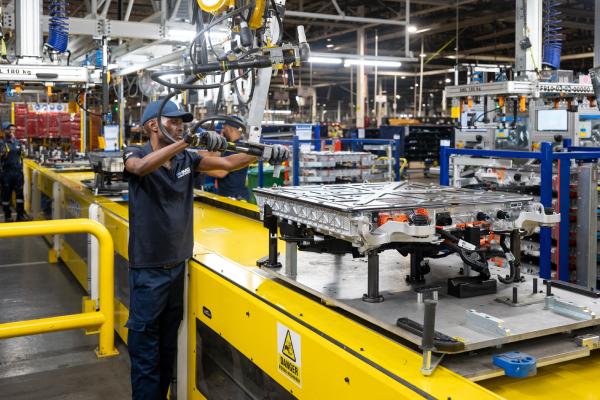
“South Africa’s automotive industry is facing increasing pressure to remain competitive as international manufacturers decide where to locate the next generation of electric-vehicle production, with the sector directly employing about 113,000 people and supporting hundreds of thousands more jobs. Reuters reports that a new 150% tax deduction for qualifying electric and hydrogen vehicle investments is intended to attract production, but industry executives and analysts say electricity reliability, charging infrastructure, consumer demand, policy certainty and export competitiveness will also influence investment decisions.”
South Africa’s automotive industry enters a critical period as electric vehicles reshape competition
South Africa’s automotive industry is facing an important period of adjustment as global vehicle manufacturers increasingly shift investment towards electric vehicles and decide where future production should be located. The issue is not only about national economic growth. At the microeconomic level, it concerns individual firms, workers, suppliers, consumers and investment decisions, all of which are affected by changing production costs, technology, demand and international competition.
A Reuters report published on 24 September and carried by South African business media on 26 September said South Africa risks losing future vehicle production to Asian competitors as international automakers determine where to build the next generation of electric vehicles. The industry is particularly important because it is strongly integrated into international supply chains and exports a substantial share of its production.
The South African government has introduced incentives intended to encourage investment in electric and hydrogen-powered vehicle manufacturing. President Cyril Ramaphosa signed legislation providing a 150% tax deduction for qualifying investments in electric and hydrogen vehicle production from March 2026. The policy is designed to reduce the effective cost of investment and encourage manufacturers to commit capital to South African facilities.
However, investment decisions by companies are rarely determined by one incentive alone. Firms compare the total cost of production, expected demand, infrastructure reliability, access to skilled labour, logistics, taxation, export markets and regulatory conditions before committing billions of rand to a new factory or production line.
Why the automotive sector matters at the microeconomic level
The automotive industry provides a useful example of microeconomics because thousands of individual decisions combine to determine the performance of the wider sector.
A vehicle manufacturer decides how much to produce based on expected demand and production costs. Component manufacturers decide whether to expand their factories according to expected orders. Workers decide whether to acquire new skills based on employment opportunities and wages. Consumers decide whether to purchase conventional vehicles, hybrids or electric vehicles according to prices, financing costs, running costs and available infrastructure.
These decisions are interconnected.
If an international manufacturer believes that electric-vehicle demand will grow strongly in another country, it may direct new investment there rather than expanding an existing South African plant. That decision could affect local production, employment, suppliers and household incomes.
Reuters reported that South Africa’s automotive industry contributed 23.8% of manufacturing output in 2025, directly employed approximately 113,000 people, and supported another 498,000 jobs.
Those figures illustrate the potential consequences of changes in firm-level investment decisions.
Competition for electric-vehicle investment
The global transition towards electric vehicles is changing the competitive environment for vehicle-producing countries.
Traditional automotive production has depended heavily on established assembly plants, component suppliers, engineering skills and export relationships. Electric vehicles, however, introduce additional considerations, including battery production, software, charging systems and access to new technology.
South Africa therefore has to compete not only with other traditional vehicle-producing economies but also with countries seeking to establish themselves as major electric-vehicle manufacturing centres.
From a firm’s perspective, the location decision involves comparing expected revenues with the costs associated with producing each vehicle. If a company can manufacture vehicles more efficiently elsewhere, it has an economic incentive to allocate new production there.
This does not necessarily mean existing South African factories will close. Established facilities have infrastructure, trained workers and relationships with suppliers. Nevertheless, future investment can determine whether production expands, remains stable or gradually shifts to other markets.
Government incentives reduce some investment costs
The 150% tax deduction is one response to this competitive environment.
A tax incentive can improve the economics of an investment by reducing the after-tax cost of qualifying capital expenditure. For an automotive company considering a new battery facility, production line or other qualifying investment, the tax treatment can influence the expected return on investment.
However, tax incentives cannot eliminate every production constraint.
Reuters reported that executives and analysts identified several factors outside the direct scope of the incentive, including electricity reliability, charging infrastructure, consumer demand, policy certainty, and export competitiveness.
This distinction is important. A company may receive a tax benefit but still face high logistics costs, unreliable electricity or insufficient domestic demand. In that situation, the overall investment calculation could remain challenging.
Electricity and infrastructure remain production considerations
For manufacturers, infrastructure forms part of the cost of doing business.
Factories require reliable electricity to operate machinery, maintain production schedules and meet delivery commitments. Interruptions can create direct costs through lost production, equipment downtime and delays.
The same principle applies to electric vehicles after they leave the factory.
Consumers considering an electric vehicle need access to charging infrastructure. If charging stations are limited, potential buyers may hesitate to purchase electric vehicles even when the vehicle itself offers attractive operating characteristics.
This creates an interaction between producer decisions and consumer decisions.
Manufacturers need sufficient demand to justify investment, while consumers may require sufficient infrastructure before they create that demand. The development of the market therefore depends on several complementary investments occurring together.
Consumer demand is another important variable
The transition to electric vehicles ultimately depends on consumers being willing and able to purchase them.
South African households face a range of financial pressures. Consumer confidence improved during the third quarter of 2026, with the FNB/Bureau for Economic Research consumer confidence index rising from -19 to -13, but the survey also indicated that household spending could remain constrained.
The broader retail market has shown some signs of resilience. South African real retail sales increased 3.4% year on year in July 2026, according to reporting based on official statistics, suggesting stronger household spending at the beginning of the third quarter.
Nevertheless, purchasing a new vehicle is substantially different from buying ordinary retail goods. Vehicle purchases frequently involve credit, making interest rates an important determinant of affordability.
The South African Reserve Bank increased the policy rate to 7.25% in September 2026, while the prime lending rate consequently increased to 10.75%. Higher borrowing costs can affect households considering vehicle finance and therefore influence demand for new vehicles.
Labour-market effects
The automotive transition also has implications for workers.
South Africa’s unemployment rate reached 33.6% in the second quarter of 2026, according to Statistics South Africa. The official QLFS showed that the number of unemployed people increased to about 8.5 million, while employment declined by 16,000 compared with the first quarter.
Against this background, the automotive industry’s direct employment base becomes particularly significant.
Electric-vehicle production may change the skills required within factories. Workers can increasingly require expertise related to battery systems, electronics, software, high-voltage systems and advanced manufacturing equipment.
This creates both risks and opportunities. Existing workers may need additional training, while companies may seek workers with specialised technical skills.
For suppliers, the transition can also change the composition of demand. Businesses producing components for conventional engines may need to adapt as vehicle manufacturers introduce new technologies.
The importance of suppliers
The automotive sector operates as a network rather than a collection of isolated factories.
A vehicle manufacturer depends on hundreds or thousands of suppliers for components, logistics and specialised services. A change in production volumes can therefore affect businesses well beyond the final assembly plant.
If an automaker increases production, suppliers may receive larger orders and invest in additional capacity. If production declines, suppliers can face lower revenue and pressure on employment.
This is why the location of future vehicle production has implications for the wider South African business environment.
A successful transition to electric vehicles could create new opportunities for battery components, electrical systems, software, charging infrastructure and related services. Conversely, businesses that fail to adapt to changing technology could face declining demand for certain products.
Export competitiveness
South Africa’s automotive industry is strongly export-oriented. Reuters reported that approximately two-thirds of industry output is exported.
That means international competitiveness is central to the industry’s future.
A vehicle produced in South Africa competes in international markets based on factors such as price, quality, specifications, supply reliability and trade arrangements.
Exchange rates can also influence competitiveness. A weaker rand can reduce some local costs when measured in foreign currency but can simultaneously increase the price of imported components and equipment.
Consequently, manufacturers must manage a complex mixture of domestic and international costs.
What happens next
South Africa’s automotive industry now faces a combination of technological change, international competition and domestic economic constraints.
The government’s electric-vehicle investment incentive provides one mechanism for improving the investment environment. However, the ultimate response of individual companies will depend on their assessments of expected demand, production costs, infrastructure, labour, supply chains and access to export markets.
For workers, the transition creates a need for skills development. For suppliers, it creates pressure to adapt products and production methods. For consumers, vehicle affordability and charging availability will influence adoption.
The wider economy is therefore connected to decisions made inside individual companies and households.
South Africa’s challenge is not simply to maintain existing vehicle production. It is also to create conditions under which manufacturers and suppliers have economic reasons to invest in the technologies that will shape future vehicle markets.
At the microeconomic level, the outcome will ultimately emerge from thousands of decisions: whether companies invest, whether suppliers expand, whether workers acquire new skills and whether consumers purchase the new generation of vehicles.
For now, the available evidence shows that South Africa has introduced significant incentives to compete for electric-vehicle investment, while industry representatives continue to identify infrastructure, demand and competitiveness as important conditions for future production.
Key microeconomic indicators to watch
- 113,000: direct jobs in South Africa’s automotive industry.
- 498,000: additional jobs supported by the automotive sector, according to figures cited by Reuters.
- 23.8%: automotive contribution to South African manufacturing output in 2025.
- 150%: tax deduction introduced for qualifying electric- and hydrogen-vehicle investment.
- 33.6%: official unemployment rate in Q2 2026.
- 3.4%: year-on-year increase in real retail sales in July 2026.
- 7.25%: South African Reserve Bank policy rate following the September 2026 decision.



