




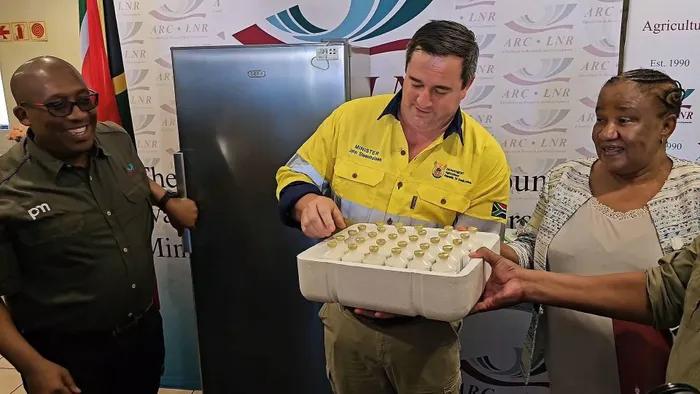
“South Africa’s Agricultural Research Council has opened the way for qualifying private companies to manufacture its locally developed foot-and-mouth disease vaccine under controlled licensing arrangements, a move intended to overcome production constraints and improve vaccine availability. Farmers and biotechnology experts have welcomed the decision, while stressing that rapid implementation, affordability, independent vaccine matching and adequate manufacturing capacity will determine whether the initiative can significantly strengthen the country’s response to the ongoing FMD crisis.”
South Africa Moves to Scale Up Local Foot-and-Mouth Disease Vaccine Production Through Private Sector
South Africa has taken another important step towards strengthening its biotechnology and agricultural health capabilities as the Agricultural Research Council (ARC) moves to allow qualifying private companies to manufacture its locally developed foot-and-mouth disease (FMD) vaccine at large scale. The development, highlighted in a report published on 6 October 2026, has been welcomed by farmers and agricultural experts who say greater domestic production capacity could help South Africa respond more quickly to outbreaks and reduce its dependence on imported vaccines.
The decision is significant beyond the immediate livestock crisis. Foot-and-mouth disease is a highly contagious viral disease affecting cloven-hoofed animals, including cattle, sheep, goats and pigs. Although it does not normally pose the same direct human-health threat as many zoonotic diseases, its economic consequences can be severe. Outbreaks can disrupt livestock production, restrict animal movement, affect exports and place enormous financial pressure on farmers and the wider agricultural value chain.
For South Africa, the availability of effective vaccines is therefore not simply an agricultural matter. It is also a biotechnology, manufacturing, food-security and national biosecurity issue.
A Response to Manufacturing Constraints
The ARC has developed vaccine technology specifically relevant to foot-and-mouth disease strains circulating in the region. However, the council has faced manufacturing limitations that have prevented it from producing sufficient quantities at the scale required by the country’s livestock sector.
On 21 September, Agriculture Minister Willie Aucamp announced that the ARC Board had unanimously agreed to a proposal allowing qualifying private companies to use ARC intellectual property to manufacture the vaccine under conditional licensing arrangements. The government said the approach would allow additional manufacturers to contribute to production while the ARC continues rebuilding and expanding its own manufacturing capacity.
The decision is particularly important because vaccine development and vaccine manufacturing are two different challenges. A country may possess the scientific knowledge, laboratory capability and intellectual property necessary to develop a vaccine but still struggle to produce millions of doses quickly enough during a national emergency.
That gap between scientific innovation and industrial-scale manufacturing has become one of the defining lessons of recent health and agricultural crises.
In South Africa’s case, the ARC has already demonstrated that local scientific expertise can produce an FMD vaccine. The challenge is now turning that capability into reliable, large-scale production.
Why Local Biotechnology Capacity Matters
The debate surrounding FMD vaccines illustrates why biotechnology is increasingly viewed as a strategic component of national economic development.
South Africa has historically relied on international suppliers for substantial portions of its vaccine requirements. During an outbreak, however, international procurement can introduce delays, competition for limited global supplies, currency risks, transportation challenges and uncertainty about availability.
Local manufacturing offers a potential alternative.
The ARC says its vaccine production programme is designed around strains relevant to South Africa and the wider Southern African region. Its FMD facility at Onderstepoort has specialised capabilities for research, diagnostics and vaccine production, and the ARC describes the facility as an important strategic resource for highly contagious animal diseases.
The council has also invested in modern production technology. Its current approach uses suspension production rather than older monolayer methods, with advantages in production volume, contamination control and product quality. The ARC has adapted strains from recent outbreaks so that vaccines can better reflect viruses circulating in the region.
This scientific infrastructure is valuable because vaccine effectiveness depends heavily on the relationship between the vaccine strains and viruses circulating in the field.
The Importance of Vaccine Matching
The latest development also includes another important scientific component. At the request of Minister Aucamp, the ARC is expected to submit representative FMD field-circulating virus isolates from South Africa to the Pirbright Institute in the United Kingdom for another round of vaccine-matching assessments.
The purpose is to provide an additional scientific assessment of how available local and imported vaccines perform against FMD viruses currently circulating in South Africa.
Vaccine matching is critical because foot-and-mouth disease is caused by multiple viral serotypes and strains. A vaccine that provides strong protection against one strain may not provide the same level of protection against another.
Independent testing can therefore provide valuable evidence for government, veterinarians, farmers and trading partners.
For South Africa, transparent publication of such results could also help build confidence in the national vaccination programme. Farmers need to know whether vaccines being deployed are appropriately matched to the viruses present in their areas.
The Scale of the Challenge
The country’s vaccine requirement demonstrates why private-sector involvement is being considered.
South Africa has millions of cattle and a major livestock economy. Earlier reporting indicated that the country needs roughly 25 million FMD vaccine doses annually if cattle are to receive the required vaccination coverage. At the same time, the country has already imported and produced millions of doses during 2026, with vaccines coming from suppliers in countries including Turkey and Argentina.
The scale of that requirement makes it difficult for a single manufacturing facility to carry the entire burden, especially during a major outbreak.
That is why the proposed licensing model could become an important biotechnology-industry development. Instead of relying exclusively on one public-sector production system, South Africa could create a network of qualified manufacturers capable of producing the same technology under strict quality and regulatory controls.
The model could also help build industrial expertise in vaccine production, quality assurance, bioprocessing, cold-chain management and regulatory compliance.
Farmers Want Speed and Affordability
Farmers have welcomed the prospect of increased production, but the reaction has also highlighted a major concern: availability must translate into actual doses reaching farms.
Daily Maverick reported that farmers and experts welcomed the ARC’s decision while warning that the practical success of the initiative will depend on implementation. FMD Response SA spokesperson Andrew Morphew noted that granting a licence is not the same as producing a vaccine dose at the required scale.
This distinction is important.
A manufacturing licence does not automatically create factories, trained workers, production lines, raw materials, quality-control systems or distribution networks. Those elements take time and investment.
Farmers are also concerned about price. Small-scale livestock producers may have fewer financial resources than large commercial operations. If privately manufactured vaccines become available but are priced beyond the reach of smaller farmers, the biotechnology expansion could fail to deliver equal protection across the livestock sector.
Consequently, affordability and equitable distribution will be as important as production volume.
Protecting South Africa’s Food System
FMD control is directly connected to food security.
Livestock contributes meat, milk, income and employment across South Africa. When outbreaks restrict animal movement, farmers can face severe losses. Disease-control measures can disrupt markets, while international trading partners may impose restrictions on livestock and animal products.
A reliable domestic vaccine supply could therefore strengthen the resilience of the entire agricultural system.
The government has described the private-sector manufacturing initiative as part of efforts to protect the livestock sector, strengthen national biosecurity and secure food supply chains.
The benefits could extend beyond the current outbreak if South Africa develops a permanent manufacturing ecosystem capable of responding to future animal-health emergencies.
Biotechnology and Industrial Development
The FMD vaccine programme also illustrates how biotechnology can support industrial development.
Successful vaccine manufacturing requires highly specialised skills, including molecular biology, cell culture, virology, bioprocess engineering, quality control, regulatory science and pharmaceutical manufacturing.
Building these capabilities can create a workforce that is useful beyond FMD vaccines. The same expertise can contribute to the development of other veterinary vaccines, human vaccines, biologics and advanced pharmaceutical products.
This broader objective is increasingly visible in South Africa’s science and innovation policy. The government has recently identified the protection of critical platforms in health, genomics, biotechnology and public-health systems as strategic priorities for national research funding.
The FMD vaccine programme therefore fits into a wider national effort to reduce scientific and manufacturing dependence while increasing domestic technological capacity.
A Test of Public-Private Cooperation
The next stage will test whether South Africa can successfully combine public scientific research with private industrial capacity.
The ARC will retain its role in vaccine development and continue expanding its own manufacturing capabilities, while private manufacturers could provide additional production capacity under licensing agreements. According to the government, income received by the ARC from licensing arrangements will be ring-fenced for expanding its own FMD vaccine manufacturing capacity.
That arrangement could create a reinforcing cycle: public research generates technology, private investment expands manufacturing, licensing generates revenue, and that revenue supports further public-sector scientific capacity.
However, strong governance will be essential. Licensing arrangements must protect intellectual property while ensuring that public-health and agricultural-security objectives remain central.
Regulatory oversight will also need to remain rigorous. Any private manufacturer must meet applicable quality, biosafety and licensing requirements before producing and distributing the vaccine.
Looking Beyond the Current Crisis
South Africa’s FMD crisis has exposed weaknesses in the country’s ability to rapidly manufacture sufficient quantities of critical veterinary vaccines. Yet the response could also become an opportunity to build a more resilient biotechnology industry.
The immediate priority is clear: produce enough effective vaccine, distribute it efficiently and protect livestock.
The longer-term opportunity is bigger.
South Africa can use the current experience to strengthen vaccine research, manufacturing infrastructure, scientific skills, regulatory systems and partnerships between universities, research councils, government and industry.
The country already possesses important scientific assets, including the ARC’s specialised FMD research and vaccine-production infrastructure. The challenge is ensuring that those assets are connected to sufficient manufacturing investment and a dependable national response system.
The private-sector manufacturing decision announced by the ARC could represent an important turning point. If implemented effectively, it could move South Africa from a position of limited vaccine manufacturing capacity toward a more diversified domestic production model.
For farmers, the measure ultimately needs to produce one result: reliable access to effective and affordable vaccines.
For the biotechnology sector, however, the implications are broader. The FMD vaccine initiative demonstrates that scientific research can become an essential part of national economic resilience when discoveries are supported by manufacturing capacity, investment and effective regulation.
As South Africa continues battling the consequences of the FMD outbreak, the success of its vaccine strategy will be closely watched by farmers, scientists, industry and policymakers. The immediate question is how quickly private manufacturing can translate into additional doses. The longer-term question is whether the country can turn this crisis into a lasting biotechnology and biosecurity capability.
If it succeeds, the FMD vaccine programme could become more than an emergency response. It could become a model for how South Africa develops, manufactures and commercialises critical biological technologies for its own needs and, potentially, for the wider African market.



